

Army Long Sleeve vs Short Sleeve Shirts for Winter
Table of Contents
- How Uniform Policy Shapes Winter Sleeve Choices
- Army Long Sleeve Shirts vs Short Sleeve: Core Differences
- Military Base Layer Shirts: The Foundation of Cold Weather Gear
- How to Layer Army Apparel for Winter
- Best Fabric for Cold Weather Military Shirts
- When Short Sleeves Still Work in Winter
- Conclusion: Choosing the Right Sleeve Length for Winter
- Frequently Asked Questions
Last Updated: September 22, 2026
How Uniform Policy Shapes Winter Sleeve Choices
Army long sleeve shirts are the default cold-weather choice under most uniform policies, but the rules leave more room for judgment than many soldiers assume. This guide breaks down what the regulations actually say, when short sleeves still work, and how to build a layering system that holds up in the field.
Uniform policy sets the floor, not the ceiling. Most branch standards allow commanders to adjust wear based on weather, mission, and base conditions. That means the real question isn't "long or short?" It's "what does my commander authorize, and what does the temperature demand?"
How to Read 'Authorized for Year-Round Wear'
The phrase "authorized for year-round wear" appears in uniform guidance for both long and short sleeve variants, and it is one of the most misread lines in the regulation. It does not mean either sleeve length is always acceptable. It means the item is not restricted to a single season by the branch-level standard, the decision moves down to the commander.
A practical way to read it:
- Branch standard: authorizes the item for wear across seasons.
- Commander's policy: sets the actual conditions, temperature thresholds, or mission-based rules for your unit.
- Local SOP: may further restrict sleeve length for specific duties, formations, or environments.
When those three layers conflict, the more restrictive local policy generally governs. A branch authorization does not override a commander's cold-weather or safety directive.
Where Local Command Policy Overrides Branch Standards
Commanders commonly issue local guidance that narrows the branch standard. Examples of the kinds of adjustments you may see:
- A temperature threshold below which long sleeves are required for formations or duty wear.
- A requirement for long sleeves during specific tasks, weapons maintenance, motor pool work, or any duty involving contact with cold metal.
- A restriction on short sleeves for field exercises or ranges regardless of temperature, for uniform appearance or safety reasons.
- A base-specific rule tied to wind chill rather than ambient temperature.
What This Means for Your Winter Kit
Because the policy floor is set locally, the safest approach is to own both sleeve lengths and treat them as interchangeable parts of one layering system. Long sleeves cover the static cold and the forearm gap. Short sleeves cover hard movement and rapid warm-ups. The regulation question and the thermal question point to the same answer: build a system, not a single shirt.
If you are unsure what your unit authorizes, ask your first-line supervisor or check the current uniform SOP. That is a faster and more reliable answer than any general guide, including this one.
Army Long Sleeve Shirts vs Short Sleeve: Core Differences
The core difference comes down to thermal regulation. Long sleeves trap a layer of warm air against the skin and block wind. Short sleeves dump heat fast and let airflow do the work.
Here's how the two compare in practice:
| Factor | Long Sleeve | Short Sleeve |
|---|---|---|
| Thermal regulation | Traps heat, blocks wind | Releases heat fast |
| Best temperature | Below 50°F | Above 60°F |
| Layering role | Base or mid layer | Standalone wear |
| Moisture-wicking | Depends on fabric | Depends on fabric |
| Sun protection | Full arm coverage | Minimal |
| Fit and mobility | Slightly restricted | Maximum range |
Neither shirt wins outright. The right pick depends on what you're doing and where.
Thermal Regulation and Airflow
Long sleeves win in still, cold air. They hold warmth close to the body and cut wind chill.
Short sleeves win when you're moving hard. Physical training, ruck marches, and hot work all generate body heat fast. In those cases, a short sleeve under a breathable outer layer beats a long sleeve every time.
The trick is matching the shirt to your output, not just the thermometer.
Fit, Mobility, and Duty Wear
Fit matters as much as fabric. A long sleeve that's too tight restricts your shoulders and elbows. Too loose and it bunches under body armor.
Short sleeves give you full range of motion with nothing to snag. For duty wear that involves climbing, crawling, or weapons handling, that freedom counts.
Military Base Layer Shirts: The Foundation of Cold Weather Gear
Military base layer shirts are the first garment against your skin, and they do the most important job: moving sweat away from your body. Get this layer wrong and everything above it fails.
A base layer has one job. It pulls moisture off your skin so it can evaporate through your outer layers. Cotton kills that process. It soaks up sweat, holds it, and chills you the moment you stop moving.
Look for synthetic fabrics or merino wool. Both wick moisture and dry fast. Both keep you warm even when damp.
- Synthetic blends: cheap, durable, dry fast
- Merino wool: warmer, less odor, costs more
- Cotton: avoid for cold weather, holds moisture
The base layer sets the tone. Choose it before you think about anything else.
How to Layer Army Apparel for Winter
Layering army apparel for winter means building three distinct layers: a moisture-wicking base, an insulating mid layer, and a weather-blocking outer shell. Each layer has a job, and each one can be added or removed as conditions change.
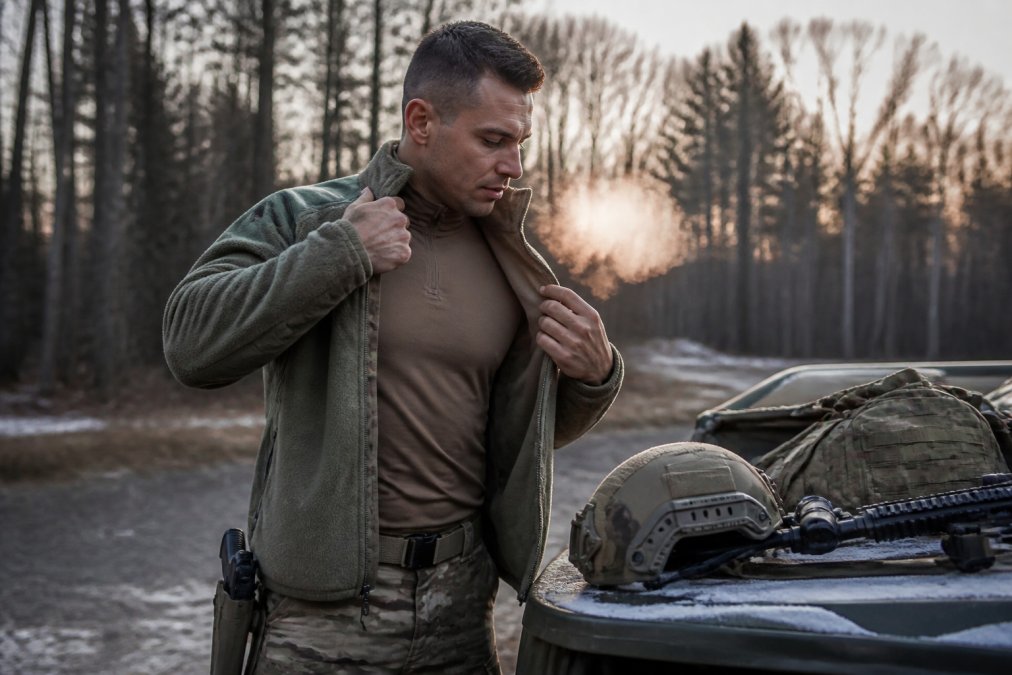
Start with the base. Add insulation next. Finish with a shell that stops wind and rain.
The system works because you can shed layers as you heat up and add them back when you cool down. A single heavy coat gives you no options. A layering system gives you climate control you carry on your back.
Tactical Layering Systems for Field Conditions
Tactical layering systems follow the same three-layer rule, but they add one wrinkle: you have to move in them. That changes what you pick.
- Keep the base layer thin and snug
- Choose a mid layer that packs small
- Pick a shell that blocks wind without trapping sweat
- Test the full stack before you deploy it
The goal is command discretion over your own temperature. Add a layer before you stop moving. Shed one before you overheat.
Best Fabric for Cold Weather Military Shirts
The best fabric for cold weather military shirts is a synthetic blend or merino wool, not cotton. Synthetic fabrics like polyester and nylon wick moisture and dry quickly. Merino wool adds warmth and resists odor over long wear.
Fabric choice decides how well a shirt performs. Here's what to weigh:
- Moisture-wicking: moves sweat off skin
- Breathability: lets heat escape during hard work
- Insulation: traps warmth when you're still
- Durability: survives repeated wash and wear
- Drying speed: matters most in wet field conditions
Blends often beat single fabrics. A polyester-wool mix gives you wicking plus warmth without the bulk.
When Short Sleeves Still Work in Winter
Short sleeves still work in winter when you're generating serious body heat or when the day warms up fast. Physical training, indoor work, and hot work all push your core temperature up. A short sleeve under a breathable layer keeps you from overheating.
Cold weather gear isn't always about staying warm. Sometimes it's about not getting too warm.
Think about a ruck march on a 40°F morning. You start cold, then heat up within the first mile. A short sleeve base under a light shell lets that heat escape. A heavy long sleeve traps it and leaves you soaked.
Short sleeves also shine for sun protection during bright winter days at altitude. Snow reflects sunlight and burns exposed skin fast.
For official guidance on cold-weather injury prevention, see the CDC cold stress resources.
Conclusion: Choosing the Right Sleeve Length for Winter
The right call depends on your mission, your commander's policy, and the temperature you're actually working in. Long sleeves win for static cold. Short sleeves win for hard work and quick warm-ups. The smartest move is building a layering system that lets you switch between both.
At US Troop Gear, Inc., we carry durable, branch-specific apparel built to honor your service.
Frequently Asked Questions
What does the army wear in cold weather for base layers?
The army typically issues moisture-wicking base layer shirts made from synthetic fabrics like polyester or merino wool blends. These base layer shirts sit close to the skin to manage sweat and provide thermal regulation. Soldiers often wear a long sleeve base layer under their uniform to trap heat while allowing breathability during physical training or field conditions.
Is 80 degrees too hot for a long sleeve shirt?
At 80 degrees Fahrenheit, a long sleeve shirt can feel uncomfortable during physical activity, but moisture-wicking synthetic fabrics help manage sweat and temperature. If you are doing light duty wear or working in shade, a long sleeve shirt offers sun protection and still allows airflow. For intense physical training in heat, short sleeves or roll-up capability is usually the better choice.
Can short sleeve shirts be worn under winter jackets?
Yes, short sleeve shirts work well as a base layer under winter jackets. A short sleeve moisture-wicking shirt under a fleece or insulated jacket keeps your core warm without adding bulk to your arms. This layering strategy gives you versatility: you stay warm outside and can remove the jacket indoors without overheating. Just ensure the short sleeve shirt fits close to the body for effective thermal regulation.
What fabrics are best for winter military-themed apparel?
Merino wool and synthetic blends like polyester or nylon are often considered the best fabrics for cold weather military-themed apparel. Merino wool provides insulation even when damp and resists odor, while synthetics dry quickly and move moisture away from your skin. Avoid cotton for base layers because it holds sweat and loses insulation when wet, which increases your risk of cold weather injuries.