

Best Materials for Long Lasting Veteran T-Shirts
Table of Contents
- Why Material Choice Decides Whether Your Veteran T-Shirt Lasts
- Quick Comparison: Best Materials for Long Lasting Veteran T-Shirts
- Durable T-Shirt Fabric Weight: What GSM Means for Military Shirts
- Screen Printing vs DTG for Military Shirts: Which Print Lasts Longer?
- How to Care for Veteran Apparel So It Survives Wash After Wash
- Fabric Testing Standards and Environmental Stressors Competitors Ignore
- US Troop Gear Picks: Putting These Materials to the Test
- Conclusion
- Frequently Asked Questions
Last Updated: September 16, 2026
Why Material Choice Decides Whether Your Veteran T-Shirt Lasts
The best materials for long lasting veteran themed t-shirts come down to three things: fabric weight, fiber blend, and how the print is applied. Get those right and a shirt survives years of wash cycles; get them wrong and you're replacing it within months.
Quick Comparison: Best Materials for Long Lasting Veteran T-Shirts
How the main fabric and print options stack up:
| Material / Method | Durability | Breathability | Print Longevity | Best For |
|---|---|---|---|---|
| 100% ring-spun cotton (heavyweight) | High | Moderate | High with screen print | Casual wear, everyday |
| Cotton-poly blend (50/50) | Very high | High | Very high | Active duty, frequent washing |
| 100% polyester performance fabric | High | High | High with heat transfer | Training, moisture-wicking needs |
| Screen printing | , | , | Excellent colorfastness | Bold, high-contrast designs |
| DTG printing | , | , | Good on cotton, weaker on blends | Detailed, multi-color artwork |
The short version: a heavyweight cotton-poly blend with screen printing gives the best balance of durability and print life. Pure cotton feels better against the skin; performance polyester wins when sweat and thermal regulation matter.
Durable T-Shirt Fabric Weight: What GSM Means for Military Shirts
GSM stands for grams per square meter, the most useful number for judging durable t-shirt fabric weight. Higher GSM means denser, heavier fabric that resists pilling, shrinkage, and thinning, the closest thing to a durability score on a spec sheet.
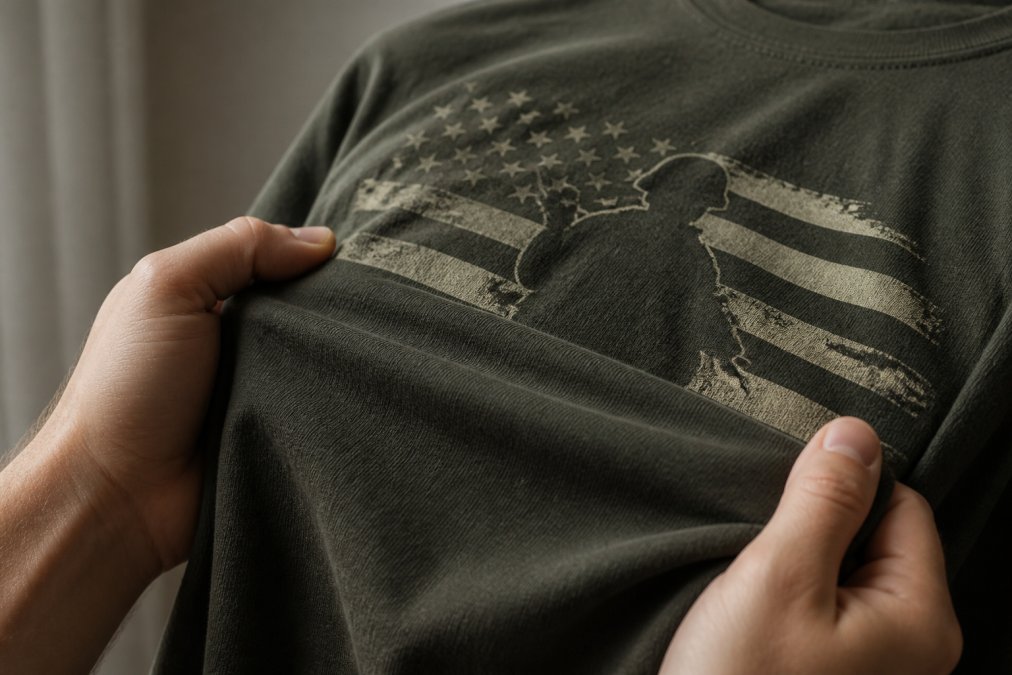
Reading the GSM Tiers Like a Spec Sheet
How the GSM tiers behave in the wash and on the body:
- 120-149 GSM (lightweight): Warm-weather layering and promotional tees. Thin enough to show through, prone to pinholes at shoulder seams and hem within a season.
- 150-179 GSM (midweight): The standard retail tee. Comfortable, but thins noticeably after roughly a year of weekly washing, fine for casual wear, weak for daily rotation.
- 180-220 GSM (heavyweight): The durability sweet spot for veteran-themed shirts. Dense enough to hold a screen-printed graphic flat, resist pilling under a backpack strap, and keep its shape through repeated laundering.
- 221-260 GSM (ultra-heavy): Thick, structured, slow to break in. Great for a work shirt, but traps heat and feels stiff for the first several washes.
Lightweight vs Heavyweight Cotton for Active Duty and Casual Wear
Lightweight cotton (under 150 GSM) works for layering and warm climates but wears out faster, especially under a plate carrier or backpack strap where abrasion concentrates.
How Yarn Construction Changes the Same GSM Number
GSM is not the whole story. Two shirts can both read 190 GSM and age very differently depending on the yarn:
- Open-end (carded) cotton: Cheaper, shorter fibers, more likely to pill and feel rougher over time.
- Ring-spun cotton: Longer, aligned fibers, smoother hand feel, better tensile strength at the same weight.
- Combed and ring-spun: Short fibers removed before spinning, producing the smoothest and most pill-resistant surface.
- Slub or heather blends: Deliberate texture, but the irregular yarn can wear unevenly at high-friction points.
Matching GSM to Climate and Use
The right weight depends on where and how the shirt gets worn:
- Hot and humid climates: 150-180 GSM ring-spun cotton or a cotton-poly blend moves moisture and dries faster than a heavy tee.
- Arid and high-UV climates: 180-200 GSM cotton holds up better against sun-driven fiber degradation, and darker dyes hide the fading that UV causes.
- Cold-weather layering: 200-220 GSM works as a base layer under a jacket without adding bulk at the seams.
- Daily casual wear: 180-200 GSM is the most versatile single choice for a veteran-themed shirt you plan to keep for years.
Screen Printing vs DTG for Military Shirts: Which Print Lasts Longer?
Screen printing outlasts DTG for military shirts when durability is the priority: screen-printed ink bonds into the fabric and holds colorfastness through hundreds of wash cycles, while DTG prints sit closer to the surface and degrade faster on synthetics. That said, DTG handles photographic detail and gradients that screen printing can't match.
How Each Print Method Actually Bonds to Fabric
The three common decoration methods work on different principles:
- Screen printing (plastisol ink): A thick ink is pushed through a mesh screen and deposited onto and slightly into the fabric. During curing, the ink reaches roughly 320°F and cross-links into a flexible film that mechanically locks around the yarn. The print stretches with the fabric instead of sitting on top of it.
- Direct-to-garment (DTG): A printer lays water-based ink directly onto the garment surface, much like an inkjet printer. The ink sits mostly on top of the fibers and bonds chemically to the cotton. On 100% cotton it can look and feel excellent; on polyester and blends, the ink has nothing to grip and washes out faster.
- Heat transfer / vinyl: A pre-printed film is pressed onto the fabric with heat and pressure. The adhesive layer is the weak point. It holds well on polyester performance fabric but can peel at the edges when exposed to hot water or high dryer heat.
Why DTG Fails Faster on Blends and Synthetics
DTG ink is formulated to bond with cotton. Polyester is a smooth, non-absorbent plastic fiber the ink cannot penetrate, so the print looks fine on day one and then fades, cracks, or washes away within a handful of cycles. That's why a detailed DTG graphic on a 50/50 blend is a durability gamble, while the same graphic on 100% ring-spun cotton can last years with proper care, fabric choice and print method have to match.
How Print Technology Affects Colorfastness and Cracking
Print cracking comes from three sources: low-quality ink, poor curing, and mechanical stress from washing. Properly cured plastisol screen printing resists all three, because the ink stretches with the fabric instead of sitting on top of it. Heat transfer sits in the middle, durable on polyester and performance fabric, but it can peel at the edges in hot water.
| Print Method | Best Fabric | Wash Resistance | Detail Level |
|---|---|---|---|
| Screen printing | Cotton, cotton-poly | Excellent | Bold, simple designs |
| DTG | 100% cotton | Good | High detail, gradients |
| Heat transfer | Polyester, blends | Good | Full color, photos |
What to Ask Before You Buy a Printed Veteran Shirt
Because print longevity depends on the fabric-ink pairing, a few questions separate a shirt built to last from one that fades in a season:
- What print method was used, and on what exact fiber content?
- Was the ink cured to the manufacturer's spec, or is this a low-volume print shop?
- Is the design heavy-coverage or line-based?
- Does the care label call for cold water and low heat, which protects both the ink and the fabric?
How to Care for Veteran Apparel So It Survives Wash After Wash
Wash veteran apparel inside out in cold water, and skip the dryer. That single habit prevents most of the fading, shrinkage, and print cracking that ruins shirts early.
Follow these steps:
- Turn the shirt inside out before washing
- Use cold water on a gentle cycle
- Skip fabric softener, which coats fibers and dulls prints
- Avoid bleach and high-heat drying
- Hang dry or tumble on low
- Iron inside out, never directly on the design
Fabric Testing Standards and Environmental Stressors Competitors Ignore
Two things separate genuinely durable veteran t-shirts from ones that just look tough: how the fabric was tested, and how it handles real-world stress.
Here's what to look for instead:
- Fabric weight stated in GSM
- Fiber content listed precisely (not just "cotton blend")
- Print method named (screen printing, DTG, or heat transfer)
- Pre-shrunk or shrinkage-controlled fabric
US Troop Gear Picks: Putting These Materials to the Test
We build our gear around the materials that survive real use. Our textile durability research from Cotton Incorporated informed our fabric choices, and every item is designed for repeat washing without losing shape or color.
Conclusion
Finding veteran t-shirts that last means choosing fabric by weight, fiber, and print method, not by design alone. The materials in this guide give you a clear standard to measure any shirt against.
Frequently Asked Questions
What type of t-shirt printing lasts the longest?
Screen printing generally outlasts direct-to-garment (DTG) printing for veteran t-shirts because the ink bonds into the fabric fibers rather than sitting on top. A properly cured screen print can survive 50 or more wash cycles without fading or cracking. DTG works well for detailed, full-color designs but tends to fade faster, especially on darker fabrics. If longevity matters most, choose screen-printed heavyweight cotton or cotton-poly blends.
How does fabric weight affect the durability of a t-shirt?
Fabric weight, measured in GSM (grams per square meter), directly affects how long a t-shirt holds up. Lightweight fabrics under 150 GSM feel comfortable but wear thin faster. Midweight fabrics around 180-220 GSM offer a balance of breathability and durability. Heavyweight fabrics above 240 GSM resist pilling, hold their shape, and handle frequent washing better. For veteran t-shirts you plan to wear regularly, a midweight to heavyweight cotton or cotton-poly blend is the most reliable choice.
What is the longest-lasting clothing material for military-themed shirts?
A cotton-poly blend is often the longest-lasting option for military-themed shirts. The cotton provides breathability and comfort, while the polyester adds tensile strength, shrinkage resistance, and moisture-wicking properties. Ring-spun cotton alone is soft and takes prints well but can shrink and pill over time. Pure synthetic fibers resist wear but may not hold screen-printed designs as effectively. A 50/50 or 60/40 cotton-poly blend gives you the best combination of comfort, print durability, and overall apparel longevity.
How do I keep my veteran apparel from fading or cracking?
Wash your veteran apparel inside out in cold water on a gentle cycle. Avoid fabric softeners, which break down fibers and weaken print adhesion. Tumble dry on low heat or hang dry to prevent shrinkage and heat damage. Skip bleach entirely. Following these steps, a quality screen-printed shirt can maintain its color and design for years. Rotating between several shirts also extends the life of each one by reducing individual wash cycles.
Are heavier t-shirts always better for durability?
Not always. Heavier fabrics above 240 GSM resist pilling and hold shape well, but they can feel hot in summer or during physical activity. For active duty or workouts, a midweight moisture-wicking cotton-poly blend around 180-200 GSM often works better. The right choice depends on how you plan to wear the shirt. Consider your climate and activity level before defaulting to the heaviest option available.