

Best Military Challenge Coins for Collectors
Table of Contents
- What Makes Military Challenge Coins Valuable to Collectors
- Branch-Specific Challenge Coins Worth Collecting
- Unit-Specific and Commemorative Challenge Coins
- Rare and Highly Collectible Military Challenge Coins
- How to Display Challenge Coins in Your Collection
- Grading, Valuation, and Authentication Standards
- High Quality Veteran Gift Ideas: Challenge Coins
- Storage and Archival Best Practices
Last Updated: August 23, 2026
What Makes Military Challenge Coins Valuable to Collectors
Military challenge coins represent tangible pieces of military heritage, each carrying the insignia, symbolism, and esprit de corps of its unit or service branch. Authenticity, provenance, rarity, and craftsmanship determine a coin's value.
Collectors prize military challenge coins for concrete reasons. First, they document military history through insignia and engraving, a squadron's emblem or commander's design tells the story of that unit's service and values. Second, numismatic quality matters: die-struck coins with proper relief and enamel work command higher valuations than flat-stamped versions. Third, provenance dramatically increases collector interest, knowing whether a coin was presented by a specific commander or commemorates a particular deployment makes it substantially more valuable.
At US Troop Gear, Inc., we understand that serious collectors acquire pieces of military tradition. The challenge coin emerged from unit pride and morale-building, and today's collectible coins reflect that commitment to honoring service and sacrifice.

The most sought-after coins share common characteristics: limited-edition runs increase scarcity, bronze or brass construction with antique finishes appreciates over time compared to zinc alloy alternatives, hand-engraved details and custom enamel work signal higher production standards, and authentication matters, officially licensed coins or those with documented command presentation histories command premiums.
Branch-Specific Challenge Coins Worth Collecting
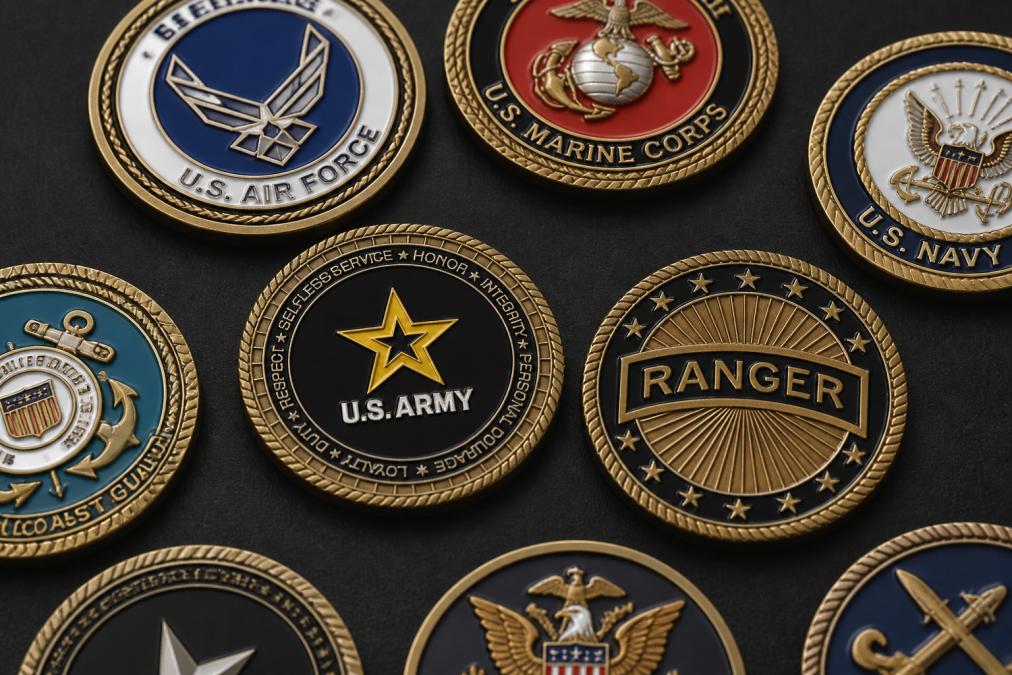
Each service branch produces challenge coins with distinct design elements reflecting their unique mission and heritage. These branch-specific coins form the foundation of most serious collections.
Navy Challenge Coins
Navy challenge coins stand out for their maritime symbolism and connection to naval tradition. Anchors, ship crests, and naval aviator insignia dominate designs. The most collectible Navy coins feature die-struck construction with proper relief.
The Navy Chief Challenge Coin ($16.45) represents one of the most recognizable designs in naval collecting. This officially licensed coin directly supports the Navy's Morale, Wellness and Recreation program through its royalties. The Chief's insignia is rendered with precise detail, and the coin's antique finish gives it the patina collectors seek.
For aviation enthusiasts, the Fly Navy Challenge Coin ($16.45) captures naval aviator pride. Naval aviator coins consistently appreciate because they represent a highly-respected community within the Navy.
The F/A 18 Super Hornet Challenge Coin ($16.45) and F-35 Lightning II Challenge Coin ($16.45) appeal to collectors focused on modern naval aviation. Platform-specific coins often become scarce within five years.
For retired sailors, the Navy Retired Challenge Coin ($16.45) holds particular value. Retirement coins commemorate the culmination of service and are frequently presented at retirement ceremonies. The Navy Veteran Challenge Coin ($16.45) similarly resonates with the veteran community.

Specialized ratings coins like the US Navy Radioman Challenge Coin ($16.45) appeal to niche collectors documenting specific naval specialties. These rating-specific coins are often harder to find because they were produced in smaller quantities.
Army Challenge Coins
Army challenge coins emphasize unit insignia, regimental crests, and the distinctive symbolism of ground combat units. The US Army Ranger Challenge Coin ($16.95) represents one of the most collectible Army coins. Ranger coins carry prestige because the Rangers represent an elite unit, typically featuring the Ranger Scroll and Tab insignia rendered with sharp relief.

Army branch coins from different time periods show variations in design and production quality. Older coins from the 1990s and early 2000s often exhibit different enamel formulations and die-striking techniques compared to modern production, creating natural collecting tiers.
Unit-Specific and Commemorative Challenge Coins
Unit-specific challenge coins represent the granular level of military organization where morale and esprit de corps take their most tangible form. Squadron coins, battalion coins, and company-level coins document the actual structure of military units.
Commemorative coins mark specific events: deployments, anniversaries, training exercises, or memorial tributes. A coin commemorating a specific ship's deployment or a squadron's 50-year anniversary carries historical weight that generic coins lack. These commemorative pieces often become harder to find over time as they're distributed to limited audiences.
The most valuable commemorative coins combine limited mintage with significant historical events. Coins marking the final deployment of a decommissioned ship become scarce collectibles. Similarly, coins from units that saw significant combat action tend to appreciate because they document real military history.
Collectors should prioritize coins with documented provenance. A coin traced to a specific unit, commander, or event is worth substantially more than an identical coin without that history. Keep presentation cases, documentation, or any paperwork that accompanied the coin when received.
Rare and Highly Collectible Military Challenge Coins
Certain military challenge coins have become recognized as high-value collectibles. These coins share common traits: extreme scarcity, historical significance, exceptional craftsmanship, or connection to pivotal military moments.
The rarest coins typically come from decommissioned units or disbanded squadrons. Once a unit is deactivated, its coins cease production, creating a finite supply. A coin from a squadron disbanded in the 1980s and produced fewer than 200 pieces represents genuine scarcity.
Coins featuring hand-engraved details command premiums over die-struck coins. Hand engraving represents labor-intensive craftsmanship and typically appears on commander's coins or special presentation pieces.
Coins with documented authentication from the originating unit or command carry significantly higher value. A coin accompanied by a letter from the commanding officer confirming its authenticity and limited production run becomes a documented collectible rather than an unverified piece.
Military aviation coins from specific eras, particularly from Cold War-era squadrons, represent a specialized collecting niche. Coins from fighter squadrons during the 1970s-1990s often feature distinctive design aesthetics and are increasingly difficult to locate.
How to Display Challenge Coins in Your Collection
Proper display elevates a collection from scattered possessions to curated exhibition. The presentation case serves both functional and aesthetic purposes: it protects coins from environmental damage while showcasing their design details.
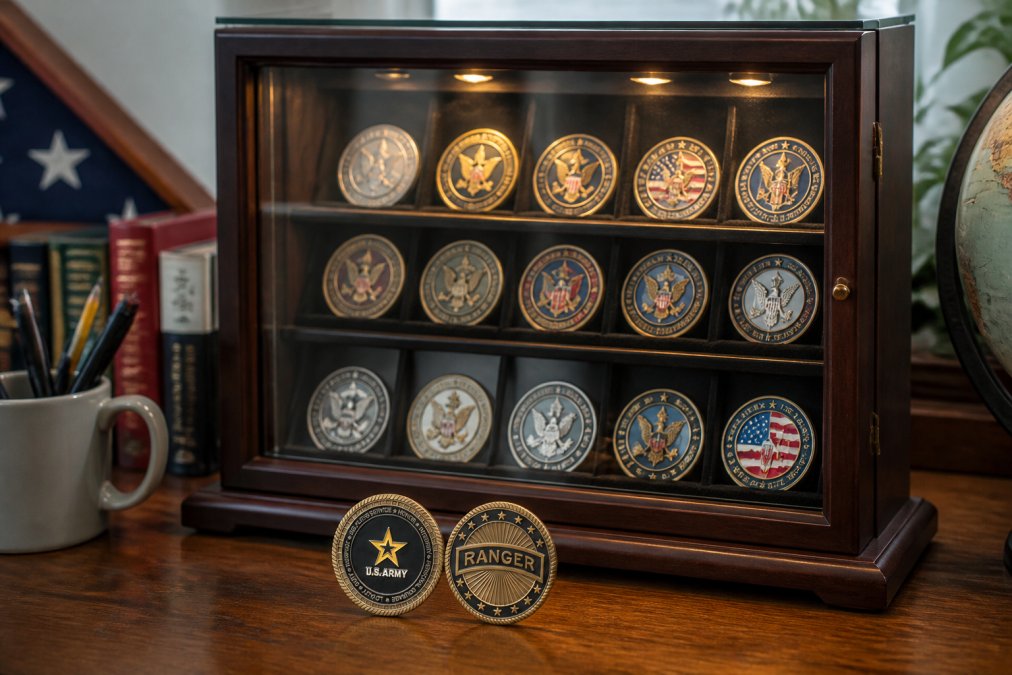
Glass display cases with individual compartments provide the gold standard for serious collectors. Each coin occupies its own space, preventing friction damage and allowing light to illuminate the insignia and relief work. Cases with interior lighting dramatically enhance visual impact.
Arrange coins thematically within the display case. Group by service branch, unit, era, or platform type. This organizational approach tells a coherent story and makes the collection easier to navigate.
Avoid stacking coins or storing them loosely in containers. Direct contact between coins causes surface abrasion that diminishes their appearance and value.
Climate control matters more than casual collectors realize. Humidity fluctuations cause enamel work to expand and contract, potentially cracking the finish. Temperature stability prevents brass or bronze from tarnishing unevenly. Display cases positioned away from direct sunlight prevent fading of enamel colors.
For coins with significant sentimental value or high monetary worth, consider archival-quality storage separate from display pieces. Keep documentation, presentation letters, unit information, and deployment dates in acid-free sleeves alongside the coins.
Grading, Valuation, and Authentication Standards
Understanding how coins are graded and valued separates informed collectors from casual buyers. Unlike numismatic coins, military challenge coins lack standardized grading systems. However, collectors apply consistent evaluation criteria.
Condition assessment focuses on surface wear, enamel quality, and relief sharpness. Coins in pristine condition with minimal handling show sharp relief detail and bright enamel colors. Coins showing moderate wear retain their appeal but command lower valuations. Enamel quality directly impacts valuation, intact, vibrant enamel commands premiums, while chips, cracks, or fading reduce value substantially.
Relief sharpness indicates production quality. Well-struck coins show crisp detail in the insignia and lettering. Poorly struck coins display soft, indistinct details that suggest worn dies or inadequate pressure during striking.
Authentication requires examining several elements. Official licensing marks or government seals indicate legitimate production. The weight and dimensions should match documented specifications. The metal composition can often be determined by weight and color characteristics.
Counterfeit military coins exist, particularly for high-value pieces. Red flags include inconsistent enamel application, poor relief detail, incorrect insignia proportions, or misspelled text. When acquiring rare coins, request provenance documentation and consider authentication by experienced collectors.
Valuation depends on scarcity, condition, historical significance, and current collector demand. A coin in exceptional condition from a decommissioned unit might command $75-150, while common branch coins in average condition typically trade for $15-30. Platform-specific aviation coins or commander's coins often command $40-100.
| Valuation Factor | Impact on Price | Collector Priority |
|---|---|---|
| Scarcity (mintage under 500) | High (+50-200%) | Critical |
| Condition (pristine vs. worn) | Moderate (+20-60%) | Important |
| Historical significance (specific event/unit) | High (+40-150%) | Critical |
| Enamel quality (intact vs. damaged) | Moderate (+15-40%) | Important |
| Relief sharpness (crisp vs. soft) | Low to Moderate (+10-30%) | Secondary |
| Authentication documentation | High (+30-100%) | Critical |
High Quality Veteran Gift Ideas: Challenge Coins
Challenge coins serve as meaningful gifts for veterans because they acknowledge military service and provide a tangible connection to that experience. The best veteran gifts combine quality craftsmanship with personal relevance to the recipient's service.
For a veteran seeking a gift that honors their specific branch, branch-specific coins from US Troop Gear, Inc. offer authentic recognition. A Navy veteran receives the Navy Veteran Challenge Coin ($16.45) as acknowledgment of their service, while an Army veteran might value the US Army Ranger Challenge Coin ($16.95) if they served in that specialty.
Retired veterans particularly appreciate coins that mark their transition to civilian life. The Navy Retired Challenge Coin ($16.45) specifically honors that milestone.
For aviation enthusiasts, platform-specific coins like the F/A 18 Super Hornet Challenge Coin ($16.45) or F-35 Lightning II Challenge Coin ($16.45) resonate deeply. Veterans who flew these aircraft recognize the specific pride associated with their platform.
When selecting a veteran gift coin, prioritize official licensing and quality craftsmanship. A coin that's officially licensed by the Department of the Navy, with royalties supporting active-duty morale programs, carries additional significance.
Storage and Archival Best Practices
Long-term preservation ensures that military challenge coins retain their value and appearance for future generations. Proper storage protects against environmental degradation and physical damage.
Temperature stability represents the first priority. Coins stored in environments with significant temperature fluctuations experience metal expansion and contraction that stresses enamel finishes. Maintain storage temperatures between 65-75 degrees Fahrenheit with minimal variation (si.edu).
Humidity control prevents corrosion and enamel deterioration. Relative humidity should remain between 30-50% (loc.gov). Excess humidity promotes oxidation on brass and bronze surfaces. Insufficient humidity can cause enamel to become brittle.
Individual coin storage prevents surface contact damage. Archival-quality coin holders or sleeves made from acid-free materials protect coins without chemical reaction. Avoid PVC-based holders, which off-gas acidic compounds that damage metal surfaces.
Store coins away from direct sunlight. UV exposure fades enamel colors and accelerates surface oxidation.
Document your collection systematically. Photograph each coin with details of insignia, enamel work, and any wear patterns. Record the coin's provenance, acquisition date, and estimated value. This documentation creates a backup record if coins are lost or stolen and provides information for insurance purposes.
For coins with significant monetary or sentimental value, consider archival storage in acid-free boxes placed in a climate-controlled safe or safety deposit box.
According to the Smithsonian Institution's conservation guidelines for military memorabilia, metal artifacts should be stored in stable environmental conditions with regular monitoring to prevent corrosion and material degradation.
Building a military challenge coin collection connects you to military heritage and honors the service of those who've carried these coins. Whether you're collecting branch-specific coins, unit commemoratives, or rare platform-specific pieces, quality matters. US Troop Gear, Inc. provides officially licensed Navy coins and Army specialty coins that serve as both collectible pieces and meaningful tributes to military service. Start with coins that resonate personally, your branch, your unit, or a specific platform you served on, then expand systematically as your knowledge and appreciation deepens.
Frequently Asked Questions
Are military challenge coins worth any money?
Yes, military challenge coins hold value for collectors, though most common coins range from $15-$25. Rare unit-specific coins, limited editions, and historically significant pieces can command higher prices depending on provenance, age, and condition. Officially licensed coins, like those from the Department of the Navy, retain value because royalties support military morale programs. Authentication and grading affect resale value significantly.
What makes a military challenge coin rare and collectible?
Rarity stems from limited production runs, unit-specific designs, historical significance, and scarcity. Coins from deactivated squadrons, specific deployments, or commemorative events become harder to find. Coins with die-struck detail work, bronze or brass construction, and antique finishes appeal to numismatic collectors. Provenance, documented military heritage and service branch connection, also increases collectibility and value.
How should I display and store military challenge coins?
Store coins in a presentation case with individual compartments to prevent damage and showcase insignia detail. Keep them in a climate-controlled environment away from humidity to prevent patina deterioration or corrosion. Display stands with felt or velvet backing protect the coin surface. For long-term archival storage, use acid-free holders and avoid direct sunlight. Proper display honors military heritage while preserving condition and value.
What is the difference between officially licensed and unlicensed military challenge coins?
Officially licensed coins carry Department of Defense or service branch authorization, ensuring authentic insignia and design accuracy. Licensed coins often direct royalties to military morale and welfare programs like Navy MWR. Unlicensed coins may use generic imagery or inaccurate details. Collectors prioritize licensed coins for authenticity, esprit de corps connection, and the assurance that purchases support military personnel and their families.
How can I identify counterfeit military challenge coins?
Authentic military challenge coins feature sharp, detailed engraving and consistent relief work. Check for proper insignia accuracy, correct service branch markings, and quality enamel application. Counterfeits often show blurred details, uneven coloring, or lightweight construction. Verify licensing through official Department of Defense channels. Purchase from reputable retailers and examine coins in person when possible. Provenance documentation and certificates of authenticity add credibility to high-value pieces.
This article was written using GrandRanker