

Best Ways to Organize Challenge Coins: A Collector's Guide
Table of Contents
- Why Organizing Your Challenge Coins Matters
- Challenge Coin Display Ideas for Every Space
- Choosing the Right Display Format for Your Collection
- Challenge Coin Storage That Protects Your Collection
- How to Inventory a Coin Collection Step by Step
- Arranging Coins by Branch, Unit, or Date
- Security and Long-Term Protection for Displayed Coins
- Frequently Asked Questions
Last Updated: October 18, 2026
Why Organizing Your Challenge Coins Matters
A challenge coin is a small medallion carrying a unit's crest, a ship's emblem, or a hard-earned token of service. Most collectors start with one coin in a drawer.
That pile creates real problems: coins rub together, edges nick, plating dulls, and the one coin you want to show a friend is always at the bottom.
When you organize challenge coins, you fix all three issues: good storage protects the finish, and a smart layout keeps every coin visible and reachable.
Here is the core tension most guides miss: display and protection are not the same job.
Challenge Coin Display Ideas for Every Space
The right challenge coin display ideas depend on three things: how many coins you own, how much wall or shelf space you have, and whether you want to show them off or store them away. Match the format to the space first, then worry about style.
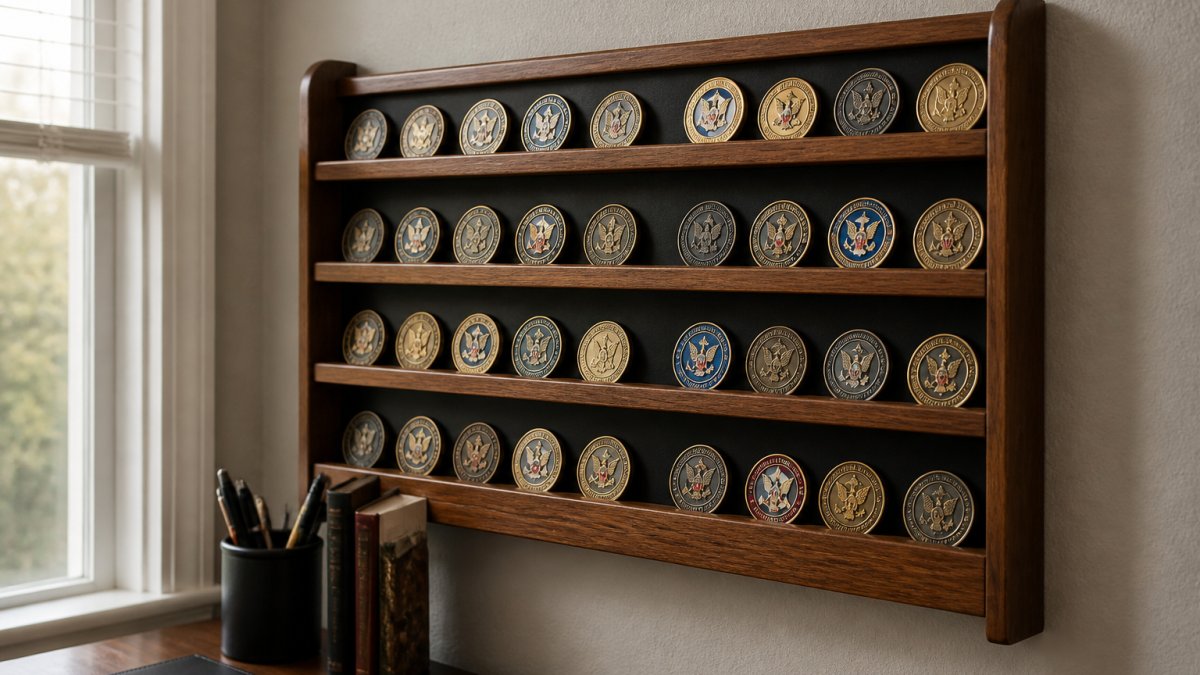
Wall-Mounted Racks and Shadow Boxes
Wall racks are the classic choice for a growing collection. Most use horizontal grooves or pegs that hold each coin upright, face out, in neat rows; mounted at eye level, the collection reads like a gallery.
Shadow boxes go a step further: deep frames hold coins behind glass, often with a branch emblem or engraved plaque in the backing. A custom display with a unit crest makes a striking gift for a retiring service member.
Two practical notes from experience:
- Measure the wall before you buy. A rack that holds 40 coins needs far more width than most people expect.
- Keep racks out of direct sunlight. UV exposure fades coin finishes over time, and glass does not stop it.
Desk Stands, Trays, and Tabletop Displays
Not every collection needs a wall. Desk stands hold a handful of favorite coins upright on a small base, perfect for a work desk or bookshelf, keeping your most meaningful coins in view without a big footprint.
Felt-lined coin trays lay coins flat in rows and often stack or slide into a drawer, keeping everything sorted and stopping movement when you open it.
For a small collection of 10 to 20 coins, a tabletop display case with a glass lid is hard to beat. It protects the coins, shows them clearly, and sits on any shelf.
Choosing the Right Display Format for Your Collection
Pick your display format by collection size, available space, and how often you want to touch the coins, not by what looks best in a product photo.
| Format | Typical Capacity | Accessibility | Protection | Space Needed | Best For |
|---|---|---|---|---|---|
| Desk stand | 1-10 coins | High, lift out by hand | Low to moderate (open air, dust) | Desktop or shelf | Favorite coins you show often |
| Felt-lined tray | 10-40 coins | High, coins lie flat, easy to pick up | Moderate (needs a lid or drawer) | Drawer or shelf | Sorting and rotating a working set |
| Wall rack | 20-80 coins | Moderate, coins sit in grooves or on pegs | Moderate (dust, light exposure) | 24-48 inches of wall | A growing collection you want visible |
| Shadow box | 10-40 coins | Low, coins are fixed behind glass | Good (glass blocks dust, not all UV) | Wall space, deeper frame | Gifts, retirement pieces, unit crest displays |
| Tabletop case with glass lid | 10-30 coins | Moderate, lift the lid to reach coins | Good (enclosed, dust-resistant) | Shelf or desktop | Small collections that need protection |
| Coin album | 30-200 coins | High, flip pages to browse | Moderate (pockets protect faces, edges still move) | Shelf | Large collections stored flat |
| Coin cabinet with drawers | 100+ coins | Moderate, open a drawer at a time | High (enclosed, felt-lined, lockable) | Dedicated floor or shelf space | Serious collections and high-value pieces |
Material matters more than price. A wood-framed case with felt lining protects coins as well as an expensive cabinet; the extra money buys joinery, finish, and customization like an engraved emblem.
Plan for growth. Buy one size up from what you need today; collections rarely shrink, and matching a discontinued rack later is a headache.
Challenge Coin Storage That Protects Your Collection
Challenge coin storage is about controlling what touches the coin and what is in the air around it. Three factors cause most damage: moisture, abrasion, and chemicals from cheap plastics.
Moisture and tarnish. Coins tarnish when moisture and sulfur compounds in the air react with the metal surface.
Abrasion. Metal on metal means scratches, and scratches cut value.
Chemical exposure from plastics. Not all plastic is safe for coins. Polyvinyl chloride (PVC) softeners can leach out of cheap flips and pockets, leaving a sticky residue that etches the surface.
Here is how the common holder types compare:
- 2x2 cardboard flips: cheap, stackable, and ideal for sorting. Choose PVC-free inserts so the plastic window never leaches onto the coin. Good for inventory and short-term storage.
- Airtight hard capsules: best for high-value coins and humid rooms. The gasket limits air exchange, but check the seal every year or two.
- Coin albums: pages of pockets store many coins flat and make browsing easy. Less ideal for display because pages flex and edges can move.
- Felt-lined trays: soft beds that stop coins from sliding. Pair with a closed drawer or lid so dust does not settle on the faces.
- Lockable cabinets: for rare or high-value pieces, a cabinet with felt-lined drawers and a lock balances protection with access.
Handling rules that matter more than any holder:
- Hold coins by the edges, never the face. Skin oils etch the surface over time.
- Clean only when needed, and never polish. Abrasive polish removes metal and detail.
- Keep coins away from windows, heaters, and damp basements.
- Check the display every few months for tarnish, loose mounts, or movement.
How to Inventory a Coin Collection Step by Step
Learning how to inventory a coin collection takes one afternoon and saves years of guesswork. An inventory tells you what you own, what it is worth to you, and what is missing from a set.
Here is the system we recommend:
- Gather everything in one place. Pull every coin from drawers, bags, and pockets. You cannot sort what you cannot see.
- Photograph each coin, front and back. Use daylight and a plain background. These photos help with insurance and identification later.
- Record the basics. For each coin, note the branch, unit or ship, the year, and how you received it.
- Assign a number. Write a small tag or use a numbered holder so each coin has an ID.
- Log it in a spreadsheet or notebook. Columns for ID, branch, unit, year, condition, and notes cover most needs.
- Note the story. The deployment, the ceremony, the person who handed it to you. That detail is the real value.
Arranging Coins by Branch, Unit, or Date
Once every coin has an ID, the fun part starts: you organize challenge coins into a layout. There is no single correct layout, but three methods work for most collectors.
By branch. Army, Navy, Air Force, Marine Corps, and Coast Guard each get their own section or rack. This layout looks sharp and makes a branch-specific gift easy to pull.
By unit or ship. Group coins from the same command together. Navy collectors often sort by ship crest, which turns a display into a visual history of a career at sea.
By date or era. Line coins up by year of receipt or by conflict. This suits collectors who want the display to tell a chronological story.
A few layout tips that make any arrangement look better:
- Put the largest or most detailed coins at the center or top.
- Keep spacing even. Crowded rows hide the engraved emblems.
- Mix finishes on purpose. A row of all-gold coins blurs together; alternating metals adds contrast.
Security and Long-Term Protection for Displayed Coins
A display invites attention, and not all of it is welcome. Coins are small, valuable, and easy to pocket. A few habits cut the risk.
Mount wall displays with proper anchors, and skip glass-front cases in rooms with heavy visitor traffic.
Long-term protection comes down to handling. Follow these rules:
- Hold coins by the edges, never the face. Skin oils etch the surface over time.
- Clean only when needed, and never polish. Abrasive polish removes metal and detail.
- Keep coins away from windows, heaters, and damp basements.
- Check the display every few months for tarnish, loose mounts, or movement.
We build our challenge coins and ship crests with detailed, readable artwork, because a coin you cannot read is a coin you cannot display with pride.
Every collection starts with one coin and a story. The challenge is giving that story a proper home before the pile takes over.
If you are still adding to your collection, US Troop Gear, Inc. carries branch-specific challenge coins and ship crests for the Army, Navy, Air Force, Marine Corps, and Coast Guard.
Get started with US Troop Gear, Inc. and give your collection the display it earned.
Frequently Asked Questions
What is the best way to store a lot of challenge coins?
For large collections, combine a display case for the coins you want visible with archival storage for the rest. Use PVC-free sleeves or 2x2 holders inside a coin cabinet or tray system, and keep everything in a cool, dry spot away from direct sunlight. Group coins by branch or unit so you can find them quickly. Label each tray or drawer, and keep a written or digital inventory so you always know what you own and where it is stored.
How do you display challenge coins without damaging them?
Keep coins out of direct sunlight and away from humid areas like basements. Use stands, trays, or racks with soft or felt-lined grooves so metal edges do not scrape against hard surfaces. Avoid PVC plastic, which can leave residue over time, and choose PVC-free or airtight holders instead. Handle coins by the edges, not the face, and dust displays with a dry microfiber cloth rather than polishing compounds that can wear down the finish.
Should challenge coins be organized by branch, unit, or date?
There is no single right answer, but branch and unit groupings work well for most collectors because they keep related coins together and make storytelling easy when guests ask about a display. Date-based organization suits collectors tracking a career timeline or deployment history. Many people use a hybrid: branch first, then unit within each branch, with the oldest coins toward the back or bottom. Pick one system and stay consistent so your inventory stays useful.
Are plastic coin holders safe for challenge coins?
Not all plastic is safe. Holders made with PVC can release chemicals that discolor or pit coin surfaces over years of contact. Look for PVC-free inserts, Mylar flips, or airtight capsules made from inert materials. Rigid acrylic stands and cases are generally fine for display as long as coins are not pressed against rough edges. If you are unsure about a holder, test it on a low-value coin first and check for residue or clouding after a few months.