

How to Clean Embroidered Military Hats Without Damage
Table of Contents
- Step 1: Check the Care Label and Assess Your Hat Before Cleaning
- Step 2: How to Hand Wash an Embroidered Hat Safely
- Step 3: How to Spot Clean a Baseball Cap Around Embroidery
- Step 4: How to Remove Sweat Stains From a Hat and Treat Odors
- Step 5: How to Dry a Hat Without Shrinking It or Warping the Crown
- Common Mistakes That Damage Embroidered Military Hats
- Keeping Your Embroidered Military Hats Looking Sharp
- Frequently Asked Questions
Last Updated: October 13, 2026
Step 1: Check the Care Label and Assess Your Hat Before Cleaning
Learning how to clean embroidered military hats without damage starts with one habit: read the label before the hat gets wet. The care label tells you the fabric, the thread type, and whether the manufacturer warns against heat or machine washing. This guide from US Troop Gear, Inc. walks through the full process, step by step, so a favorite cap keeps its shape and its stitching.
Start by checking three things:
- Fabric: Cotton twill caps handle water well. Wool or blended dress caps need a gentler touch.
- Insignia: Metal pins, rank devices, and hard badges may rust or snag. Remove them first.
- Construction: A structured crown with buckram backing holds shape well but dislikes heat.
Vintage hats deserve extra caution. Older thread weakens over time, and colors can bleed. Test any cleaning method on a hidden spot first, like inside the sweatband.
Step 2: How to Hand Wash an Embroidered Hat Safely
Hand washing is the safest method for most caps. Fill a clean sink or tub with cool water, add a small amount of mild detergent or dish soap, and let the hat soak for about 15 minutes. Cool or lukewarm water protects both fabric and thread; hot water invites shrinkage.
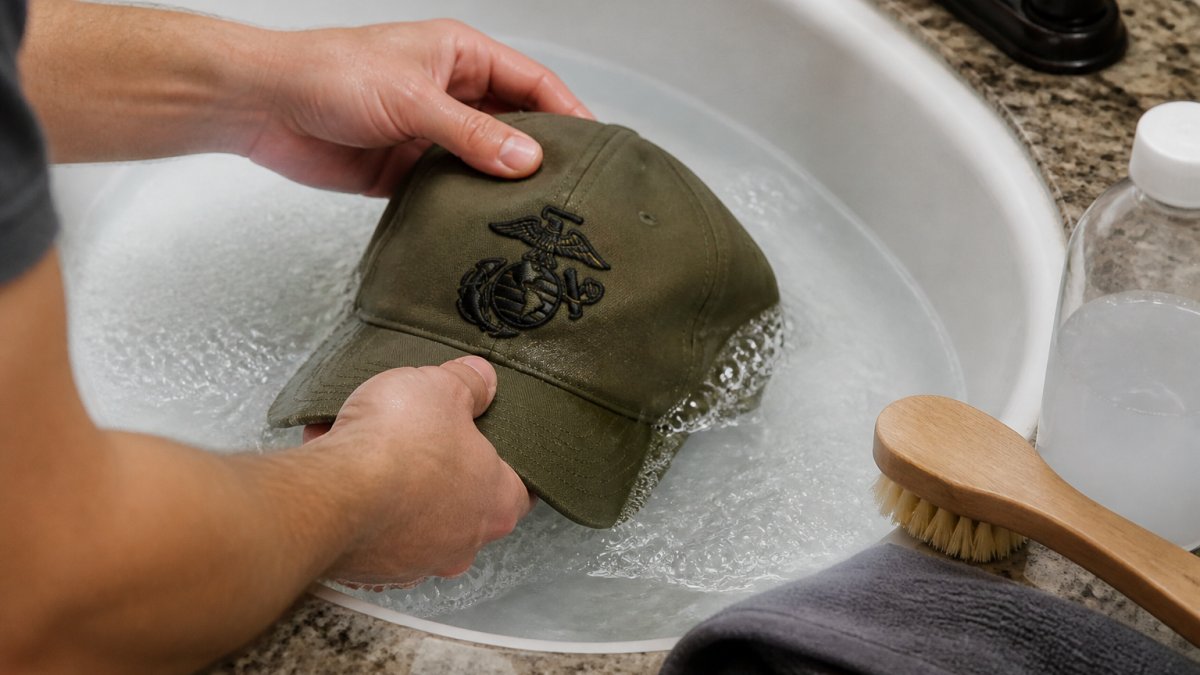
Then work through these steps:
- Submerge the cap and let dirt loosen on its own.
- Use a soft-bristled brush or cloth on the crown and brim.
- Clean around the embroidery gently. Never scrub hard over stitching.
- Rinse with cool water until no soap remains.
Skip the washing machine and the dishwasher entirely. Both beat the crown out of shape and fray thread. For a cap like our Vietnam Veteran Flat Top Embroidered Cap, with its triple-stitched bill and padded sweatband, hand washing protects the structure that machine washing destroys.

Step 3: How to Spot Clean a Baseball Cap Around Embroidery
Spot cleaning handles most day-to-day mess without a full soak. Mix a few drops of mild detergent in cool water, dip a soft cloth or toothbrush, and dab the dirty area. Work from the outside of the stain inward so you don't spread it.
Around embroidery, use short, light strokes. Thread takes dye differently than fabric, and hard scrubbing can fray it or pull a stitch loose. Rinse the cloth often and blot with a clean towel.
Some stains need a second pass. Give the spot a few minutes to loosen, then dab again. Patience beats pressure every time.
Step 4: How to Remove Sweat Stains From a Hat and Treat Odors
Sweat, salt, and skin oil build up in the sweatband and cause most of the yellowing on light-colored caps. To remove sweat stains from a hat, make a paste of mild detergent and cool water, then work it into the sweatband with a soft brush. Let it sit for 15 minutes before rinsing.
For odor, a short soak in cool water with a spoonful of baking soda helps. Avoid chlorine bleach, which weakens fabric and can yellow white thread.
- Rinse the sweatband thoroughly. Leftover soap attracts more dirt.
- Air the hat outside in the shade after treatment.
- Repeat for heavy buildup rather than scrubbing harder.
A padded sweatband, like the one on our US Flag Veteran Embroidered Cap, absorbs sweat before it reaches the crown, which keeps stains off the visible fabric.

Step 5: How to Dry a Hat Without Shrinking It or Warping the Crown
Air-drying is the only safe method for an embroidered military cap, but "air-dry" is not a single instruction. A structured crown and a pre-curved bill dry at different rates, and if the cap is unsupported while wet, gravity pulls the fabric and the buckram backing settles into a new, flatter shape. The goal is to hold the cap in its original silhouette for the entire drying window, usually 12 to 24 hours.
Build a drying form that matches the crown. A rolled towel works for a soft crown, but a structured cap needs firmer support. Options, from most to least accessible:
- Rolled bath towel: Fold a towel lengthwise into a cylinder roughly the height of the crown, then stand it inside the cap. Good for soft crowns and dad caps.
- Balloon or crumpled plastic bag: Inflate a balloon (or stuff a zip-top bag) inside the crown to push the fabric back out to its original curve. Adjust the fill until the front panel sits flat, not bulging.
- Hat form or bowl: Set the cap over an inverted bowl or a purpose-made hat form so the brim rests flat and the crown keeps its height. This is the best setup for a stiff dress cap with a hard bill.
Support the bill separately. A pre-curved bill will relax as it dries. While the fabric is still damp, curve the bill back to shape by hand and hold it for a few seconds, or wrap a rubber band loosely around the bill to hold the curve. Remove the band once the bill is dry to the touch so it doesn't leave a crease.
Vietnam Veteran Flat Top Embroidered Cap →
Control the environment. Dry at room temperature, in the shade, with airflow. Three rules:
| Risk | Cause | Fix |
|---|---|---|
| Shrinkage | Hot water or heat drying | Cool water, air-dry only |
| Warped or collapsed crown | No support while wet | Towel roll, balloon, or hat form inside the crown |
| Curled or flattened bill | Bill unsupported while damp | Reshape by hand while damp; hold with a loose band |
| Faded color | Direct sunlight | Dry in the shade |
| Mildew or sour smell | Drying in a closed, humid space | Fan or open window; never a sealed closet |
Never use heat. A clothes dryer, radiator, hair dryer, or hot car will shrink cotton twill, melt or distort polyester thread, and can warp the buckram that gives a structured crown its shape. Buckram is a stiffened fabric, once it takes a set from heat, it does not relax back.
Reshape before fully dry. The window when the cap is damp-but-not-wet is the only time you can correct a bent bill or a dented crown by hand. Once the fabric is bone-dry, the shape is locked in until the next wash.
Most caps dry within a day. A heavy wool dress cap can take closer to 36 hours; check the inside of the crown, not just the outside, before you call it done.
Common Mistakes That Damage Embroidered Military Hats
The biggest mistake is treating a structured cap like laundry. Tossing it in the washing machine or dishwasher collapses the crown and frays embroidery in a single cycle. Here is why each shortcut fails, so you can recognize the risk before you take it.
Washing machine. The agitator and the spin cycle are the problem, not the water. Agitation twists the cap against itself and against the drum, which pulls at every stitch. Embroidery thread sits proud of the fabric, so it catches first, a single cycle can lift a satin-stitch letter or fray a border. The spin cycle then wrings the crown, and a buckram-backed front panel that gets wrung does not spring back.
Dishwasher. This is the most damaging shortcut because it combines three failures at once: heat, harsh detergent, and a drying cycle. Dishwasher detergent is formulated to cut grease off hard surfaces and is far more alkaline than a mild laundry or dish soap; it strips dyes from fabric and thread. The heated dry cycle then bakes the cap, shrinking cotton and setting any stain that wasn't fully rinsed. The result is a faded, shrunken, warped cap, usually in one run.
Other errors we see often:
- Soaking a vintage hat with fragile thread for too long. Older thread and older dyes both weaken with time; a 15-minute soak on a 1970s cap is not the same as on a new one.
- Using chlorine bleach or harsh cleaners on colored embroidery. Bleach weakens cotton fibers and can yellow white thread while fading colored thread unevenly.
- Scrubbing hard over stitching instead of dabbing. A stiff brush snags the top thread and can pull a stitch loose, and a pulled stitch on a military cap is nearly impossible to repair cleanly.
- Drying in direct sun, which fades both fabric and thread and can make a colored embroidery design look washed out next to the base fabric.
- Wearing the cap before the sweatband is fully dry, which traps moisture and starts odor and mildew.
When to stop and get help. If a hat has metal insignia that won't come off, heavy soiling that has set for years, or delicate vintage construction, professional cleaning is the safer call. The cost of a cleaner is far less than replacing a cap you can't buy again.
Keeping Your Embroidered Military Hats Looking Sharp
A clean cap honors the service it represents. With cool water, mild detergent, gentle handling around stitching, and patient air-drying, most embroidered military hats stay sharp for years. The routine takes minutes and protects the details that make these caps worth wearing. Consistent habits in caring for embroidered caps ensure that the fabric remains resilient and the threadwork stays vibrant regardless of the specific emblem displayed.
At US Troop Gear, Inc., we build caps to last, with high-definition embroidery, triple-stitched bills, and padded sweatbands on every design. Browse our Middle East Veteran Embroidered Cap and Vietnam Veteran Embroidered Cap to find gear made to be worn with pride, then follow the steps above to keep it that way. Continue shopping and wear your pride with purpose.

Frequently Asked Questions
Can you wash an embroidered military hat in a washing machine?
A washing machine's agitation can loosen embroidery, bend the brim, and shrink the crown, especially on structured military caps. Hand washing in cool water with a small amount of mild detergent is the safer choice. If you must use a machine, place the hat in a structured hat cage or pillowcase on a gentle cycle, but understand that stitching and shape are still at risk. For caps with insignia or older embroidery, hand washing is the only reliable way to protect the design.
How do you clean an embroidered hat without damaging the stitching?
Use cool or lukewarm water, a small amount of mild detergent or dish soap, and a soft-bristled brush or clean cloth. Clean around the stitching rather than scrubbing directly over it, and never use hard scrubbing or bleach, which can weaken thread and cause color bleeding. Spot clean dirty areas first, then hand wash if needed. Rinse thoroughly and air-dry away from direct heat to keep both the embroidery and the hat's shape intact.
Can you use dish soap to clean an embroidered hat?
Yes, a small amount of mild dish soap works well for spot cleaning and hand washing embroidered hats. It cuts through sweat, salt, and oil without the harsh additives found in some laundry detergents. Dilute a few drops in cool water, apply with a soft cloth or soft-bristled brush, and rinse thoroughly. Avoid dish soaps with bleach or heavy degreasers, as these can fade thread color and weaken fabric over time.
How often should you clean an embroidered cap?
Spot clean your embroidered military hat whenever you notice dirt, sweat rings, or stains, which may be after every few wears in warm weather. A full hand wash is typically needed every two to three months with regular wear, or sooner if the sweatband becomes stiff or odorous. Vintage or commemorative caps with delicate insignia should be cleaned less often and more gently. Always air-dry completely before wearing or storing to prevent mildew.