

Military Unit Cap Design Trends for 2026
Table of Contents
- Military Unit Cap Design Trends Shaping 2026
- Performance Fabrics and Technical Materials
- Embroidered Military Caps: Quality and Detail Standards
- Military Cap Embroidery Ideas for Unit Identity
- Custom Unit Patches for Hats: Insignia Placement and Compliance
- Military Hat Color Combinations and Bold Contrast
- Heritage and Vintage Styling in Modern Unit Caps
- Structured vs. Unstructured: Fit, Comfort, and Branch Standards
- Frequently Asked Questions
Last Updated: October 10, 2026
Military Unit Cap Design Trends Shaping 2026
Military unit cap design in 2026 blends performance requirements with heritage symbolism. At US Troop Gear, Inc., we've tracked these trends across all service branches: this year marks the shift from generic branding to precision-engineered identity wear.
Three forces converge: technical fabric innovation, stricter insignia compliance, and renewed emphasis on unit pride. Service members want caps that perform in the field, look sharp at ceremonies, and carry their unit's story accurately.
Performance Fabrics and Technical Materials
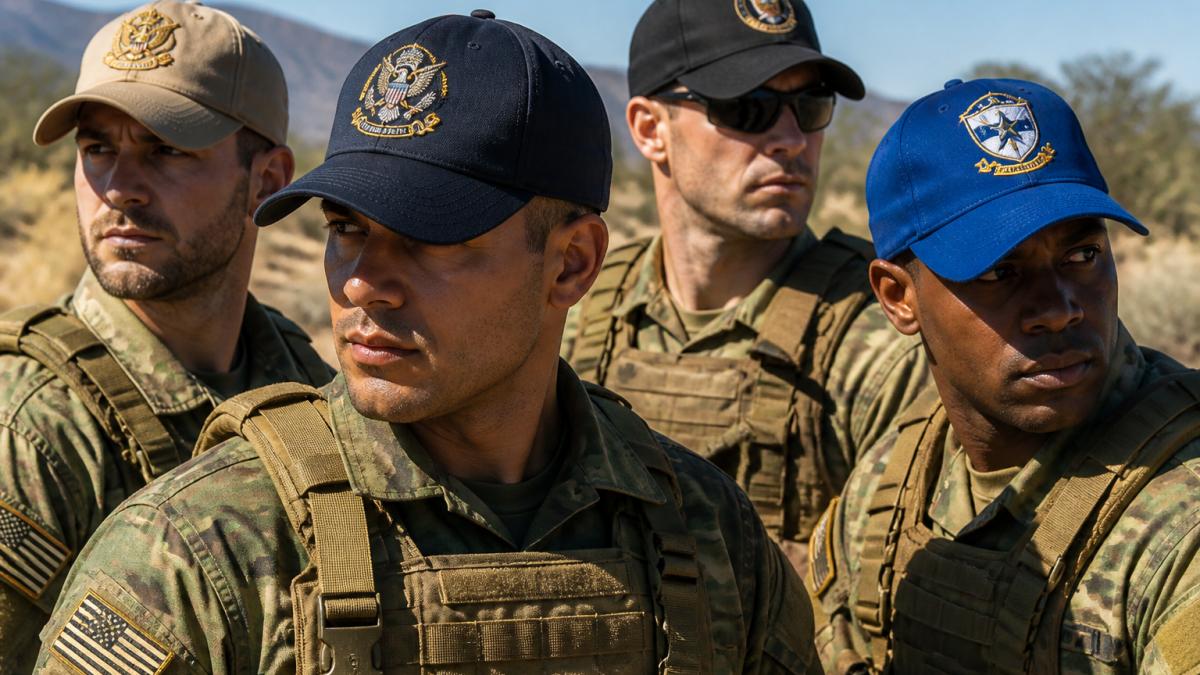
Performance-grade fabrics dominate military unit cap design in 2026. Cotton twill blended with moisture-wicking synthetics and reinforced stress points extends durability. The United States Space Force (USSF) Embroidered Cap exemplifies this: cotton twill with padded sweat band and triple-stitched bill for extended wear.

Stress-point engineering separates field-ready caps from decorative ones.
Breathability is essential for training environments. Moisture-wicking properties and ventilation holes at crown and sides maintain airflow without compromising structural integrity.
Choose based on intended use.
Embroidered Military Caps: Quality and Detail Standards
Embroidery is where military unit cap design becomes technically demanding. High-definition embroidery requires precision threading, stitch density control, and color accuracy. Units must navigate production specifications, approval timelines, and quality verification.
The Army ACU (Army Combat Uniform) Flat Top Cap demonstrates proper execution: consistent stitch density, reinforced backing, and thread colors matching official insignia. Direct fabric embroidery allows more detailed insignia than patch-based designs.
Production Specifications for Unit Cap Orders
Approval and Quality Verification Workflow
Color Matching and Thread Selection
Gold works best on Navy and Army green caps; silver suits Air Force sage and lighter OD shades.
Lead Times and Batch Considerations
Military Cap Embroidery Ideas for Unit Identity
Unit identity in military cap design goes beyond slapping a logo on fabric. The most effective designs layer insignia elements: unit crest, branch symbol, service years, or mission designation. The Navy Cap with 3D Lettering shows how dimensional embroidery adds depth to flat designs, making insignia pop without bulk.
Consider a three-tier embroidery strategy for military unit cap design. Front placement carries the primary unit identifier, the crest, designation, or ship name. Side placement can feature branch symbol or service ribbon. Back placement works for service years, unit motto, or secondary insignia. This distributed approach tells a complete story without overcrowding the front.
Color blocking within embroidery creates visual hierarchy. Navy blues, Army greens, and Air Force silvers work as primary colors, with gold or white accents for insignia detail. The contrast between base thread color and accent stitching guides the eye to the most important elements.
Typography in military unit cap design requires restraint. Service branch names, unit designations, or mottos should use clean, legible fonts.
Custom Unit Patches for Hats: Insignia Placement and Compliance
Patch placement on military unit caps follows both aesthetic and regulatory guidelines. The front center remains standard for primary unit insignia, positioned 1-1.5 inches above the bill. This placement ensures visibility during wear and maintains proper insignia hierarchy according to branch standards.
Beachmaster Unit 1 (Old Design) Cap →
Insignia compliance is non-negotiable. Each service branch maintains official specifications for how unit crests, rank insignia, and service symbols must appear (Army Uniforms and Grooming Guide). The Beachmaster Unit 1 (Old Design) Cap maintains Navy licensing and regulation adherence, fully authorized for official wear.

Patch size directly affects cap appearance and insignia legibility.
Military Hat Color Combinations and Bold Contrast
Color strategy in military unit cap design for 2026 emphasizes branch authenticity with selective bold contrast. Navy blue, Army green (OD), Air Force sage, and Marine Corps forest green remain the foundation colors. The United States Air Force Cap with 3D Lettering OD Green and US Air Force Cap with 3D Lettering Coyote Brown demonstrate how branch-appropriate base colors paired with embroidery accents create visual distinction.

Two-tone caps, base color with contrasting undervisor, are gaining traction in military unit cap design. The Navy Cap (Two Tone Color) pairs dark navy with lighter interior, creating visual interest while maintaining regulation appearance. This approach works especially well for units seeking subtle differentiation without departing from official color palettes.
Gold and silver embroidery thread provides contrast against dark base fabrics. Gold works best on Navy and Army green caps, while silver suits Air Force sage and lighter OD shades.
Avoid trendy color combinations that diverge from branch standards. The most effective military unit cap design uses color psychology within official parameters: darker base colors project authority, while strategic accent colors draw attention to insignia.
Heritage and Vintage Styling in Modern Unit Caps
Vintage military aesthetics are resurfacing in 2026, but with a modern execution. Heritage styling in military unit cap design draws from historical unit insignia, discontinued emblems, or service-era specific designs. This approach appeals to veterans seeking caps that reflect their service period while maintaining contemporary construction quality.
The flat-top cap style, exemplified by the Navy Flat Top Cap and Army Flat Top OD Green Cap, represents a return to structured, formal military headwear. Unlike unstructured caps that collapse when removed, flat-tops maintain their shape and project a more formal appearance. This style works particularly well for ceremonial wear and official unit functions.
Retro insignia designs, pulling from unit histories spanning decades, create authentic connection to service lineage. A unit established in 1985 might feature its original crest alongside current designation, bridging past and present. This layered approach to military unit cap design tells a unit's complete story rather than its current moment alone.
Vintage color combinations also resurface. Lighter OD greens, faded navy blues, and weathered finishes appeal to collectors and veterans.
Structured vs. Unstructured: Fit, Comfort, and Branch Standards
The structured-versus-unstructured debate in military unit cap design hinges on intended use and branch culture. Structured caps (flat-top, cadet, or service styles) maintain rigid shape, project formal appearance, and suit ceremonial or official wear. Unstructured caps offer comfort for extended field wear but sacrifice the crisp silhouette expected in formal settings.
| Cap Style | Best For | Appearance | Comfort | Durability |
|---|---|---|---|---|
| Flat Top (Structured) | Ceremonies, official wear | Formal, sharp | Moderate | Very High |
| Cadet (Structured) | Mixed use, training | Professional | Good | High |
| Unstructured | Field operations, daily wear | Casual, relaxed | Excellent | High |
| Trucker (Structured) | Casual unit wear | Distinctive, bold | Good | High |
The Blank OD Flat Top Cap provides a foundation for custom military unit cap design, offering structured support without pre-printed insignia. This approach allows units to add their specific embroidery while maintaining the formal aesthetic flat-tops deliver.
Branch standards often dictate style expectations. Navy personnel traditionally favor structured caps for official functions. Army units increasingly adopt flat-tops for training and ceremony. Air Force culture embraces both structured and casual styles depending on context. Understanding your branch's aesthetic preferences shapes military unit cap design decisions.
Fit and comfort matter more than appearance alone. Adjustable straps with embroidered reinforcement (standard across US Troop Gear, Inc. caps) accommodate various head sizes without requiring multiple SKUs. Padded sweat bands reduce pressure points during extended wear, critical for units conducting outdoor training or ceremonial events lasting hours.
Military unit cap design in 2026 demands precision across fabric selection, embroidery execution, insignia compliance, and color strategy. The caps that resonate most with service members are those that balance performance durability with heritage respect, gear that serves function while honoring unit identity. US Troop Gear, Inc. specializes in branch-specific caps with high-definition embroidery, reinforced construction, and official licensing across Army, Navy, Air Force, Marine Corps, and Space Force designs. Explore our collection of military unit caps to find designs that represent your service with authenticity and pride.
Frequently Asked Questions
What makes a military unit cap design look current in 2026?
Current military unit cap design in 2026 combines high-definition embroidery with technical fabrics that perform in the field. Look for crisp insignia placement, bold color contrast (such as OD green paired with navy or coyote brown accents), and durable cotton twill construction with padded sweat bands. Triple-stitched bills and reinforced vent holes signal quality that lasts beyond a single deployment season.
Which embroidery styles work best for military unit caps?
High-definition direct embroidery onto cotton twill caps delivers the sharpest unit insignia. 3D lettering adds depth and readability from a distance, making rank, unit designation, and ship crests stand out. Ensure embroidered straps are adjustable for comfort and that stitching is triple-reinforced at stress points. This approach honors the detail of your unit's identity while maintaining wear resistance.
What colors are popular for custom military caps in 2026?
Branch-standard colors dominate: Navy dark blue and two-tone combinations for naval units, OD green and coyote brown for Army and special operations, and service-specific blues for Air Force and Space Force. Bold color contrast, pairing primary colors with complementary accents on bills or visors, adds visual impact while respecting uniform regulations. These palettes reflect both heritage styling and modern tactical functionality.
How do I ensure my unit's insignia is accurate and compliant?
Work with vendors who are licensed by your branch and understand uniform regulations for insignia placement. The insignia should be centered on the front panel, properly sized for readability, and embroidered with high definition. Verify that ship crests and rank insignia match official specifications before production. Padded sweat bands and reinforced vent holes protect the embroidery during wear and washing.