

7 Sustainability Trends Reshaping Tactical Manufacturing
Last Updated: November 1, 2026
Quick Summary
Sustainability in tactical manufacturing now covers materials, energy, water, waste and product end-of-life. Manufacturers evaluate recycled fabrics against the same performance specs as conventional ones, and track energy, water and scrap per product line before claiming progress.
- Recycled fabrics must still meet tear strength, abrasion and performance requirements for their intended use.
- Track energy, water, fabric utilization and scrap rate per product line rather than plant-wide totals.
- Compressed air can account for a meaningful share of a plant's electricity, often through unnoticed leaks.
- Design gear for repair with replaceable panels, accessible high-wear stitching and standardized hardware.
- Start with one product line to set a baseline, then track two or three KPIs quarterly.
Table of Contents
- Why Sustainability Is Now Part of Tactical Manufacturing
- Sustainable Tactical Gear Materials: What Is Changing in Fabrics and Components
- Recycled Fabrics for Military Apparel: Performance Trade-Offs to Weigh
- Energy, Water and Waste: Operational Trends on the Production Floor
- Low-Waste Apparel Production: Cutting Scrap and Dyeing Impact
- Circular Economy in Defense Manufacturing: Repair, Reuse and End-of-Life
- Measuring Progress: KPIs, Procurement Standards and Your Next Steps
- Frequently Asked Questions
Why Sustainability Is Now Part of Tactical Manufacturing
Sustainability has moved from a marketing line to a production question in tactical manufacturing. Buyers, procurement officers and the manufacturers serving them now ask how gear is made, what it is made from and what happens when it wears out. Veterans, family members and collectors often ask the same questions, and they want clear answers rather than slogans.
Sustainability trends in modern tactical manufacturing cover materials, energy, water, waste, and what happens to products after use. Some of these shifts are driven by buyers, some by regulation, and some by the simple cost of wasted material. Taken together, they are reshaping how tactical apparel and equipment get designed and produced.
The trends below are not a checklist to be completed in one quarter. Each one touches design, sourcing and the production floor, and each one involves trade-offs that deserve honest discussion.
Sustainable Tactical Gear Materials: What Is Changing in Fabrics and Components
Material choice is where most sustainability decisions begin. Tactical gear has traditionally relied on nylon, polyester and cotton blends selected for durability and performance under harsh conditions. Manufacturers are now testing lower-impact alternatives, including recycled synthetics and fibers with reduced dye and finishing requirements.
The practical challenge is that a material has to perform before it can be sustainable. A fabric that fails under load or abrasion creates more waste than the one it replaces. For that reason, sustainable tactical gear materials are usually evaluated against the same performance specifications as conventional ones, with environmental attributes added to the scorecard rather than substituted for it.
Component choices matter too. Hardware, thread, webbing and coatings each carry their own environmental footprint, and a garment is only as low-impact as its least-considered part.
Recycled Fabrics for Military Apparel: Performance Trade-Offs to Weigh
Recycled fabrics for military apparel are the trend most buyers ask about first, and they deserve a careful answer. Recycled polyester and nylon can reduce reliance on virgin petroleum feedstocks, but the fiber quality, consistency and abrasion resistance of recycled input can vary from batch to batch.
A useful way to evaluate these fabrics is to ask four questions:
- Does the material meet the tear strength and abrasion requirements of the intended use?
- How consistent is the fiber across production runs?
- How does it handle moisture, heat and repeated laundering?
- Is the recycled content verified by a documented chain of custody?
Recycled content is not automatically better for every application. A lightweight training garment and a load-bearing vest impose very different demands, and the right choice depends on which of those demands dominates.
Energy, Water and Waste: Operational Trends on the Production Floor
Production-floor sustainability in tactical manufacturing is less about slogans and more about instrumentation. The facilities that make progress are the ones that can answer a simple question: how much energy, water and material does one unit of this product actually consume? Everything else follows from that baseline.
Energy. Tactical production is energy-intensive in specific, identifiable places: cut-and-sew lines running industrial sewing and bartacking machines, heat presses and seam-sealing equipment, coating and lamination lines, and the compressed-air systems that drive pneumatic tools and clamping.
Water. Water use concentrates in wet processing: dyeing, washing, and finishing. Low-liquor dyeing machines use substantially less water per pound of fabric than conventional beck dyeing, and counter-current rinsing recovers water from one stage to feed another.
Waste. Waste in tactical manufacturing shows up as cutting offcuts, rejected sewn assemblies, coating and laminate trim, and packaging. Offcuts from high-denier nylon and Cordura-style fabrics are the most visible cost because the material itself is expensive. Pattern-nesting software, marker efficiency reviews, and end-of-roll reuse programs are the standard levers.
Measure before you manage. The tactical manufacturers making real progress track a small set of KPIs per product line rather than plant-wide totals:
- Energy intensity: kWh per unit produced, or per pound of fabric cut and sewn.
- Water intensity: gallons per pound of fabric dyed or finished.
- Fabric utilization rate: the percentage of fabric that ends up in the finished product versus offcuts and rejects.
- Scrap rate: rejected units as a percentage of units started, tracked by product line.
- Emissions intensity: often estimated from energy use and fuel combustion until direct measurement is available.
The trade-off to be honest about is cost and disruption. Submetering, leak repair and equipment upgrades require capital, and some efficiency projects pay back in months while others take years.
The article's key production-floor KPIs can be scanned at a glance, as follows.
| KPI | What it measures | Example basis |
|---|---|---|
| Energy intensity | Energy used per unit | kWh per unit or per pound cut and sewn |
| Water intensity | Water used per fabric weight | Gallons per pound dyed or finished |
| Fabric utilization rate | Fabric kept in finished product | Share of fabric versus offcuts and rejects |
| Scrap rate | Rejected units | Percentage of units started, by product line |
| Emissions intensity | Emissions from energy and fuel | Estimated until direct measurement is available |
Low-Waste Apparel Production: Cutting Scrap and Dyeing Impact
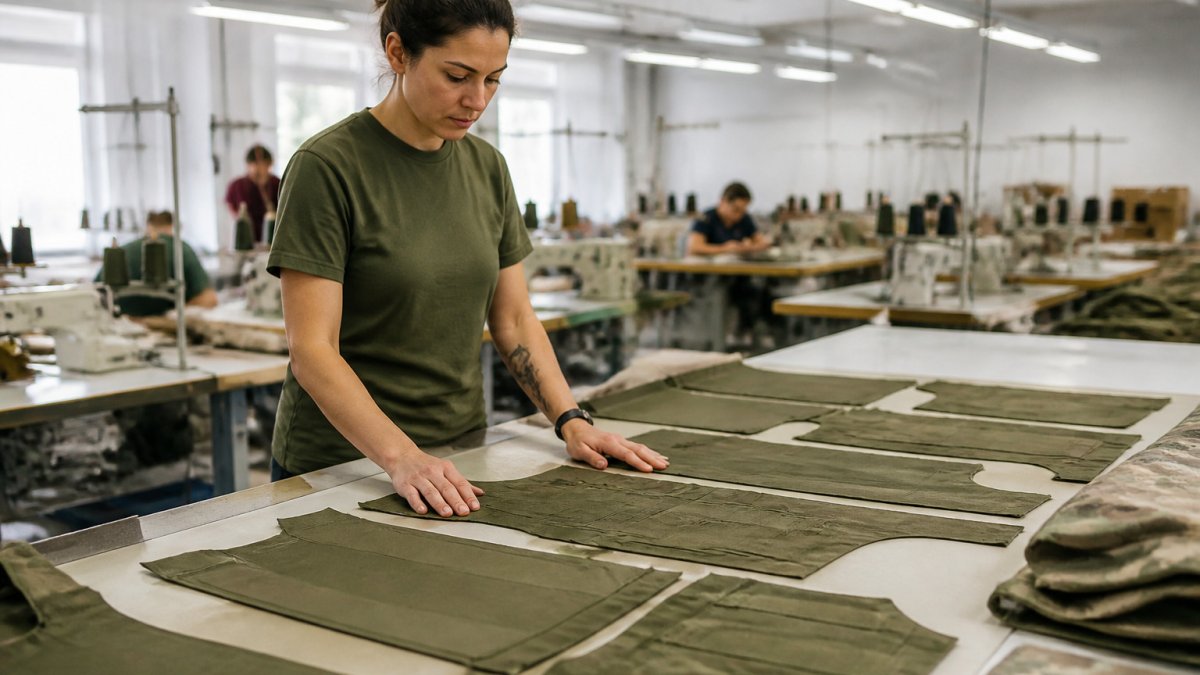
Low-waste apparel production focuses on two problems: cutting scrap and the environmental load of dyeing. Pattern nesting software, which arranges pattern pieces on fabric to minimize unused material, is a widely adopted way to reduce cutting waste. Small percentage gains in fabric use add up quickly across large production volumes.
Dyeing is the more complex challenge. Conventional dye processes use significant water and chemicals, and the effluent must be treated before discharge. Lower-impact approaches include low-liquor dyeing, which uses less water per kilogram of fabric, and waterless or reduced-water finishing methods, which are still maturing and are not yet suitable for every fabric or color.
A common mistake is to pursue waste reduction without checking its effect on quality. Changes to cutting or dyeing should be validated against colorfastness and dimensional stability before they reach production at scale.
Circular Economy in Defense Manufacturing: Repair, Reuse and End-of-Life
The circular economy in tactical manufacturing is where the sector's sustainability claims are tested hardest, because tactical gear is built to be durable and is often built from materials that are difficult to take apart. The question is not whether a product can be recycled in theory, but whether it can be repaired, re-issued, or responsibly disposed of in practice.
Reuse and refurbishment depend on records and inspection. Re-issue and refurbishment programs work where there is a reliable way to inspect returned items and a record of what was done to them. In practice that means lot or serial tracking, documented inspection criteria (abrasion, seam integrity, hardware function, coating condition), and a clear decision rule for repair versus retire.
End-of-life is material-specific. Technical textiles are not uniform in recyclability:
- Mono-material garments, for example, an all-nylon shell without mixed trims, are far easier to recycle than blends of nylon, polyester, elastane and cotton.
- Coated and laminated fabrics (polyurethane coatings, waterproof breathable membranes) complicate mechanical recycling because the coating must be separated from the base fabric.
- Composite and hard goods, helmets, plates, rigid components, often have no established recycling pathway and are more likely to be downcycled or disposed of through controlled channels.
- Treated fabrics (flame-resistant, anti-microbial, or water-repellent finishes) may face restrictions on recycling or disposal depending on the chemistry involved.
That is why some manufacturers are simplifying their material palettes and reducing the number of trims and blends per garment: fewer materials make end-of-life handling more feasible.
The tactical-specific angle competitors miss. Most general circular-economy content treats recycling as the goal. In tactical manufacturing, the higher-value levers are repair and re-issue, because they preserve the embodied energy and material already invested in a durable product and they extend service life, which is the single biggest determinant of lifecycle environmental impact.
Do not assume a take-back program equals circularity. Ask where returned items actually go, what inspection criteria decide repair versus retirement, and whether the material streams have a real recycling pathway. A collection box without a downstream process is a gesture, not a system.
Measuring Progress: KPIs, Procurement Standards and Your Next Steps
Commitments to sustainability are only as credible as the measures behind them. Useful tactical manufacturing KPIs include energy use per unit produced, water use per kilogram of fabric dyed, fabric use rate, scrap rate by product line, and the share of recycled content verified by documentation.
Procurement standards are beginning to shape these measures. Buyers increasingly request material declarations, test reports for performance and documentation of recycled content. Requirements vary by agency and contract, so suppliers should confirm the specifications that apply to their own buyers rather than relying on general claims. We recommend asking any supplier, including us, for the test data behind a performance or sustainability claim.
For a team starting this work, a practical next step is to pick one product line, establish a baseline for energy, water and waste, and choose two or three KPIs to track quarterly. Expand from there once the measurements are reliable. Shoppers who want to learn more about gear materials can start by browsing our current selection at US Troop Gear, Inc. and asking us directly about the materials in any item they are considering.
Frequently Asked Questions
Are recycled fabrics as durable as conventional military fabrics?
What should I look for in a sustainable tactical garment?
Do sustainability measures reduce the cost of gear? Pricing depends on materials, quantity and construction, so check current prices directly with the seller.
Frequently Asked Questions
What does sustainable manufacturing mean for tactical gear?
Sustainable manufacturing for tactical gear means producing durable, protective equipment while reducing energy use, water consumption, material waste and emissions across the production process. It does not mean lowering performance. Manufacturers aim to keep fabrics and components rated for demanding field use while sourcing lower-impact materials, using efficient machinery and designing products that last longer and can be repaired or recycled at end of life. Buyers should ask suppliers for specifics on each of these areas rather than accepting general sustainability claims.
Can durable tactical gear be more sustainable than disposable alternatives?
Often yes. A well-made item that lasts through many years of use usually carries less environmental impact per year of service than cheaper gear that must be replaced quickly. Durability, repairability and replacement frequency matter as much as the materials themselves. When evaluating products, look for reinforced construction, replaceable components and clear care guidance, since these extend service life and reduce the number of items that end up as waste.
How can manufacturers reduce waste in tactical gear production?
Common approaches include optimizing pattern layouts to reduce fabric offcuts, reusing or recycling cutting scraps, using lower-impact dyeing and finishing methods, and tracking waste by production stage so problem areas are visible. Measuring waste per unit produced gives a clear baseline for judging whether these changes are working.
How does recycled fabric perform in military and tactical applications?
Recycled fabrics can meet many performance requirements, but results vary by fiber, blend and finish. Strength, abrasion resistance, colorfastness and flame resistance should be verified through testing for each specific product rather than assumed from the recycled label. Buyers should request performance data and confirm that any treatments used to meet protective requirements remain effective after the fabric is recycled or washed repeatedly.
