

Why Embroidered Military Caps Last Longer
Table of Contents
- What Makes Embroidered Military Caps More Durable
- The Anatomy of a Long-Lasting Military Cap
- Why Veterans Choose Embroidered Headwear
- How to Care for Embroidered Hats to Extend Their Life
- Benefits of Embroidery vs Screen Printing for Daily Wear
- What to Look For in the Best Military Apparel Brands 2026
- Conclusion: Invest in Gear That Honors Your Service
- Frequently Asked Questions
Last Updated: September 9, 2026
What Makes Embroidered Military Caps More Durable
The reason embroidered military caps last longer comes down to how they are constructed: dense stitching physically embeds the design into the fabric rather than laying it on top. This guide from US Troop Gear, Inc. breaks down the engineering behind that durability so you can buy with confidence. Unlike a printed graphic that sits on the surface and cracks, embroidery threads pass through the cotton twill and lock together, creating a design that is part of the cap itself.
That structural difference matters for anyone who wears a cap daily. A printed logo will fade, peel, and fray within months of sun exposure and washing. Embroidery, by contrast, holds its shape because the thread count and backing material reinforce the crown from the inside. The result is a cap that survives long-term wear and still looks sharp at a reunion or a Memorial Day ceremony years later.
The Anatomy of a Long-Lasting Military Cap
A durable cap is more than its front panel. The best military headwear combines a structured crown, quality fabric, and reinforced stress points that take daily abuse. When you flip a well-made cap inside out, you should see a clean embroidery backing, taped seams, and a sweatband that is actually sewn in, not glued.
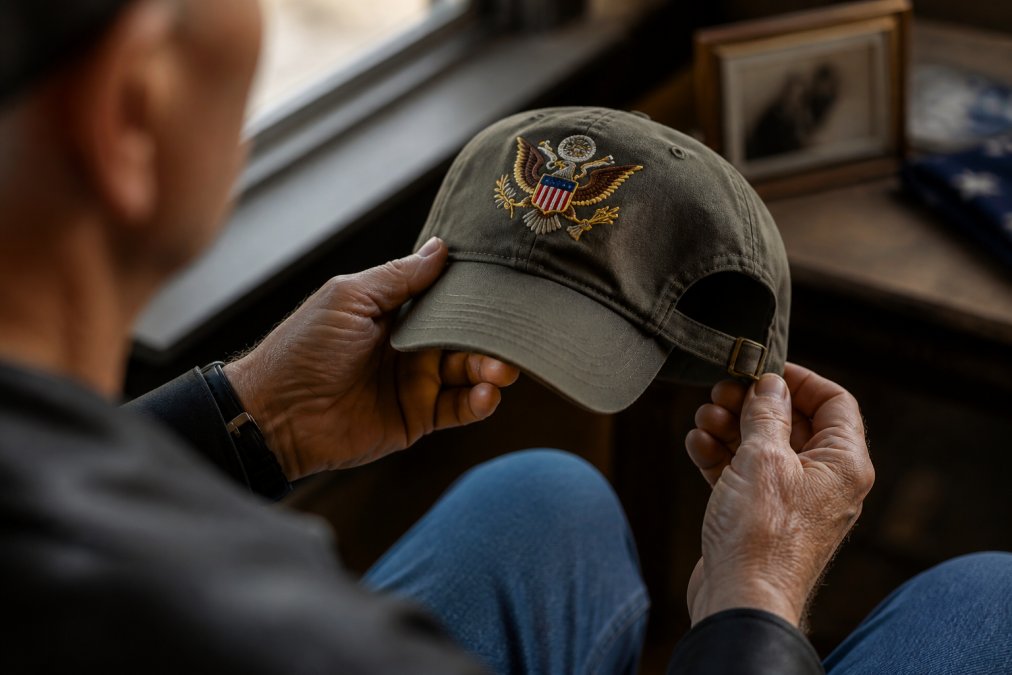
But understanding why a cap lasts requires looking at how each component bears load and resists deformation. Here is the structural breakdown.
Crown Construction: The Six-Panel vs. Five-Panel Debate
The crown is the dome that sits on your head. Most military caps use a six-panel construction, meaning six triangular fabric segments are sewn together. Six panels create a more rounded, structured dome that holds its shape when wet or crushed. Five-panel caps, often called 'dad hats,' have a single front panel that curves over the crown. The five-panel design is easier to embroider on because there is no center seam interrupting the design, but it lacks the internal support of a six-panel cap. For a cap that must survive being stuffed in a duffel bag or a glovebox, the six-panel structure is superior because the seams act as ribs that prevent the crown from collapsing flat.
The Buckram: The Invisible Skeleton
Inside the front panels of a structured cap sits a material called buckram. Buckram is a coarse, stiff cotton or linen fabric that has been soaked in a starch-based binder (britannica.com). It is fused between the outer fabric and the lining to give the front panels their rigid shape. The quality of the buckram determines whether the cap develops a permanent crease down the middle after a few months. Low-grade buckram is thin and breaks down with sweat exposure, causing the cap to go limp. Military-grade caps use a heavier-weight buckram, typically 8-ounce or higher, which resists moisture absorption and retains its stiffness for years. When you press on the front of a cap and it bounces back, that is the buckram working.
Brim Reinforcement: The Triple-Stitch and Plastic Insert
The brim, or bill, is the most abused part of a cap. It gets bent, gripped, and rested on steering wheels. A standard cap has a plastic insert inside the brim to provide stiffness. The failure point is not the plastic; it is the seam where the brim meets the crown. A single line of stitching here will pull apart under repeated flexing. Triple-stitching, where three parallel rows of thread sew the brim to the crown, distributes the stress across a wider area. Each row carries a third of the load, so a single thread break does not compromise the seam. Additionally, look for a 'button' at the top of the crown. This small fabric-covered button is not decorative; it is the termination point for all the crown panels. A reinforced button with a plastic core prevents the top of the cap from developing a hole where the panels converge.
The Sweatband: Absorption and Structural Anchor
The sweatband is the strip of fabric inside the cap that touches your forehead. Its role in longevity is twofold. First, it absorbs sweat, preventing moisture from soaking into the buckram and the embroidery backing. Second, it anchors the lower edge of the crown panels, keeping the cap's shape taut. A sweatband that is sewn in with a lockstitch will stay put (textileschool.com). A sweatband that is glued will peel away after a few hot days, exposing the raw edge of the fabric to your skin and allowing sweat to saturate the crown. Military caps often use a terry-cloth or a microfiber sweatband with a moisture-wicking treatment. These materials dry faster than plain cotton, reducing the time the cap stays damp, which is a leading cause of fabric breakdown.
Ventilation Eyelets: The Hidden Stress Points
Most structured caps have four or six embroidered eyelets near the top of the crown for ventilation. These are not just holes; they are stress concentrators. A hole in a woven fabric creates a point where tension gathers. If the eyelet is simply cut and left raw, the fabric will fray outward from the hole. A quality cap uses a dense satin stitch around the eyelet to seal the edge and distribute stress. Check the eyelets on a cap you own: if the stitching around the hole is loose or the fabric is fraying, the cap is nearing the end of its structural life.
How the Pieces Work Together
A cap fails when one component fails and cascades. If the sweatband peels, sweat soaks the buckram. The buckram softens, the crown loses its dome, and the front panel wrinkles. The wrinkles pull on the embroidery backing, causing the stitches to loosen. The design then frays, and the cap looks worn out even though the fabric itself is intact. Conversely, a cap with a sewn sweatband, heavy buckram, and triple-stitched brim will keep its shape, protecting the embroidery from the flexing that causes thread breakage. This is why the best military caps are not just embroidered well; they are engineered as a complete system.
Why Veterans Choose Embroidered Headwear
Veterans choose embroidered headwear because it carries weight. A custom insignia stitched in high density reads as service recognition, not a mass-produced souvenir. The raised texture of the thread catches light and gives the design a hand-finished presence that flat printing cannot match.
There is also a practical reason rooted in military heritage. Service members are used to gear that must perform. A cap with a flimsy printed logo feels wrong because it will not survive the field, the job site, or the garage. Embroidered caps offer the same structural integrity expected of any piece of uniform-adjacent gear, which is why they become the everyday cap a veteran reaches for.
How to Care for Embroidered Hats to Extend Their Life
Caring for an embroidered cap is straightforward, but most people make one critical mistake: throwing it in the washing machine. The agitation and spin cycle crush the crown and fray the embroidery threads. Instead, hand wash the cap in cold water with a mild detergent, gently scrubbing the sweatband and any soiled areas.

- Clean: Hand wash in cold water. Never machine wash or dry.
- Dry: Reshape the crown and let it air dry on a towel or a cap form.
- Store: Keep it off direct sunlight when not worn to protect colorfastness.
- Handle: Grab the cap by the brim or crown, not the embroidery, to avoid bending the design.
Following this maintenance protocol is the simplest way to protect your investment. A cap that is cared for properly will last for years, and the fade-resistant stitching will keep the design legible through long-term wear.
Benefits of Embroidery vs Screen Printing for Daily Wear
For daily wear, embroidery wins on every practical axis. The raised stitch density provides a tensile strength that resists abrasion from car headrests, backpack straps, and repeated handling. Screen printing cannot match this because the ink layer is brittle and will eventually crack at the crease points of the cap (peer-reviewed research).
Embroidery also handles weather resistance better. Rain and sweat do not degrade polyester thread the way moisture breaks down printed inks. The sweatband on a quality cap, often padded and moisture-wicking, protects the fabric from the oils and salts that cause deterioration. When you combine these elements, you get a cap built for everyday utility, not just display.
What to Look For in the Best Military Apparel Brands 2026
When evaluating the best military apparel brands 2026, look past the marketing and inspect the construction details. Check whether the design is embroidered directly onto the cap or patched on. Look for a fully adjustable embroidered strap rather than a plastic snapback. Confirm the bill is triple-stitched and the vent holes are reinforced to prevent fraying at the eyelets.
For a concrete example of these standards, consider the [US Troop Gear 101st Airborne Cap(/products/101st-airborne-cap) | ustroopgear.com], which features high-definition embroidery on cotton twill, a padded sweatband, and reinforced vent holes. Similarly, the Vietnam Veteran Flat Top Embroidered Cap uses the same construction for a branch-specific design. These details reflect a broader industry push toward durability that veterans expect.
Conclusion: Invest in Gear That Honors Your Service
Your service deserves better than a cap that falls apart after a few washes. The difference between a cap that lasts and one that disintegrates comes down to embroidery quality, fabric choice, and construction details like triple stitching and reinforced eyelets. When you choose gear built to those standards, you are investing in a piece that honors your service every time you put it on.
At US Troop Gear, Inc., we build embroidered military caps with the structural integrity that service demands, from high-density designs on cotton twill to fully adjustable embroidered straps. Whether you are looking for a 101st Airborne Cap or a Middle East Veteran Embroidered Cap, our gear is designed to serve you as faithfully as you served. Continue shopping with US Troop Gear, Inc. and find headwear that stands the test of time.
Frequently Asked Questions
How do you properly clean an embroidered military cap?
Hand wash your cap in cold water with a mild detergent to protect the high-density embroidery. Gently scrub the fabric with a soft brush, focusing on the sweatband and brim, but avoid soaking the embroidered area for too long. Rinse thoroughly and let it air dry on a cap form or a rounded object to preserve its shape. Never put an embroidered cap in the washing machine or dryer, as the agitation can loosen threads and cause fraying.
What is the difference between screen-printed and embroidered caps?
Screen printing lays a thin layer of ink on the surface of the cap, which can crack, peel, or fade after a few washes and regular sun exposure. Embroidery uses high-density thread that is stitched directly into the fabric, making the design part of the cap itself. This creates a raised, textured finish that resists fading and wear. For a cap you plan to wear for years, embroidery is the more durable choice.
Why do embroidered military caps cost more than printed ones?
The higher price reflects the materials and labor involved. A cap like the 101st Airborne Cap at $27.95 uses a cotton twill shell, a padded sweatband, and a triple-stitched bill. The high-density embroidery process uses more thread and requires precise machinery to create a detailed design that won't unravel. You are paying for structural integrity and fade-resistant stitching that will hold up to long-term wear, not just a one-season look.
How can I tell if a military cap is made to last?
Check the construction details before you buy. Look for a fully adjustable embroidered strap, a padded sweatband, and a structured crown that holds its shape. The fabric should be a durable cotton twill or canvas, not a thin polyester blend. Inspect the stitching: high-density embroidery should feel smooth and dense to the touch with no loose threads. Reinforced vent holes and a triple-stitched bill are also signs of a cap built for years of use.