

Armed Forces Gear vs Military Best: 2026 Comparison
Table of Contents
- Armed Forces Gear vs Military Best: Quick Comparison
- What Sets Armed Forces Gear Apart from Military Best
- Best Military Apparel Brands 2026: What to Look For
- How to Choose Military Apparel That Lasts
- High-Quality Military-Themed Clothing: Key Indicators
- Legal and Regulatory Restrictions on Personal Gear
- Maintenance and Lifecycle Cost Analysis
- Frequently Asked Questions
Last Updated: September 12, 2026
Armed Forces Gear vs Military Best: Quick Comparison
Armed Forces Gear and Military Best are two of the most-searched names in military-themed apparel, yet the phrase "armed forces gear vs military best" hides a bigger question: issued equipment versus what you buy yourself. This guide from US Troop Gear, Inc. breaks down the difference between field gear built for combat and the embroidered caps and apparel that let you wear your pride with purpose.
Here is the short version. Armed Forces gear is equipment issued by the military and built to durability standards set by the branch that buys it. Military Best style gear is the retail side of the same culture: caps, shirts, and commemorative items made for veterans, families, and supporters. One is mission-critical. The other is personal.
That distinction matters more than most buyers realize. The U.S. Department of Defense acquisition guidelines draw a hard line between equipment bought for combat readiness and personal items a service member purchases on their own. Confusing the two leads to bad purchases in both directions.
Below, we compare the two categories side by side, explain what actually separates quality from costume, and show you how to choose apparel that lasts.
| Category | Armed Forces Gear | Military Best Style Retail |
|---|---|---|
| Purpose | Combat readiness and field endurance | Pride, commemoration, daily wear |
| Buyer | Government procurement | Veterans, families, supporters |
| Durability standard | Mission-critical specifications | Depends on the brand |
| Typical items | Load-bearing equipment, body armor inserts, optics | Caps, shirts, challenge coins |
| Regulated? | Yes, unit compliance rules apply | Mostly no, with some exceptions |
| Price driver | Contract logistics | Embroidery quality and materials |
What Sets Armed Forces Gear Apart from Military Best
Issued gear exists to survive combat scenarios. Every stitch, strap, and buckle is specified by a procurement contract, tested against durability and functionality standards, and issued through a logistics chain that answers to unit compliance.
Retail military-themed gear answers to a different master: the customer.
That is not a knock. A veteran buying a branch cap is not trying to survive a field exercise. They want something that represents their service accurately and holds up to years of washing. The failure point is when a retailer treats apparel like surplus and skips the details that matter.
Best Military Apparel Brands 2026: What to Look For
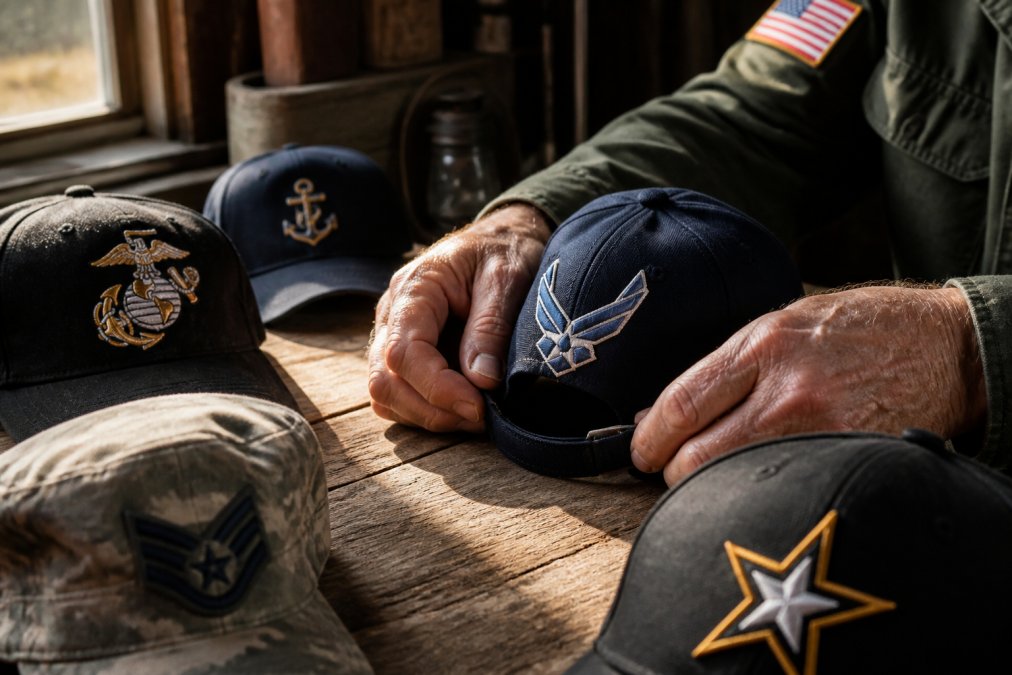
The best military apparel brands in 2026 share three traits: accurate branch insignia, embroidery that survives repeated washing, and construction details you can inspect before buying. Brand size and social media following matter far less than those three things.
Here is what separates a serious brand from a screen-printed novelty shop:
- Direct embroidery over patches. Embroidered designs hold detail and color far longer than glued-on or printed graphics.
- Reinforced stitching. Triple-stitched bills and reinforced vent holes are signs the maker expects the cap to be worn hard.
- Padded sweat bands. A small detail that decides whether a cap is comfortable in hour eight.
- Branch accuracy. Crests, ship crests, and unit insignia should match the real thing, not a stylized approximation.
- Adjustable, embroidered straps. A quality strap signals the rest of the build got the same attention.
US Troop Gear, Inc. builds its line around exactly these markers. The U.S. Army's official heraldry program maintains the reference standards for branch insignia, and any retailer serious about military heritage should be matching them.
How to Choose Military Apparel That Lasts
Choosing military apparel that lasts comes down to inspecting four things before you buy: the embroidery, the stitching, the hardware, and the fabric. If a listing does not show those details clearly, that tells you something too.
A practical checklist:
- Is the design embroidered directly onto the fabric, not printed or patched?
- Are the bill and seams triple stitched?
- Does the cap have a padded sweat band and reinforced vent holes?
- Is the strap fully adjustable and embroidered rather than flimsy plastic?
- Does the branch insignia match official heraldry?
- Is the fabric a cotton twill or poly blend rated for repeated washing?
US Troop Gear, Inc. stocks branch-specific caps built this way, including the United States Army Cap at $27.95 and the Navy Cap at $27.95, both with high-definition embroidery, padded sweat bands, triple-stitched bills, and reinforced vent holes.

High-Quality Military-Themed Clothing: Key Indicators
High-quality military-themed clothing shows its quality in the details you can see up close: raised embroidery with clean edges, even stitching, and hardware that does not flex under thumb pressure.
Three indicators do most of the work:
- Stitch density. Dense, even embroidery reads clearly from a distance and holds shape over time.
- Material weight. Cotton twill and quality poly blends drape properly and resist pilling.
- Fit consistency. A maker that controls its own construction delivers the same fit across branches and styles.
What most guides miss is that embroidery quality is the single biggest cost driver in this category. It is also the reason two caps that look similar in a photo can differ sharply in price. You are paying for thread count, digitizing work, and the labor to apply the design directly to the garment.
Legal and Regulatory Restrictions on Personal Gear
Most personal military-themed apparel is legal to buy and wear. The restrictions cluster in four specific places, and understanding the mechanism behind each one is what separates a confident purchase from a risky one.
1. Uniform regulations for active duty. Each branch publishes its own wear policy, and those policies govern what a service member may wear with, or in place of, issued items. The Army's AR 670-1 and its companion DA Pam 670-1, the Navy's NAVPERS 15665I, the Air Force's DAFI 36-2903, and the Marine Corps' MCO P1020.34 all set the same basic principle: unauthorized items cannot be mixed into a uniform, and morale or unit shirts must be approved through the chain of command before they are worn in formation. A veteran or family member is not bound by these rules, but an active-duty buyer should assume any apparel worn on duty needs command approval first.
2. Trademarked insignia and licensing. Branch names, seals, crests, and many unit insignia are protected marks. The Department of Defense and each service license those marks to manufacturers, and a legitimate retailer operates under that license. The practical test is simple: a maker that can name its licensing arrangement is almost always operating above board, and a maker that cannot is a question mark. This is also why two caps with similar artwork can differ sharply in price, licensed digitizing and royalty costs are baked into the legitimate version.
3. The Stolen Valor Act's actual scope. The Stolen Valor Act of 2013 (18 U.S.C. § 704) makes it a federal crime to fraudulently claim receipt of certain military decorations or medals, the Medal of Honor, Distinguished Service Cross, Navy Cross, Air Force Cross, Silver Star, Purple Heart, and Combat Action Badge among them, with the intent to obtain money, property, or other tangible benefit. It does not criminalize wearing a branch cap or a generic "veteran" shirt. The line is fraud for gain, not apparel.
4. Personal protective equipment and body armor. This is where the rules get genuinely strict. Federal law restricts the purchase, possession, and transfer of body armor by persons convicted of a felony involving violence (18 U.S.C. § 931), and many states layer their own restrictions on top (congress.gov). Ballistic plates, helmets, and hard armor are also frequently prohibited in unit areas unless issued and fitted by the command. A service member who buys personal armor for off-duty use should confirm both the federal prohibition and any state-level rule before ordering.
For veterans and supporters, the practical rule is straightforward: buy from a retailer that licenses its designs, respects the heritage behind the insignia, and does not imply service that was never rendered. That is the difference between honoring military heritage and cashing in on it.
Maintenance and Lifecycle Cost Analysis
Maintenance and lifecycle cost is where cheap military apparel loses, but the loss only becomes visible when you run the math instead of eyeballing the price tag. The right metric is cost per year of wear, and it almost always favors the better-built item.
Here is the mechanism. A cap's useful life is set by its weakest component. On a printed or patched cap, that component is the design: plastisol ink cracks along fold lines, heat-applied patches lift at the edges, and neither can be repaired. The fabric underneath may still have years left, but the cap is retired anyway. On a directly embroidered cap, the design is thread stitched through the fabric, so the decoration and the garment age together. The cap is retired when the fabric fails, not when the graphic does.
Run the math on a simple basis. Suppose a low-cost printed cap sells for $12 and lasts about a year before the design is unacceptable. That is roughly $12 per year of wear. A directly embroidered cap at $27.95 that holds its color and shape for five years works out to about $5.59 per year. The cheaper cap costs more than twice as much per year, and that gap widens if the embroidered cap lasts longer than five years, which is common when it is washed inside out and air-dried.
| Factor | Low-Cost Printed Cap | Quality Embroidered Cap |
|---|---|---|
| Upfront cost | Lower | Higher |
| Design method | Printed or heat-applied patch | Direct embroidery |
| Typical lifespan | 1-2 years | 4-6 years |
| Wash durability | Fades, cracks, lifts | Holds color and shape |
| Repairability | None | Re-stitch possible |
| Approx. cost per year | $6-$12 | $5-$7 |
The pattern repeats across tactical clothing, tactical accessories, and commemorative items. Direct embroidery, reinforced stitching, and quality fabric raise the upfront price and lower the annual cost. The same logic applies to boots, gloves, and load-bearing gear: the item with the higher sticker price is often the cheaper one over its service life.
There is a second, less obvious cost driver: standardization versus personalization. Issued gear is standardized so that a unit can swap parts, share load, and maintain a common supply chain, a real operational advantage. Personally purchased gear is personalized for fit and comfort, which can improve endurance on long movements but creates a maintenance problem: a non-standard item cannot be repaired from unit stocks, and a non-standard fit cannot be reissued to anyone else. For a buyer choosing between issued-style and retail gear, the honest trade-off is uniformity and supportability on one side, individual comfort and longevity on the other. Neither wins outright; the right answer depends on whether the gear is meant to be shared, reissued, and sustained by a logistics chain, or worn by one person who intends to keep it for years.
US Troop Gear, Inc. prices reflect that build quality. The United States Air Force Cap at $31.25 and the US Air Force Cap at $31.25 come with embroidery applied to a made-in-the-USA poly military ball cap. The Marine (USMC) Cap starts at $10.95.


Frequently Asked Questions
Is Armed Forces Gear a legit site?
Armed Forces Gear is a known retailer of military-themed apparel. However, legitimacy involves more than just name recognition. Check for clear return policies, verified customer reviews, and specific product details like material and embroidery quality. US Troop Gear, Inc. provides detailed descriptions and uses the same suppliers as military exchanges, ensuring authenticity. Always verify a site's contact information and look for transparency about sourcing before purchasing.
What is the best military gear?
The best military gear depends on your needs. For apparel, look for durable materials like cotton twill or poly blends, reinforced stitching, and branch-specific designs. High-quality gear often includes features like padded sweatbands and adjustable straps. US Troop Gear, Inc. offers caps from $10.95 to $31.25, with options like the US Air Force Cap made in the USA. Prioritize construction and fit over brand names alone.
What should I look for when buying military-themed apparel?
Focus on three things: material, construction, and authenticity. Material should be breathable and durable, such as cotton twill or poly. Construction details include triple-stitched seams, reinforced vent holes, and high-definition embroidery. Authenticity means the design accurately represents the branch or unit. Avoid generic patches; instead, seek items with direct embroidery. US Troop Gear, Inc. uses these standards, ensuring each cap meets military exchange quality.
Are there specific quality standards for military-themed clothing?
There are no universal standards, but military exchanges often set high benchmarks. Look for caps that mirror those issued on bases: adjustable straps, padded sweatbands, and durable embroidery. US Troop Gear, Inc. caps feature triple-stitched bills and reinforced vent holes. These details indicate a cap built to last, unlike cheaper alternatives that fray or fade quickly.
How can I verify the authenticity of military branch-specific gear?
Check for accurate branch emblems, colors, and wording. Authentic gear often includes official seals or crests, not generic designs. Read product descriptions for details like 'embroidered' versus 'printed.' US Troop Gear, Inc. provides high-definition embroidery and specifies branch names, such as the United States Army Cap. You can also look for 'made in the USA' labels.