

How to Choose Tactical Boots for Your Terrain?
Last Updated: November 4, 2026
Quick Summary
The right tactical boots depend first on your terrain: pavement needs shallow, tight lugs and cushioning, while mud and loose soil need deep, widely spaced lugs and a stiffer collar. Choose waterproofing when water comes from outside and breathability when sweat is the main problem. Confirm fit with a thumb's width at the toe and a secure heel before committing.
- Write down your terrain, daily distance, and whether you stand, walk or climb before comparing models.
- Shallow lugs of 2-3 mm suit pavement and concrete; deep lugs of 6 mm and up suit mud and loose soil.
- Waterproof membranes block outside water but trap sweat, so favor breathable boots in hot, dry climates.
- Leave a thumb's width at the toe and check that the heel does not lift when you walk.
- Break in new boots over one to three weeks using the socks you will wear in the field.
Table of Contents
- Start With the Terrain and Operating Environment
- Matching Tread Patterns and Outsole Traction to Your Ground
- Waterproof vs Breathable Tactical Boots: Choosing the Trade-Off
- Checking Fit, Sizing and Ankle Support Before You Commit
- Break-In Tips to Prevent Blisters in the Field
- Matching Weight, Durability and Load to Mission Length
- Finding Your Terrain-Matched Pair at US Troop Gear
- Frequently Asked Questions
Start With the Terrain and Operating Environment
Choosing tactical boots starts with the ground you will cover.
Before comparing models, write down three things: the terrain, the typical distance per day, and whether the work involves standing, walking or climbing. This simple list narrows the field fast.
Here is a quick decision guide:
| Terrain | What to Prioritize | Typical Trade-Off |
|---|---|---|
| Urban pavement | Cushioning, lightweight build | Less grip on mud |
| Mountain trails | Ankle support, aggressive lugs | Heavier weight |
| Wet or swampy ground | Waterproofing, stable sole | Less breathability |
| Hot, dry desert | Breathable upper, flexible sole | Less water protection |
| Mixed terrain | Balanced traction and support | Compromises on extremes |
Match your boot to your most common terrain first. Then plan for the occasional exception rather than designing around it.
Matching Tread Patterns and Outsole Traction to Your Ground
!Close-up of the underside of tactical boots showing deep lugged rubber outsoles with dried mud in the tread
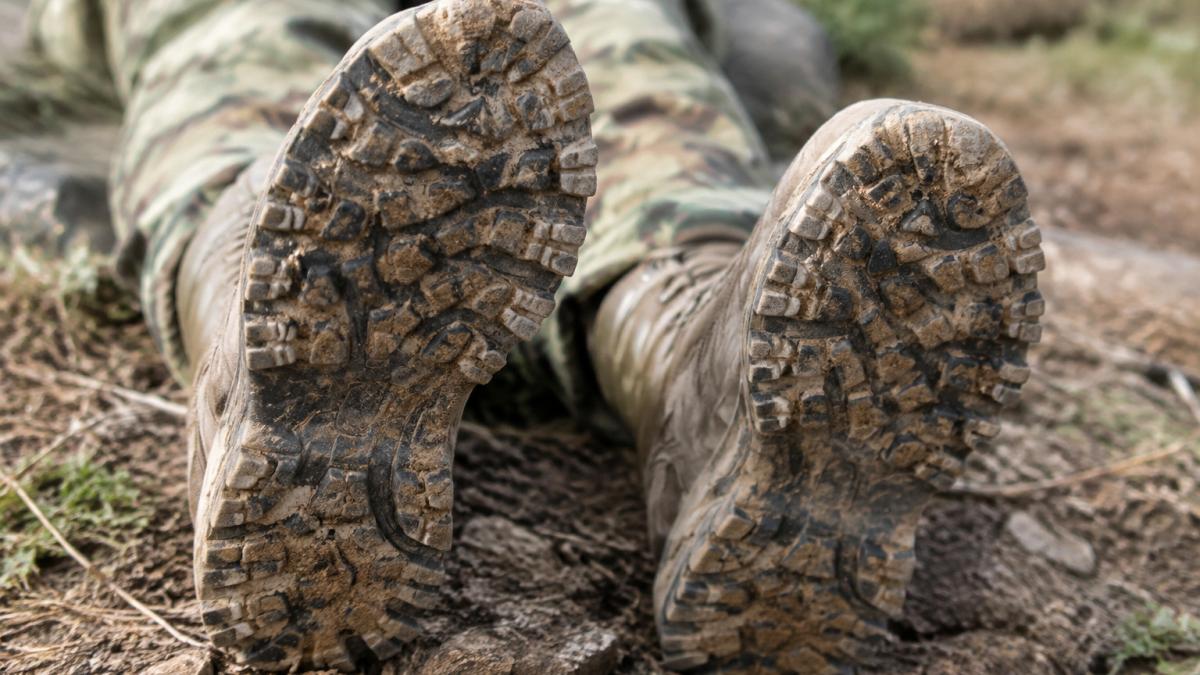
The outsole is the only part of the boot that touches the ground, so it decides how much grip, stability, and surface feel you get. For a closer look at how specialized military-style apparel compares with standard tactical gear, see Navy SEAL Gear vs Standard Tactical Apparel.
How Lug Depth and Spacing Change Grip
Lug depth is measured from the base of the outsole to the top of the tread block. As a working rule:
- Shallow lugs (roughly 2-3 mm): Best on pavement, concrete, and hard packed trails. They put more rubber in contact with the surface and do not squirm underfoot.
- Mid-depth lugs (roughly 4-5 mm): A general-purpose range for mixed terrain, gravel, and light trail use.
- Deep lugs (roughly 6 mm and up): Built for mud, loose soil, snow, and soft ground where the lug needs to bite into the surface rather than rely on friction.
Lug spacing matters as much as depth. Wide spacing lets mud and debris clear as you step, which keeps the tread working. Tight spacing puts more edges on rock and pavement but packs mud in and turns the outsole into a slick. A common pattern is a center zone of tighter, flatter lugs for hard surfaces surrounded by wider, deeper lugs at the perimeter for soft ground.
Rubber Compound and Surface Feel
Rubber hardness is usually described on the Shore A scale. A softer compound (lower Shore A) conforms to small irregularities and grips wet rock and smooth surfaces better, but it wears faster on abrasive pavement.
This is the trade-off most buyers miss: the boot that lasts longest on pavement is often the one that grips worst on wet rock, and the reverse is also true.
A Terrain-to-Outsole Decision Matrix
Use this to translate the surface you actually work on into outsole priorities:
| Surface | Lug Depth | Lug Spacing | Rubber Priority | Support Need |
|---|---|---|---|---|
| Pavement and concrete | Shallow (2-3 mm) | Tight | Harder, abrasion-resistant | Moderate; cushioning matters more |
| Gravel and hardpack | Mid (4-5 mm) | Medium | Balanced | Moderate ankle support |
| Mud and loose soil | Deep (6 mm+) | Wide, self-clearing | Softer for bite | Higher, stiffer collar |
| Wet rock and slick stone | Mid | Medium with siping | Soft, high-friction | High; stability on uneven ground |
| Sand and loose scree | Deep | Wide | Moderate | Higher; flotation and ankle control |
| Mixed terrain | Mid (4-5 mm) | Medium | Balanced | Balanced |
Siping, the small slits cut into tread blocks, adds edges that grip wet hard surfaces without adding lug depth. If your work mixes pavement and wet stone, siped mid-depth lugs are usually a better compromise than either extreme.
Features Worth Checking
- Heel brake: A defined, squared-off heel edge bites on steep descents and reduces sliding.
- Toe and heel wrap: Rubber that wraps up the toe and heel protects against scuffs and adds grip when climbing or scrambling.
- Slip resistance: Look for outsoles marketed for wet or oily surfaces if you work indoors or on pavement; these usually use softer, siped compounds.
- Midsole stiffness: A firmer midsole spreads load and stabilizes the foot on uneven ground; a softer one feels better on flat, hard surfaces.
Watch out: Buying the most aggressive tread available for every job is a common mistake. Deep, wide lugs feel unstable on hard pavement, wear down quickly, and can actually reduce traction on smooth floors.
When to Replace the Outsole
Replace the outsole when the lugs are worn flat, when the midsole is visible through the tread, or when the boot starts to slip on surfaces it used to grip well. Check the heel and the ball of the foot first, since those zones wear fastest. A worn outsole reduces stability and raises the risk of rolled ankles, especially on uneven ground. Many people wait too long because the upper still looks serviceable while the tread underneath is already compromised.
Waterproof vs Breathable Tactical Boots: Choosing the Trade-Off
Waterproof boots use a membrane, a thin, porous layer laminated inside the upper, that blocks liquid water while allowing some water vapor to pass. The membrane works, but it also reduces airflow and traps heat. That is the core trade-off: waterproofing buys protection from outside water at the cost of slower moisture escape from inside the boot.
When Waterproofing Helps
- Wet climates with frequent rain or dew.
- Stream crossings and standing water.
- Snow and slush.
- Long periods standing on wet ground where splash and seepage are constant.
In these conditions a waterproof membrane plus moisture-wicking socks usually keeps feet drier than a breathable boot, because the water coming from outside is the bigger problem.
When Waterproofing Hurts
- Hot, dry climates where sweat is the main moisture source.
- High-output days with heavy sweating.
- Humid conditions where the air itself is near saturation.
- Repeated water crossings deeper than the boot collar, where water enters from the top anyway and then cannot drain.
In these cases a waterproof membrane can turn the boot into a trap: sweat cannot escape, the inside stays damp, and the skin softens, which is exactly the condition that produces blisters. A breathable boot that drains and dries quickly is often the better choice.
The Decision Framework
Ask three questions before choosing:
- Where does the water come from? If it comes from outside (rain, puddles, wet ground), favor waterproof. If it comes from inside (sweat), favor breathable.
- How deep will you get wet? If water will exceed the collar height, waterproofing buys little and breathability buys more.
- How fast do you need the boot to dry? Breathable boots dry faster overnight; a soaked waterproof boot can stay damp for days.
A hybrid approach, a waterproof membrane with a breathable upper and drainage-friendly design, is a reasonable compromise for mixed conditions, but accept that it is a compromise on both ends rather than a solution to both.
Socks and Moisture Management
Wet feet cause more blisters than almost anything else, so treat breathability as a performance feature, not a minor detail. Pair either boot type with moisture-wicking socks (merino wool or synthetic blends) rather than cotton, which holds water against the skin.
Watch out: A waterproof boot is not a substitute for keeping water out from the top. If you routinely wade above the collar, no membrane will keep you dry, and a boot that cannot drain will stay heavy and wet long after the crossing.
Checking Fit, Sizing and Ankle Support Before You Commit
Fit matters more than brand. Use these checks when trying on a pair:
- Stand with your full weight on the boot and check for at least a thumb's width of space at the toe.
- Confirm your heel does not lift more than slightly when you walk.
- Walk up and down a slope or stairs to see if the foot slides forward.
- Wear the socks you plan to use in the field.
Ankle support depends on boot height and the stiffness of the collar. Higher boots add support on uneven ground and loose footing. Lower boots feel lighter and allow more natural movement on flat, firm surfaces. If you have a history of ankle injuries, favor a higher, stiffer collar.
Try boots later in the day, when your feet have swollen slightly. This gives a more accurate fit than trying them on first thing in the morning.
Break-In Tips to Prevent Blisters in the Field
New boots need time before they can carry a full load. Plan a break-in period of several short walks before a long mission or hike. Start with an hour or two and build up gradually over one to three weeks, depending on the boot's stiffness.
Practical tips to prevent blisters:
- Wear the same socks you will use in the field during every break-in session.
- Use moleskin or athletic tape on hot spots before they turn into blisters.
- Lace the boots so the heel stays locked in place.
- Carry spare dry socks on long days.
Watch out: Skipping break-in is the most common cause of blisters on the first real outing. Even a well-fitting boot can rub until the leather softens.
Matching Weight, Durability and Load to Mission Length
Heavier boots offer more protection and support but cost you energy over long distances. Lighter boots reduce fatigue but may offer less protection for rough terrain or heavy loads.
Match the boot to your mission length:
- Short patrols or urban work: A lighter boot with good cushioning keeps you comfortable.
- Long-distance hikes or extended field use: A sturdier boot with a stiffer sole protects your feet and distributes load well.
- Heavy loads: Choose a boot with a firm midsole and good heel support.
Durability depends on materials. Full-grain leather and reinforced stitching generally last longer than thinner synthetic uppers, though they weigh more. Check the stitching at the toe and heel, since these areas fail first.
Finding Your Terrain-Matched Pair at US Troop Gear
Once you know your terrain, your weather and your mission length, you can narrow your search. Once you know your terrain, use the fit and tread checks above to compare options. Browse the US Troop Gear website for current product details and pricing.
Frequently Asked Questions
Should tactical boots be tight or loose?
Tactical boots should fit snugly through the heel and midfoot with no lift when you walk, while leaving about a thumb's width of room at the toe. A boot that is too loose lets the foot slide and causes blisters on descents, and one that is too tight compresses toes and restricts circulation over long patrols or hikes. Try boots on in the afternoon, when feet have swelled, and wear the socks you plan to use in the field. Walk on an incline and check for heel slippage before you decide. Pricing and sizing options vary by model, so confirm the fit guidance on the product page or with US Troop Gear before ordering.
Can you wear tactical boots for hiking?
Yes, many tactical boots work well for hiking, especially models with aggressive lug outsoles, a stable midsole and a supportive ankle collar. Boots built for patrol work often carry more weight and have stiffer soles, which suits rough trails and loaded carries but may feel heavy on long, flat routes. Look for a waterproof or moisture-managing liner if your hikes cross wet ground, and check that the boot's traction suits the surfaces you expect, such as loose rock, wet roots or packed dirt. Break the boots in on shorter walks before attempting a long hike.
What does a tread pattern do for tactical boots?
Tread pattern determines how the outsole grips different surfaces. Deep, widely spaced lugs shed mud and bite into soft ground, while shallower, siped patterns with more rubber contact perform better on wet rock, concrete and urban surfaces. The rubber compound matters too: softer compounds grip better on slick surfaces but wear faster, while harder compounds last longer on abrasive terrain. Replace the outsole or the boot when lugs are worn smooth, when the sole separates from the upper, or when the boot no longer grips wet surfaces with confidence.
