

How to Display Challenge Coins: 7 Methods
Table of Contents
- Why Proper Challenge Coin Display Matters
- Challenge Coin Display Cases: Wall-Mounted and Tabletop Options
- Floating Frames and Shadow Boxes for Military Memorabilia
- Building a DIY Challenge Coin Rack
- Military Challenge Coin Etiquette and Display Respect
- Coin Preservation and Maintenance for Long-Term Display
- Displaying Coins of Varying Thicknesses and Sizes
- Security and Insurance for Your Collection
- Frequently Asked Questions
Last Updated: September 1, 2026
Why Proper Challenge Coin Display Matters
Displaying challenge coins properly transforms a collection from loose memorabilia into a curated tribute to service and achievement. A well-presented display case honors the significance behind each coin while protecting it from damage, dust, and fading. Challenge coins carry weight beyond their metal, they commemorate unit pride, military service, and pivotal moments in a service member's career. When you display them with intention, you're telling the story of that service to everyone who sees them.
US Troop Gear, Inc. understands this significance. Below, we'll walk you through seven proven methods for displaying challenge coins, from commercial display cases to handcrafted wooden racks, plus essential guidance on preservation, security, and military etiquette.
Challenge Coin Display Cases: Wall-Mounted and Tabletop Options
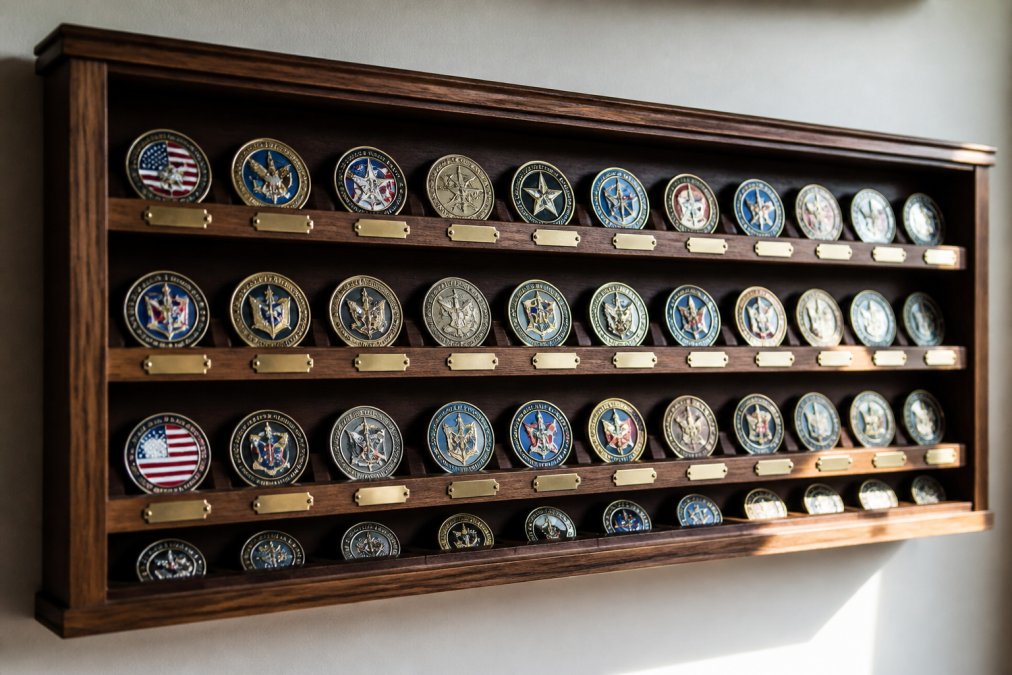
The most straightforward way to display challenge coins is through a dedicated display case. These come in two primary configurations: wall-mounted units that hang like artwork, and tabletop versions that sit on a desk, shelf, or dresser. Both styles protect your coins while making them immediately visible.
Wall-Mounted Display Cases
Wall-mounted cases are ideal when floor or desk space is limited. A good wall-mounted case features individual slots for each coin, keeping them separated and preventing them from rubbing against each other. Many include small engraving plates beneath each slot where you can label the coin's origin, date, or significance.
Material matters significantly. Wood cases offer a classic, warm aesthetic that complements most room décor. Glass fronts protect coins from dust while allowing full visibility. Metal frames provide durability and a modern look. When selecting a wall-mounted case, verify that the mounting hardware is rated for the weight of your full collection, a loaded case of 20+ coins can become surprisingly heavy.
Installation requires minimal effort. You'll need to find studs in your wall or use heavy-duty anchors. Measure the height carefully; most collectors prefer mounting cases at eye level so viewers don't have to crane their necks to see the coins clearly.
Desk and Tabletop Racks
Tabletop racks work well if you want to display coins in a shared living space, office, or bedroom where wall space isn't ideal. These stands sit on any flat surface and can be moved easily if you rearrange your room. Many tabletop racks feature rotating designs, allowing you to spin the entire unit to view coins from different angles.
Tabletop racks typically accommodate 12 to 30 coins depending on the design, making them perfect for displaying your most prized or recently acquired coins while keeping the rest in secure storage. The advantage is flexibility, you can move the display to show guests or relocate it if your living situation changes. The downside is that tabletop displays take up valuable surface real estate and are more vulnerable to accidental tipping.
Floating Frames and Shadow Boxes for Military Memorabilia
Floating frames and shadow boxes offer an elegant alternative to traditional display cases. These methods work particularly well if you want to combine challenge coins with other military memorabilia, medals, ribbons, insignia, or photographs, in a single unified display.
A floating frame suspends your coin behind glass or acrylic, creating the illusion that the coin is hovering within the frame. Shadow boxes provide deeper space, allowing you to layer multiple items and tell a more complete story of your service.
Both methods offer excellent UV protection when you choose frames with UV-blocking glass or acrylic. This prevents the coin's finish from fading over time, particularly important for coins with colorful enamel or special coatings. The frame also seals out dust and moisture, creating a stable environment for long-term preservation.
Installation is straightforward, most floating frames and shadow boxes come with standard picture-hanging hardware. You can arrange them individually or create a gallery wall with multiple frames, each showcasing a different coin or memory.
Building a DIY Challenge Coin Rack
For those who enjoy woodworking or want a more personalized display solution, building your own challenge coin rack is entirely feasible. A handcrafted wooden rack adds character and allows you to customize the design to match your coins' specific dimensions and your room's aesthetic.
Materials and Tools You'll Need
A basic DIY challenge coin rack requires minimal materials. Start with a piece of solid wood, walnut, oak, or cherry work beautifully, roughly 1 inch thick, 12 inches wide, and 18 inches tall. You'll also need wood stain or finish (polyurethane, wax, or oil), sandpaper (120-grit and 220-grit), and wood glue. For the coin slots, you'll need a drill with a spade bit or Forstner bit sized to match your coins' diameter. Most challenge coins are 1.5 inches in diameter, so a 1.5-inch bit is standard (defense.gov).
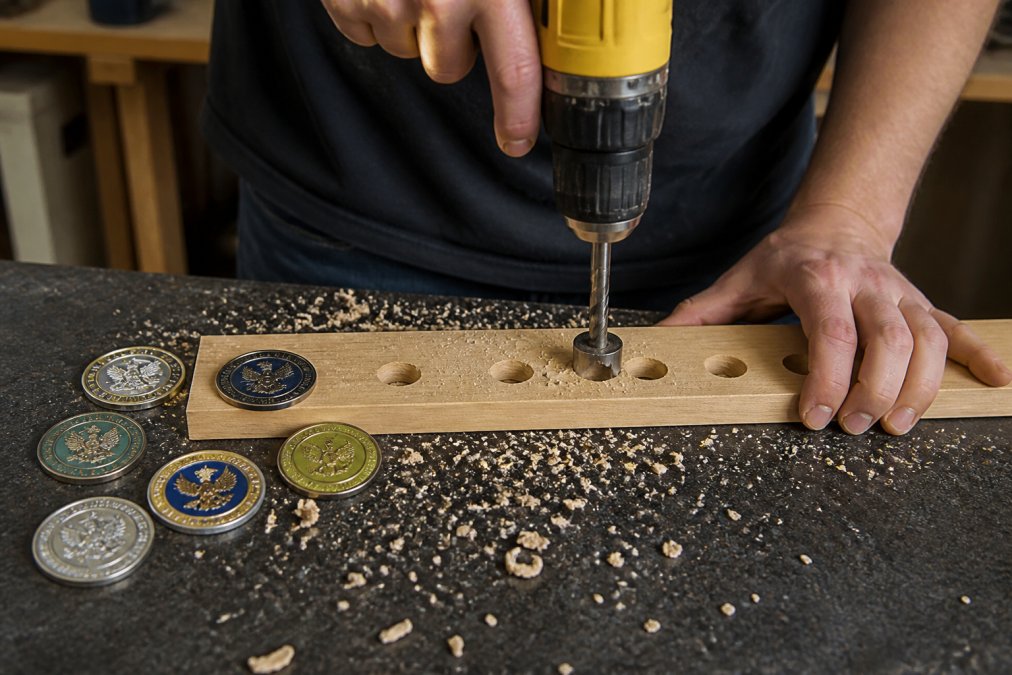
Optional additions include brass corner brackets for reinforcement, felt or cork backing to protect the wood from wall damage, and engraving plates or small brass labels for identifying each coin.
Step-by-Step Construction
Step 1: Design Your Layout Sketch your design on paper first. Decide how many coins you want to display and arrange the holes in rows. A common approach is three rows of five coins, creating a 15-coin display. Space holes 2 inches apart horizontally and 3 inches apart vertically to prevent the wood between holes from becoming too thin.
Step 2: Mark Hole Positions Transfer your design to the wood using a pencil and ruler. Mark the center point of each hole carefully. Misaligned holes will make your rack look amateurish and may cause coins to sit unevenly.
Step 3: Drill the Holes Secure your wood to a workbench using clamps. Drill slowly and steadily, using a backing board underneath to prevent splintering on the back side. Drill to a depth of about 0.75 inches, deep enough to hold the coin securely without drilling completely through the wood.
Step 4: Sand and Finish Sand the entire piece, starting with 120-grit sandpaper and finishing with 220-grit for a smooth surface. Round over the edges slightly to prevent splinters. Apply your chosen finish, stain followed by polyurethane creates a durable, professional look. plastic card stands.
Step 5: Add Hardware If using corner brackets, install them on the back for reinforcement. Attach mounting hardware appropriate for your wall type. If concerned about wall damage, add felt pads to the back corners.
Step 6: Mount and Display Hang your rack securely, ensuring it's level. Insert coins gently into the holes, tilting them slightly if needed. Some builders add small felt pads inside the holes to cushion the coins and prevent them from sliding out.
A well-constructed DIY rack becomes a conversation piece. The time investment, typically 4 to 6 hours for a beginner, pays dividends in both functionality and pride of ownership.
Military Challenge Coin Etiquette and Display Respect
Understanding military challenge coin etiquette ensures your display honors the traditions behind these commemorative pieces. Challenge coins carry ceremonial weight within military culture, and how you present them reflects your respect for that tradition.
The primary rule is straightforward: never display a challenge coin carelessly or casually. These aren't trinkets or souvenirs. They represent unit cohesion, achievement, and membership in a select group. A displayed coin should be positioned prominently and protected from damage.
When displaying coins from multiple service branches, maintain visual separation if possible. Coins from your own branch or unit deserve prominent placement. If you've received coins from other units or branches during your service, honor that exchange by including them in your display but perhaps in a secondary position.
Displaying a challenge coin in your home is a form of storytelling. Visitors, especially fellow service members, will recognize the significance immediately. The placement, the care taken in presentation, and the inclusion of context all communicate respect for military service and unit pride.
Coin Preservation and Maintenance for Long-Term Display
Protecting your challenge coins from environmental damage ensures they remain vibrant and legible for decades. The primary threats are oxidation, fading, dust accumulation, and physical damage.
Oxidation is the most common issue. Challenge coins are typically made from brass, copper, nickel, or zinc alloy (defense.gov). These metals naturally oxidize when exposed to air and moisture, developing a dull patina or greenish tarnish. To prevent oxidation, minimize exposure to humidity. Display cases with sealed fronts protect coins far better than open racks.
UV light fades enamel work and special finishes over time. If your coins feature colorful enamel details or gold plating, position your display away from direct sunlight. Floating frames and shadow boxes with UV-blocking glass provide excellent protection.
Dust accumulation is inevitable but manageable. A sealed display case eliminates this problem entirely. For open displays, wipe coins gently every few months using a soft, lint-free cloth. Never use abrasive materials or harsh cleaning solutions. If a coin develops heavy tarnish, consult a professional conservator rather than attempting to clean it yourself.
Handle coins minimally and always by their edges, never touching the face or back. Oils from your skin can accelerate oxidation and leave visible fingerprints.
Displaying Coins of Varying Thicknesses and Sizes
Challenge coins come in various sizes and thicknesses, creating a practical challenge for display. Standard challenge coins are 1.5 inches in diameter and 0.1 to 0.2 inches thick, but variations exist (defense.gov).
If your collection includes coins of varying sizes, custom display cases are your best option. Many manufacturers offer cases with adjustable dividers or multiple slot sizes to accommodate different coin dimensions. Alternatively, shadow boxes or floating frames allow you to position each coin individually, adjusting depth and spacing as needed.
DIY racks can be modified to handle size variations. Instead of uniform holes, drill different-sized holes in different sections of your rack. This approach requires more planning but results in a display that accommodates your actual collection.
Security and Insurance for Your Collection
As your collection grows in size and sentimental value, security becomes a legitimate concern. Challenge coins can be valuable, rare or historically significant coins may be worth hundreds of dollars each. More importantly, they're irreplaceable from a personal perspective.
For valuable collections, consider a lockable display case. These feature glass fronts for visibility but lock to prevent unauthorized access. Wall-mounted lockable cases are particularly effective because they're difficult to remove from the wall without obvious damage.
Photographing your collection serves multiple purposes. Document each coin with a clear photo showing both sides, any engraving plates, and identifying information. Store these photos digitally and in a separate physical location. This documentation is invaluable if coins are lost, stolen, or damaged.
Check your homeowner's or renter's insurance policy. Most standard policies include personal property coverage, but high-value collections may require a rider or separate policy. Contact your insurance agent with details about your collection's total value.
For exceptionally valuable coins or collections with significant historical importance, consider professional appraisal. A certified appraiser can document the collection's value and condition, providing documentation for insurance and estate planning purposes.
Displaying challenge coins thoughtfully transforms a collection from personal memorabilia into a meaningful tribute to service and achievement. Whether you choose a commercial display case, a handcrafted wooden rack, or a shadow box arrangement, the key is intentionality. US Troop Gear, Inc. offers officially licensed challenge coin slate plaques like the USS Nimitz CVN-68 Slate Plaque and USS Theodore Roosevelt CVN-71 Slate Plaque, each featuring laser-engraved Navy designs on 12" x 6" black slate, a professional display solution that honors naval service with lasting quality. Proper preservation ensures your collection remains vibrant and protected for years to come, while thoughtful security protects both the coins and your peace of mind.


Frequently Asked Questions
Q: What is the proper etiquette for displaying challenge coins?
A: Challenge coins earned through military service deserve respectful display. Keep coins clean and free from damage, display them in a prominent location that shows honor for the achievement they represent, and avoid casual handling. When presenting coins to others or receiving them, use both hands and acknowledge the significance of the moment. Never treat challenge coins as ordinary collectibles, they represent unit pride, service, and sacrifice. Displaying them properly shows respect for the military memorabilia and those who earned them.
Q: How do you organize a large challenge coin collection?
A: Start by grouping coins by branch of service, unit, or chronological order of acquisition. Use a display case or shadow box that accommodates your total count, leaving room for future additions. Consider using engraving plates beneath each coin to identify the unit, ship, or commemoration. For coins of varying thicknesses, use adjustable stands or custom-drilled wooden racks that provide individual slots. Label your collection systematically so you can locate specific coins easily. This organizational approach protects your collectible while making your display arrangement visually coherent.
Q: What materials work best for a DIY challenge coin rack?
A: Wood is the most popular choice for handcrafted racks because it's durable, customizable, and honors the military tradition. Use hardwoods like oak or walnut for longevity. Drill individual holes sized to fit your coins snugly, or create slots with wood strips. Acrylic stands work well for smaller displays and protect coins from dust. For shadow boxes, use acid-free backing and UV-protective glass to shield coins from light damage. Avoid materials that corrode or tarnish, such as untreated metal. Quality materials ensure your display will last decades while keeping coins in pristine condition.
Q: How do you preserve challenge coins on display?
A: Keep coins away from direct sunlight, humidity, and temperature fluctuations. Display them in a case with UV protection to prevent fading of any enamel or paint. Dust coins gently with a soft cloth periodically, avoid harsh cleaners that can damage finishes or engravings. Store coins in individual slots or compartments so they don't rub against each other. For coins with enamel details, ensure the display case maintains stable humidity below 50%. If your collection includes coins of varying thicknesses, provide adequate spacing to prevent pressure damage. Regular inspection helps catch any environmental issues early.
This article was written using GrandRanker