

Why Military Challenge Coins Vary in Price
Table of Contents
- What Determines Challenge Coin Pricing
- Custom Challenge Coin Cost Factors Explained
- How Quantity Breaks Impact Unit Price
- Size, Dimension, and Production Lead Time
- High Quality Veteran Gift Ideas and Secondary Market Value
- Commemorative vs. Promotional Coins
- Sustainability and Eco-Friendly Manufacturing
- Conclusion
Last Updated: August 26, 2026
What Determines Challenge Coin Pricing
Military challenge coins aren't mass-produced commodities. Every element, from the metal itself to the intricate details etched into the surface, carries a cost. Understanding why military challenge coins vary in price requires looking at the actual manufacturing process, not just the final product.
The price you pay reflects decisions made long before the coin reaches your hands. A commemorative coin honoring a specific unit costs more than a generic promotional token. A hand-finished piece with antique patina costs more than one with a simple polished finish. The factors that determine challenge coin pricing fall into distinct categories: materials, design complexity, production volume, and manufacturing specifications.
Custom Challenge Coin Cost Factors Explained
The price of a custom challenge coin depends on decisions you make about what the coin should be and how it should be made.

Material Selection and Metal Finishes
The base metal you choose sets the foundation for the entire price. Zinc alloy is the most economical option for bulk manufacturing. Brass costs more but offers better durability for coins that will be handled frequently. Copper blends fall between the two.
The finish applied to the base metal adds another layer of cost. A simple polished finish requires basic buffing. An antique finish demands chemical treatment and hand-finishing work. Plating, whether gold, silver, or nickel, adds material cost and processing time. A hand-applied antique patina requires skilled labor and monitoring during the chemical process to achieve the right depth of color.
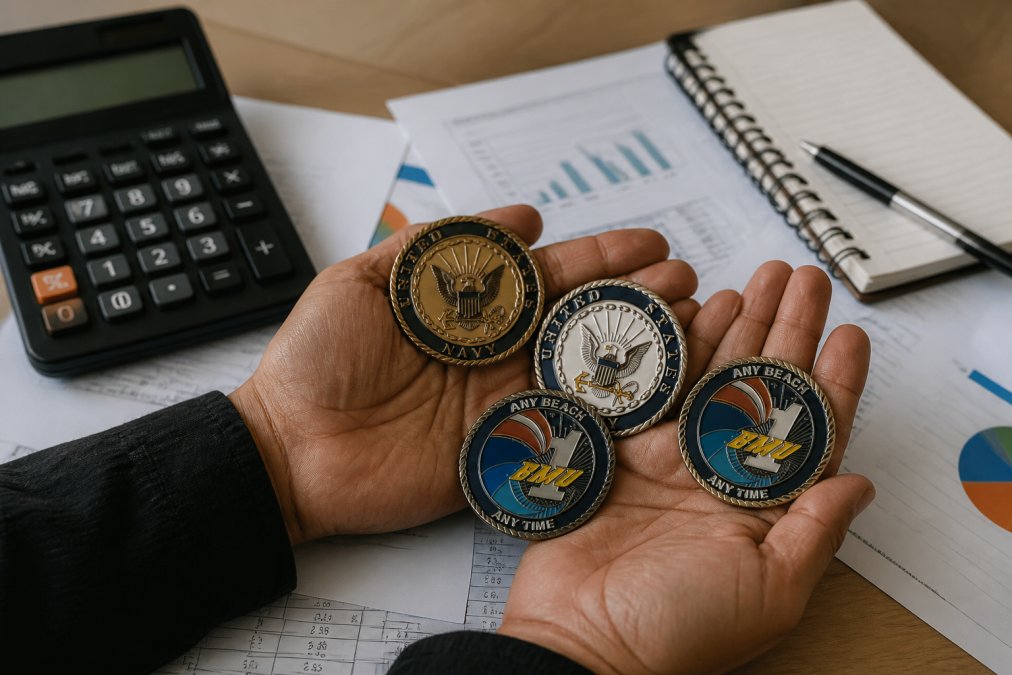
Design Complexity and Engraving
The artwork on your coin drives manufacturing complexity. A simple design with minimal detail requires straightforward die creation. A highly detailed design with multiple layers, 3D relief work, and intricate edge detailing demands significantly more skilled die-making.
The depth of relief affects both die cost and per-unit production cost. Shallow relief is cheaper to produce. Medium relief is standard. High 3D relief requires more sophisticated die work and longer production runs to justify the die cost.
Engraving adds cost on top of the base design. Laser engraving allows personalization with names, ranks, dates, or unit numbers. Hand engraving, where a skilled craftsperson uses traditional tools, costs more but produces results that machine engraving cannot match.
Enamel work is a significant cost driver. Soft enamel is applied and cures at room temperature. Hard enamel is baked at high temperature, creating a more durable, glass-like finish. Hard enamel coins cost more per unit but resist wear better and maintain their appearance longer.
Die and Mold Fees
A custom die is a precision tool, typically made from hardened steel, that stamps the design into the blank coin. Creating a die requires a skilled die-maker to translate your artwork into a three-dimensional cutting tool. A simple design might require a few hours of work. A highly detailed design can require days.
The die fee is a one-time cost paid up front. This is why small orders (under 100 coins) rarely make economic sense, the die cost gets spread across so few units that the per-coin cost becomes prohibitive. This is also why manufacturers offer quantity breaks. At 500 coins, the die cost represents a smaller percentage of your total investment. At 5,000 coins, it becomes almost negligible on a per-unit basis.
Understanding whether a quote includes the die fee or charges it separately is critical to comparing prices across manufacturers.
How Quantity Breaks Impact Unit Price
Volume changes everything about challenge coin pricing. The relationship between quantity and unit price is tiered, with dramatic drops at certain volume thresholds.
At 100 coins, your unit price is high because manufacturing costs are spread thinly and the die cost looms large. At 500 coins, the unit price drops significantly. At 1,000 coins, you see another drop. At 5,000 coins, the unit price approaches the manufacturer's true production cost plus margin.
A manufacturer running 5,000 coins can set up production once and run continuously, minimizing setup time. A manufacturer running 100 coins has the same setup costs but spreads them across far fewer units. The labor cost per coin is higher. The material waste is proportionally higher.
Size, Dimension, and Production Lead Time
The physical dimensions of your coin affect both die cost and per-unit production cost. Larger coins require larger dies and more material per coin. A 1.5-inch coin costs less to produce than a 2-inch coin.
Standard sizes that manufacturers produce frequently (1.5 inches, 1.75 inches, 2 inches) have lower costs than unusual sizes because the dies already exist or tooling is optimized. Custom sizes require custom dies, which adds to the die cost.
Edge detailing adds cost proportional to complexity. A plain edge is cheapest. A reeded edge (fine vertical lines) requires additional tooling. A custom edge design requires specialized dies and skilled production.
Production lead time affects pricing significantly. Standard production timelines (4-6 weeks) allow manufacturers to schedule your order into their regular production run (sba.gov). Rush orders (2-3 weeks) typically incur a rush fee. Expedited orders (1 week or less) demand premium rates. Rushing through production steps either reduces quality or increases labor costs.
High Quality Veteran Gift Ideas and Secondary Market Value
Challenge coins have evolved beyond military use into a broader collecting culture. Understanding the secondary market helps explain why some coins command higher prices than others.
A commemorative coin issued by a specific unit, ship, or military organization often develops value beyond its production cost. Collectors seek officially licensed coins from their own service branch, their specific unit, or historically significant military moments. The Department of Defense heritage and tradition resources emphasize the importance of authentic, officially sanctioned commemorative items in preserving military history.
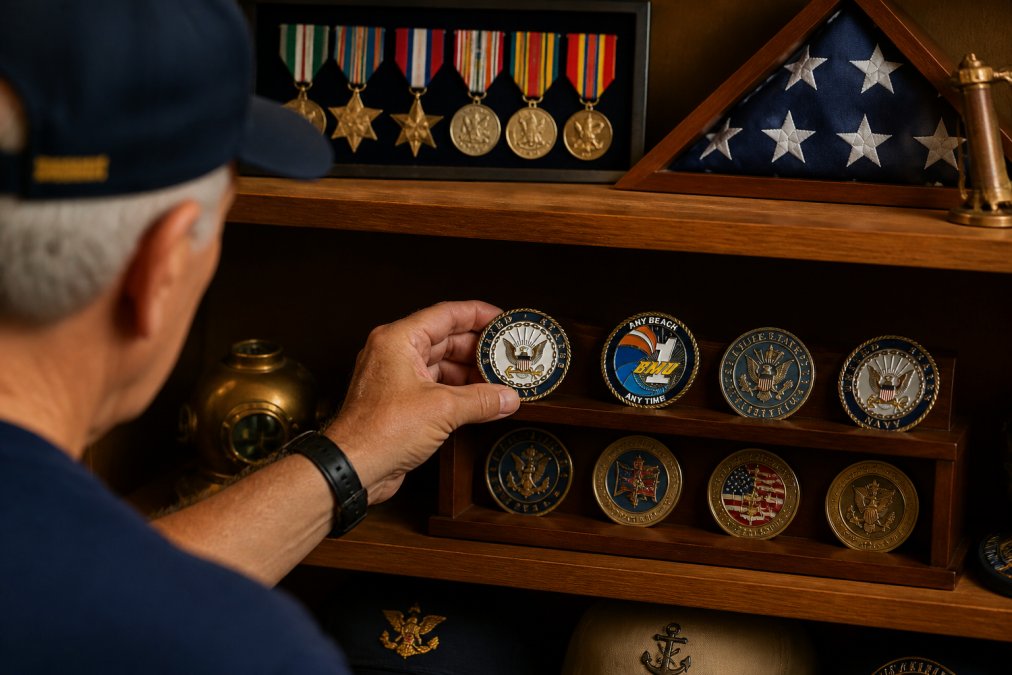
US Troop Gear, Inc. carries officially licensed coins like the Beachmaster Unit 1 Challenge Coin (available in both Enlisted and Officer versions) that honor specific naval traditions. These coins carry the Department of the Navy license, meaning royalties support the Navy's Morale, Wellness and Recreation program. That official status matters to collectors and service members, it's not just a coin, it's a piece of authenticated military heritage.
The secondary market values coins based on rarity, condition, authenticity, and historical significance. A coin minted 30 years ago in limited quantities might be worth significantly more than a new coin of similar production quality. When choosing a high-quality veteran gift, selecting an officially licensed coin with historical significance ensures the recipient gets something that holds or appreciates in value.
Commemorative vs. Promotional Coins
A commemorative coin is designed to honor a specific event, unit, person, or tradition. It typically includes historically accurate imagery, official insignia, and details that matter to people who were actually part of that history. Commemorative coins are often limited-edition, making them more valuable to collectors.
A promotional coin is designed to promote an organization, event, or brand. It's often generic enough to apply to multiple organizations and is typically produced in larger quantities. Promotional coins are less likely to appreciate in secondary markets because they're common and lack specific historical significance.
The production cost difference between commemorative and promotional coins can be minimal. The price difference comes from perceived value and market demand. A commemorative coin from a specific Navy SEAL team command carries value to people who served there. A generic promotional coin has broader appeal but less intense demand.
According to military heritage preservation standards, authenticity and official licensing are critical factors in commemorative coin value. Coins that carry official military branch licensing command premium prices because they're recognized as legitimate historical artifacts.
Sustainability and Eco-Friendly Manufacturing
The manufacturing choices that affect price also affect environmental impact. Recycled zinc alloy is becoming more common as manufacturers respond to environmental concerns. The cost difference is minimal, as recycled material often costs less than virgin material.
The finishing process has environmental implications. Chemical treatments used in antique finishing require proper disposal. Manufacturers committed to reducing environmental impact invest in waste treatment systems and cleaner production methods, which increases manufacturing cost.
Some manufacturers are exploring alternative materials and processes. Biodegradable enamel formulations and water-based coatings reduce environmental impact compared to traditional solvent-based finishes. These alternatives typically cost more because they're newer technologies with smaller production volumes.
The most significant environmental impact comes from shipping and packaging. Bulk orders reduce per-unit shipping impact because coins are consolidated. Larger orders are more economical and reduce waste in the supply chain.
Conclusion
Military challenge coins vary in price because every decision about materials, design, production volume, and manufacturing specifications carries real cost. The die fee, the choice between soft and hard enamel, the complexity of 3D relief work, the metal finish, and the production lead time all compound to create the final price.
The coins US Troop Gear, Inc. carries, like the Beachmaster Unit 1 Challenge Coin and Crossing the Line Challenge Coin, are officially licensed by the Department of the Navy, with royalties supporting military morale and wellness programs. These coins combine authentic design, quality materials, and official status, making them meaningful veteran gifts that hold value. Explore US Troop Gear, Inc.'s full collection of branch-specific challenge coins and discover the piece that honors your service or commemorates your unit's legacy.


Frequently Asked Questions
What factors determine the cost of a custom challenge coin?
Challenge coin pricing depends on several interconnected factors: material choice (zinc alloy, brass, or higher-grade metals), design complexity including 3D relief and laser engraving, quantity ordered, die and mold creation fees, metal plating and finishes like antique or polished, and production lead time. Coins with intricate unit insignia and detailed edge detailing cost more than simple designs. Ordering in bulk reduces per-unit costs through economies of scale, while smaller orders face higher die fees distributed across fewer pieces.
How does the complexity of a design impact production costs for challenge coins?
Design complexity directly affects minting process costs. Intricate 3D relief work, multiple colors using soft enamel or hard enamel techniques, laser engraving, and detailed edge detailing all require more precise tooling and longer production times. Simple, flat designs with one or two colors cost significantly less. Custom artwork featuring valor symbolism or unit-specific imagery requires skilled design work before mold creation begins, adding to overall expenses. The more detailed your design, the higher your per-unit cost, especially on smaller orders.
Why do bulk orders result in lower per-unit prices for challenge coins?
Bulk manufacturing creates economies of scale. The die fee, a one-time cost for creating the mold, gets divided among more units, reducing the per-coin cost dramatically. A 500-coin order spreads the die fee across 500 pieces, while a 50-coin order spreads it across just 50. Additionally, bulk orders allow manufacturers to optimize production runs, reduce material waste, and negotiate better pricing on metals like brass or zinc alloy. This is why unit price drops significantly as quantity increases, making large commemorative orders far more cost-effective per coin.
Are military challenge coins worth money to collectors?
Yes, military challenge coins hold collectible value, though secondary market prices vary widely. Officially licensed coins like those supporting Navy MWR programs appreciate based on rarity, historical significance, unit prestige, and condition. Limited-run coins from specific ships or units command higher prices than mass-produced promotional merchandise. Collectible value differs from production cost, a coin costing $16.45 to produce might be worth $25-$50 on the secondary market if it represents a sought-after unit or has sentimental tradition attached. Condition, authenticity, and demand among collectors drive resale value.
This article was written using GrandRanker