

7 Military Gear Standards Navy Veterans Should Check
Quick Summary
High quality military gear for Navy veterans is judged by materials, construction and branch accuracy rather than flashy design. Look for heavier cotton twill, reinforced stitching, dense embroidery with correct Navy colors and insignia, and sizing checked against measurements. Each feature is easy to verify before you order.
- Structured caps use roughly 8-10 oz/yd² cotton twill, while promotional caps often use 5-6 oz/yd².
- Garment seams with 8-12 stitches per inch distribute stress better than sparse stitching under 6 per inch.
- Stitched patches hold up better than glued patches, which can curl at the edges.
- Measure chest width, body length, sleeve length and shoulder width instead of trusting size labels.
- Treat consumer apparel as a different category from rated professional tactical equipment.
Table of Contents
- What Makes Military Gear High Quality for Navy Veterans
- How to Judge Materials, Stitching and Embroidery
- Navy Veteran Hats: Choosing the Right Cap Style
- Navy Veteran Apparel and Fit: Getting Sizing Right
- Navy Ship Crest Apparel and Authentic Branch Designs
- Navy Veteran Gifts That Hold Up Over Time
- Choose Your Navy Veteran Cap and Start Shopping
- Frequently Asked Questions
What Makes Military Gear High Quality for Navy Veterans
Last Updated: October 27, 2026
High quality military gear for Navy veterans isn't about flashy designs, it's about materials, construction and branch accuracy, all easy to check once you know what to look for.
Good military gear withstands repeated wear, laundering and sun exposure, and reflects the branch's official look. Authentic Navy pieces should match standard colors and insignia, not approximations.
Here is what separates durable gear from disposable gear:
- Materials: Heavier cotton twill and reinforced stitching hold their shape longer than thin, unstructured fabrics.
- Construction: Triple-stitched bills, padded sweatbands and adjustable straps signal careful manufacturing.
- Accuracy: Branch colors, lettering and crests should match official Navy specifications.
Check product details before ordering, and favor construction features described specifically rather than generically.
How to Judge Materials, Stitching and Embroidery
Here is a verification framework you can apply to any product page or garment.
Fabric: read the weight, not the adjective
Fabric weight is expressed in ounces per square yard (oz/yd²) for wovens and grams per square meter (GSM) for knits.
Check fiber content and weave, not just the fiber name. Ring-spun cotton is smoother and stronger than open-end cotton at the same weight. A cotton-poly blend (often 60/40 or 50/50) resists shrinkage and holds color better than 100% cotton, at the cost of some breathability.
Stitching: count the seams and check the type
Stitch quality is where budget gear fails first, and it is visible if you know where to look:
- Stitch density. Dense stitching, roughly 8-12 stitches per inch on garment seams, distributes stress better than sparse stitching. For more detail, see signs of premium embroidery on military caps. Sparse stitching (under about 6 per inch) puckers and pulls out under load.
- Seam type. A flat-felled or double-needle seam is stronger and cleaner than a single-needle seam. On caps, a triple-stitched or reinforced bill holds its curve; a single row of stitching on the brim is a warning sign.
- Bar tacks. Small dense stitches at stress points, pocket corners, strap anchors, fly openings, prevent tearing. Their absence on a workwear item is a cost-cutting tell.
Embroidery: density, backing, and registration
Embroidery fails in predictable ways. High-definition embroidery uses a tight stitch count with clean edges and no fabric showing through. Loose or low-density stitching puckers, frays and lifts after washing. Check three things:
- Stitch count and density. More stitches per square inch produce sharper lettering and crest detail. Very low stitch counts on a complex crest mean the design will look muddy.
- Backing and stabilizer. A cut-away or tear-away backing behind the embroidery keeps the design from distorting. Cheap gear often skips adequate backing, so the embroidery ripples.
- Registration. On multi-color designs, colors should align cleanly with no gaps or overlaps. Misregistration is a manufacturing defect, not a style choice.
Direct embroidery is generally more durable than a sewn-on patch, which can curl at the edges. Read why embroidered military caps last longer to see how these factors play out over time. A well-made embroidered patch with tight edge stitching can outlast poor direct embroidery, but the patch must be stitched, not glued.
Hardware and findings
Zippers, snaps, buckles and grommets are where "military style" gear most often cuts corners. Look for metal zippers (YKK is the common benchmark) over plastic coils, metal snaps over plastic, and bar-tacked strap anchors. On caps, a metal buckle or quality plastic snapback adjuster outlasts a thin friction strap. If the gear will see sweat, salt air or rain, stainless or coated hardware is worth the small premium.
A practical inspection checklist
Use this whether you are reading a listing or holding the item:
- Fabric weight and fiber content are stated, not just "premium cotton"
- Seams are double-needle, flat-felled, or otherwise reinforced
- Stitch density looks tight and even (roughly 8-12 per inch)
- Bar tacks at stress points (pockets, straps, openings)
Materials and stitching also determine how a piece handles laundering. Extend its life by turning garments inside out, washing cold and air drying. For more, see our guide to How to Clean and Preserve Military Apparel.
The article's checklist of fabric, stitching and embroidery features can be scanned at a glance:
| Feature | Benchmark in the article | Why it matters |
|---|---|---|
| Structured cap fabric | 8-10 oz/yd² cotton twill | Holds crown shape better |
| Promotional cap fabric | 5-6 oz/yd² twill | Structure and durability are weaker |
| T-shirt weight | 5.5-6.5 oz/yd² | Wears longer, shrinks less |
| Garment stitch density | 8-12 stitches per inch | Distributes stress well |
| Sparse stitching | Under 6 stitches per inch | Puckers and pulls out under load |
| Thread type | Bonded nylon or polyester | Outlasts cotton thread |
| Embroidery backing | Cut-away or tear-away | Keeps design from distorting |
| Patch attachment | Stitched, not glued | Glued patches can curl at edges |
Navy Veteran Hats: Choosing the Right Cap Style
Navy veteran caps come in two main silhouettes, both available in dark navy with embroidered Navy designs, so the choice comes down to fit preference and look.
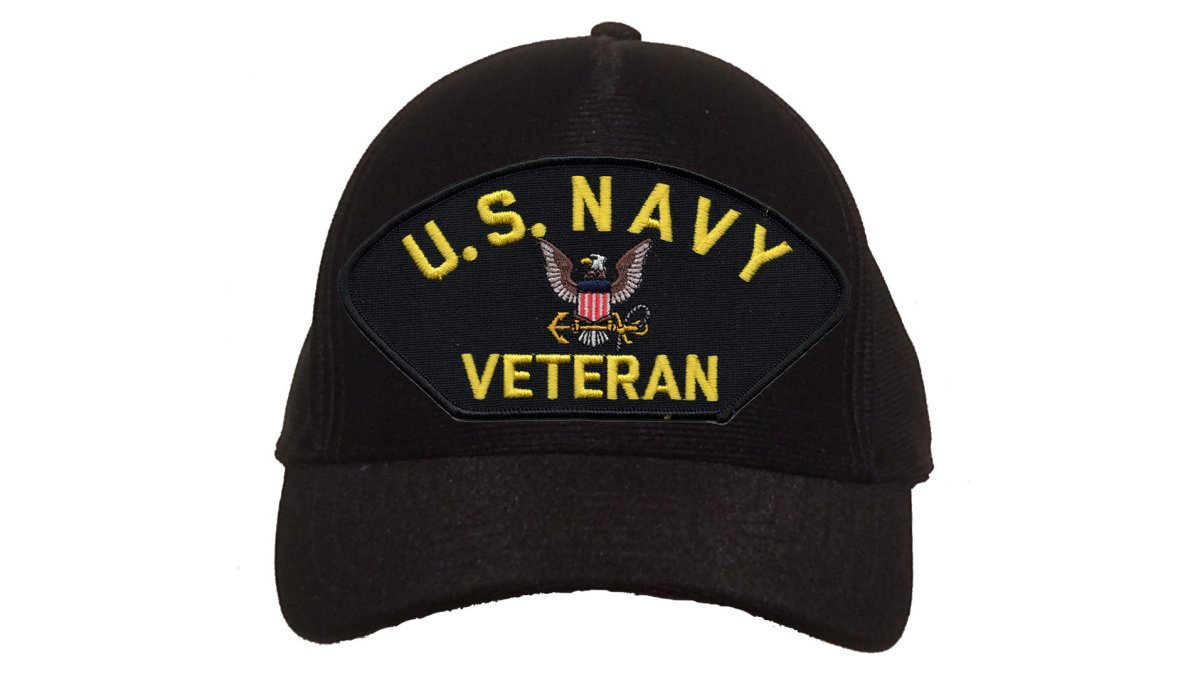
Five-Panel High Profile vs. Six-Panel Low Profile
A five-panel high profile cap sits taller with a flatter crown for a structured, bold silhouette. Our US Navy Veteran Cap comes in both styles at $31.25.

For most people, the choice comes down to these questions:
- Do you want a bolder, more structured look? Choose the five-panel high profile.
- Do you prefer a snug, low-profile fit for everyday wear? Choose the six-panel low profile.
- Do you need a cap for work or outdoor activity? Both styles work, but the low profile often sits better under a helmet or hood.
If you prefer a different colorway or embroidery style, our Navy Veteran Cap (Coyote Brown) and Navy Veteran Cap (3D Lettering) are each priced at $29.95. For a cap that acknowledges service directly, the Navy Veteran Proudly Served Cap is also $29.95.


Navy Veteran Apparel and Fit: Getting Sizing Right
Fit is the most common reason a veteran stops wearing a piece of gear, and the hardest thing to judge from a photo. Treat sizing as a measurement problem, not a label problem, and account for how Navy uniforms and body proportions have changed over the decades.
Measure, don't guess
Before you order, measure a shirt or jacket you already own that fits the way you want, then compare those numbers against the product's size chart. Focus on four measurements:
- Chest width (pit-to-pit, measured flat, doubled)
- Body length (from high point of shoulder to hem)
- Sleeve length (from shoulder seam to cuff, or center-back to cuff for raglan cuts)
- Shoulder width (seam to seam across the back)
Brands vary more in these numbers than in their size labels, a "Large" from one maker can match a "Medium" from another. If a listing lacks a size chart with at least chest and body length, look elsewhere or contact the seller before ordering.
Why your old uniform size may not translate
Navy uniform cuts and sizing have changed across eras. A size that fit decades ago may not match modern apparel because grading (how a brand scales a pattern) differs and today's cuts sit differently than older issue garments. Treat your old size as a hypothesis, not a guarantee, and measure again. Between sizes, size up for outerwear and down for base layers.
Fit by use case
Fit should follow function:
- Everyday wear. A relaxed fit is comfortable and forgiving. A cap or tee that sits slightly loose breathes better in warm weather.
- Layering. A jacket worn over a sweatshirt or fleece needs roughly one size of extra room in the chest and shoulders. If you plan to layer, size up or choose a cut described as roomy.
- Physical activity. Gear for working out or working outdoors should fit closer without restricting range of motion. Check that the sleeve and shoulder allow you to reach overhead without the hem lifting past your waist.
- Climate. In hot, humid conditions, breathability and a looser fit matter more than insulation. In cold weather, layering room and a wind-resistant shell matter more than a slim cut.
Headwear fit
Cap sizing is simpler but still worth checking. A one-size-fits-most cap with an adjustable strap typically fits roughly 21.5-24 inches in circumference. Near the top of that range, look for a generous adjuster or a fitted option. A padded sweatband improves comfort and helps the cap hold its shape.
Use-case and safety boundaries
It helps to separate three categories, because they carry different expectations:
- Veteran apparel and everyday gear, caps, tees, hoodies, and jackets meant for casual wear. Quality here is about construction, fit, and accurate branch design.
- Outdoor and workwear, items meant for hiking, yard work, or job sites. Look for abrasion resistance, weather resistance, and reinforced stress points.
- Professional tactical equipment, duty belts, armor carriers, and load-bearing gear. This category involves safety standards and training requirements, and it is not the same as apparel. If you need professional tactical equipment, buy from a supplier that specifies standards and ratings, and get training on its use. Do not treat consumer apparel as a substitute for rated safety equipment.
Try it before you commit
Getting fit right the first time saves the cost and hassle of returns, and it is the difference between gear that sits in a drawer and gear you reach for daily.
Navy Ship Crest Apparel and Authentic Branch Designs
The USS South Carolina ship crest cap is one example of a vessel-specific design. You can find it here: USS South Carolina CGN 37 Ship Crest Cap. Before buying any ship-specific item, confirm the design matches the commissioning period and crest you know, since some vessels have carried more than one design over their service lives.
Authentic branch designs follow official colors and insignia. When comparing options, look for descriptions that name the branch and design element specifically, rather than generic "military style" wording.
Navy Veteran Gifts That Hold Up Over Time
Gifts for a Navy veteran are most meaningful when practical. A quality cap or shirt works as an everyday reminder of service, while durable items suit longer-term display or use.
Consider the recipient's preferred style and whether they already own similar items; matching branch and service details to their history shows real attention. For more ideas, read our guide to unique gifts for veterans.
Choose Your Navy Veteran Cap and Start Shopping
The right choice comes down to matching construction, fit and design to how you'll wear the gear. Start with a cap or shirt built from quality materials, check the embroidery and stitching, and confirm sizing before ordering. Our US Navy Veteran Cap is a solid starting point at $31.25 in either the five-panel high profile or six-panel low profile style, proudly made in the USA and fully licensed by the Navy.
Frequently Asked Questions
What should Navy veterans look for in high-quality military gear?
For the US Navy Veteran Cap, the listing states that it is made in the USA and fully licensed by the Navy, and that it is available in either 5 panel high profile or 6 panel low profile styles. Compare the details stated in product listings.
How can you tell whether military-themed apparel is durable?
The Navy Veteran Cap (Coyote Brown) listing describes a high-definition design directly embroidered onto a cotton twill cap, with a fully adjustable embroidered strap, padded sweat band, triple stitched bill and reinforced vent holes. The Navy Veteran Cap (3D Lettering) listing describes the same features.
What is the difference between Navy veteran gear and official Navy apparel?
The US Navy Veteran Cap is fully licensed by the Navy and made in the USA.
U.S. Navy official website for branch insignia and history
Department of Defense guidance on wearing of uniforms and insignia
National Archives reference on Navy ship histories and commissioning records
