

7 Stages in the History of the M65 Field Jacket Design
Last Updated: November 24, 2026
Quick Summary
The M65 field jacket design evolved over four decades of Army field uniform development, starting with the M-1941 jacket and moving through the M-43 and M-51 before the M-1965 standardized the pattern we recognize today. Each earlier model solved a specific field failure, and the M65 inherited those fixes in one garment.
- The M-1941 was the Army's first purpose-built field jacket, replacing a short wool combat jacket.
- The M-43 added a longer hip-length cut, a detachable hood, and room to layer a sweater underneath.
- The M-51 moved to a denser cotton sateen and settled the zipper-with-snap-placket closure.
- The 1965 adoption added a stowaway hood, a button-in liner, and a higher wind-sealing collar.
- Date an original by reading the label, contract number, and stock number together, not by color or cut.
Table of Contents
- How did the M65 field jacket design evolve from earlier Army jackets?
- Origins: The M-1941 and the First Field Jacket
- The M-43 and M-51: Building Toward the M65
- M-65 field jacket vs. M-51: What Changed in 1965
- M-65 jacket design features that defined the standard-issue jacket
- The original M-65 field jacket: materials, liners, and construction
- How to date an M-65 field jacket by label and contract details
- Shop M-65-Inspired Gear at US Troop Gear, Inc.
- Frequently Asked Questions
How did the M65 field jacket design evolve from earlier Army jackets?
The M65 field jacket design evolved through four decades of Army field uniform development, starting with the M-1941 jacket and moving through the M-43 and M-51 before the M-1965 standardized the pattern we recognize today. Each earlier model solved a specific failure in the field, and the M65 inherited those fixes in one garment.
The M65 field jacket is one of the most frequently asked-about pieces of military heritage gear. The questions are always the same: what makes it different, how do I spot an original, and why does the pattern matter.
This guide walks the full arc, from the first standardized field jacket to the contract labels collectors use to date a piece. Below, we break down what changed at each stage and what to look for on a real jacket.
Origins: The M-1941 and the First Field Jacket
The M-1941 was the Army's first purpose-built field jacket, replacing the short wool combat jacket that offered almost no weather protection. It introduced the waist-length cut and the general pocket layout that every later model refined.
Its weaknesses showed up fast. The cotton poplin shell absorbed water, the lining was thin for cold weather, and the jacket was never designed to layer over a sweater. Soldiers in the field wanted warmth and wind resistance in one garment, and the M-1941 delivered neither reliably.
That gap drove the next two redesigns.
The M-43 and M-51: Building Toward the M65
The M-43 and M-51 are the two intermediate steps that made the M65 possible, and the design changes between them are specific enough to date and identify. Most retellings blur them together; separating the dates of development, standardization, and production is what resolves the conflicting timelines you see in collector guides.
The M-43 field jacket was standardized during World War II as a replacement for the M-1941.
The M-51, standardized in the early 1950s, is the direct parent of the M65. Its changes were incremental but consequential:
- Shell fabric. The M-51 moved to a denser cotton sateen (often described as a wind-resistant poplin), a tighter weave that shed more wind than the M-43's poplin. It was still cotton, so it still wet out in sustained rain.
- Fit and silhouette. The M-51 tightened the fit relative to the M-43 and shortened the body slightly, producing the straight, four-pocket silhouette that the M65 inherited almost unchanged.
- Closure. The front closure settled into the zipper-with-snap-placket arrangement that carried forward to the M65.
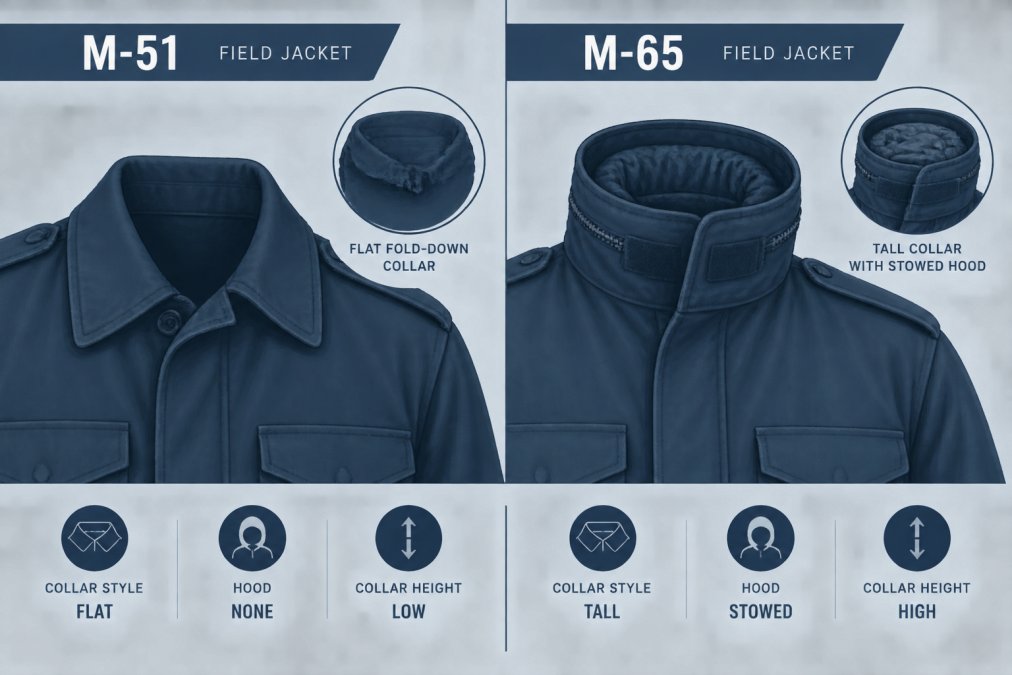
- Collar. The M-51 collar was a conventional fold-down style. It did not seal at the throat, which is the single biggest functional difference a wearer notices against the M65.
- Liner. The M-51 introduced a button-in liner concept, but it was not standardized across all production the way the M65 liner later was.
A practical way to tell an M-51 from an M-65 at a glance, without reading labels: look at the collar. The M-51 has a flat fold-down collar with no hood stowed inside it. The M65 collar is taller and bulkier because it contains the stowaway hood.
What the M-51 still lacked was a fully sorted cold-weather layering system and a collar that sealed against wind. Those two gaps, not the shell fabric, are what the M65 program set out to close.
M-65 field jacket vs. M-51: What Changed in 1965
The M-65 field jacket vs. M-51 comparison comes down to three changes: a stowaway hood in the collar, a button-in liner that made the jacket a true layering system, and a revised collar that closed higher against wind and rain.
The 1965 adoption also standardized the nylon-cotton sateen shell, a blend that resisted wind and shed light rain far better than the M-51's cotton. The four-pocket design stayed, but the chest pockets gained angled openings for easier access while wearing gloves.
| Feature | M-51 | M-65 |
|---|---|---|
| Shell fabric | Cotton | Nylon-cotton sateen |
| Hood | Detached | Stowaway in collar |
| Liner | Not standardized | Button-in removable liner |
| Collar | Standard | Higher, wind-sealing |
| Closure | Zipper and snaps | Zipper with storm flap |
M-65 jacket design features that defined the standard-issue jacket
The M-65 jacket design features that made it standard-issue are functional, not decorative: a four-pocket front, a zipper hidden behind a storm flap, hook-and-loop cuff adjusters, a drawcord waist, and a stowaway hood folded into the collar.
Every one of those details exists to solve a field problem. The storm flap keeps rain out of the zipper. The waist drawcord traps warmth without a belt. The angled chest pockets let a soldier reach in with gloves on. What most guides miss is that the cuffs adjust with hook-and-loop rather than buttons, a change that cut snagging on gear.
The military fashion influence on streetwear traces how these same details moved from the field into civilian wardrobes.
The original M-65 field jacket: materials, liners, and construction
An original M-65 field jacket uses a nylon-cotton sateen shell, a removable button-in liner, and bar-tacked stress points at the pockets and placket. The sateen weave gives the fabric its slight sheen and its wind resistance.
The liner is the part buyers underestimate. Early liners were a quilted polyester fill; later versions varied in weight and attachment style. A jacket sold without its liner is a shell, not the full cold-weather garment.
Construction quality shows at the seams. Look for even stitching at the pocket corners, a placket that lies flat, and a collar that holds its shape. If you own an original with seam damage, our guide on how to repair tactical gear seams covers the field fix. For buyers weighing vintage pieces, whether vintage Air Force flight jackets are worth money offers a useful parallel on value and condition.
How to date an M-65 field jacket by label and contract details
You date an M-65 field jacket by reading the label, the contract number, and the stock number together, not by guessing from color or cut. This is the section most guides skip, and it is where a real identification guide earns its keep. The method below separates development, standardization, production, and later revisions so you are not relying on a single date.
Work through it in this order:
- Find the label. It sits inside the collar or at the back neck. If it is missing, dating becomes guesswork, and a jacket with no label should be priced as a reproduction or a stripped original.
- Read the contract code. The contract number is the strongest single clue. It typically combines a procurement prefix with a year segment, and the year segment points to the procurement period rather than the date the jacket was worn. Compare the code against known production records rather than assuming the year in the code is the year of manufacture.
- Check the stock number. The stock number format changed over the decades. Earlier jackets carry a stock number in the older format; later ones use the National Stock Number (NSN) structure, a 13-digit number broken into a 4-digit federal supply class, a 2-digit national codification bureau code, and a 7-digit item number. The shift in format is itself a dating clue.
- Inspect the liner attachment. Button placement and liner style shifted between production runs. A liner that does not match the jacket's button pattern is either a later replacement or a sign the jacket has been assembled from parts.
- Match the hardware. Zipper brand and pull style, snap finish, and hook-and-loop style all changed over time. Hardware that does not match the label era is a red flag.
- Check the shell and lining. The nylon-cotton sateen shell and the lining material varied across production, and later civilian reproductions often use a different blend or a lighter sateen.
A common pattern with reproductions is a jacket that copies the outer pattern faithfully but gets the label and hardware wrong. A perfect-looking jacket with a mismatched contract code or a stock number in the wrong format is a reproduction, and that matters if you are paying original prices.
Treat the label as a window, not a precise date, and cross-check it against the hardware and liner before you commit.
If you own an original with seam damage, our guide on how to repair tactical gear seams covers the field fix. For buyers weighing vintage pieces, whether vintage Air Force flight jackets are worth money offers a useful parallel on value and condition.
Shop M-65-Inspired Gear at US Troop Gear, Inc.
The M65 field jacket earned its place through decades of field-driven fixes, and that heritage is why it still resonates with service members and collectors today.
If you want gear that carries that same respect for military history, US Troop Gear, Inc. stocks branch-specific apparel and embroidered caps built for people who served and the families who stand behind them. Our full collection includes respectful designs across the Army, Navy, Air Force, Marine Corps, and Coast Guard, plus challenge coins and ship crests for collectors.
Start with the pieces that speak to your branch and wear your pride with purpose.
The history is worth knowing, but the gear you wear should live up to it. US Troop Gear, Inc. builds military-themed apparel and embroidered caps with the same attention to detail the M65 earned in the field, from branch-specific designs to hard-to-find ship crests. Browse the collection and find the piece that represents your service.
Frequently Asked Questions
How can you tell how old an M-65 jacket is?
Check the label inside the collar or side seam. Original M-65 field jackets carry a military specification number (starting with MIL-J) and a contract number with a two-digit year code. The DSA or DLA prefix on the contract label also narrows the production era. Zipper brand, liner buttons, and fabric content on the label add further clues. Reproduction jackets often omit contract numbers entirely.
What are the main design features of an original M-65 field jacket?
The original M-65 field jacket has four front pockets with snap flaps, a full-length zipper covered by a storm flap with snap fasteners, an adjustable drawcord at the waist, and hook-and-loop cuffs. The collar holds a stowaway hood that rolls into a zippered compartment. A button-in liner adds cold-weather insulation. The shell is a cotton-nylon blend treated to resist wind and light rain. These M-65 jacket design features stayed largely consistent across production runs, which makes the jacket easy to identify.
When did the M-65 become standard issue?
The M-65 entered the Army supply system in 1965 as the replacement for the M-51 field jacket. It reached widespread issue during the Vietnam War and remained standard-issue cold-weather outerwear for decades. The design proved adaptable enough that later contracts updated fabrics and closures without changing the overall pattern. Collectors often use the contract year on the label to confirm whether a jacket falls into the early standard-issue period or a later production run.
Why is the M-65 jacket so popular today?
The M-65 moved from field uniform to civilian wardrobe because its functional design works off the battlefield. The four-pocket layout, waist drawcord, and removable liner suit everyday wear, and the olive drab and woodland camouflage patterns carry military heritage. Surplus jackets became widely available after service life ended, and the jacket appeared in films and music scenes that spread its reputation. Veterans and collectors value original contract pieces, while modern reproductions keep the silhouette available.
