

How to Properly Clean and Care for Tactical Uniforms
Last Updated: November 2, 2026
Quick Summary
To properly clean and care for tactical uniforms, read the care label first, then remove patches and detachable components, shake off loose dirt, and pre-treat stains. Wash in cold water on a gentle cycle with a mild, clear detergent, and air dry or use only low heat.
- Remove patches, name tapes, and hard inserts before washing, and close every zipper and fastener.
- Never combine cleaning chemicals, and never put a stained item in the dryer because heat sets stains.
- Use a mild, clear detergent without bleach, fabric softener, or optical brighteners, and never exceed the recommended amount.
- Wash uniforms separately from towels and heavy denim, avoid overloading the drum, and turn items inside out.
- Air dry in the shade, or use the lowest heat setting and remove items while slightly damp.
Table of Contents
- Read the Care Label Before Anything Else
- Step 1: Strip Patches, Accessories, and Detachable Components
- Step 2: Shake Off Loose Dirt and Pre-Treat Stains
- Step 3: Choose the Best Laundry Detergent for Military Uniforms
- Step 4: Wash in Cold Water on a Gentle Cycle
- Tactical Clothing Drying Instructions: Air Dry or Low Heat Only
- Inspect, Repair, and Store Your Tactical Uniforms
- Shop Durable Gear Built to Serve at US Troop Gear
- Frequently Asked Questions
Read the Care Label Before Anything Else
Learning how to properly clean and care for tactical uniforms starts with one small tag.
Tactical uniforms are not ordinary work clothes.
Service members and veterans often want their gear to hold up for years, not months. The label is where that starts.
Here is what to check on the care label:
- Water temperature: cold is almost always safest
- Bleach symbols: a crossed-out triangle means no bleach, ever
- Dryer symbols: a crossed-out circle means air dry only
- Iron settings: many tactical fabrics should never be ironed
- Dry clean warnings: some coatings break down in dry cleaning solvents
If the label is faded or missing, follow the gentlest method. Cold water, mild detergent, and air drying will not damage most fabrics.
Step 1: Strip Patches, Accessories, and Detachable Components
Before anything touches the washing machine, remove every detachable piece. If you are deciding what to reattach afterward, see why embroidery is better for tactical gear.
Detachable components to pull off first:
- Unit and branch patches
- Name tapes and rank insignia
- Belt keepers and detachable pouches
- Any hard inserts, pads, or armor plates
- Lanyards and badge holders
Set these aside and clean them separately. Readers who want to replace worn patches can learn how to design custom military unit patches.
Close every zipper and fastener before washing. This keeps them from catching on other fabric and protects the teeth from bending.
Step 2: Shake Off Loose Dirt and Pre-Treat Stains
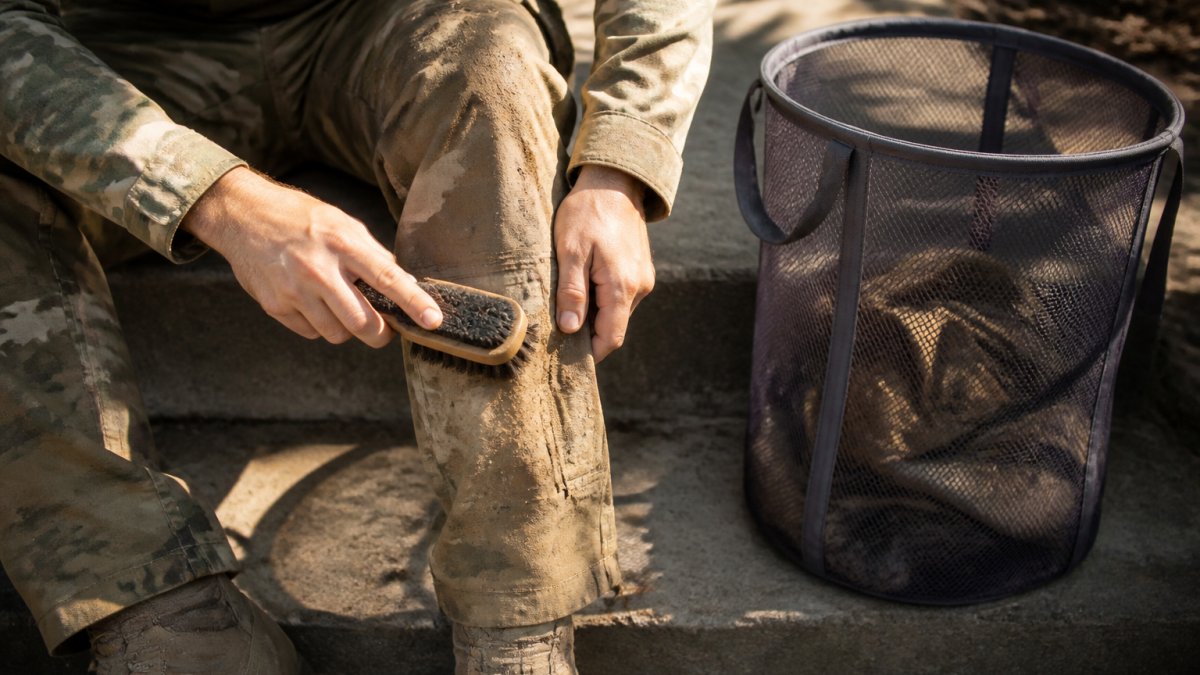
Surface dirt and loose debris should come off before the uniform gets wet. Removing grit before washing outdoor gear helps protect the fabric from abrasion as it moves through the wash.
Next, pre-treat stains, and match the treatment to both the stain and the fabric.
Stain-Treatment Decision Guide
| Stain | Safe first step | What to avoid | Fabric notes |
|---|---|---|---|
| Mud and dirt | Let dry, brush off, then pre-treat with mild detergent and cold water | Scrubbing wet mud into the weave; hot water | Safe on cotton blends and ripstop; on water-repellent finishes, rinse thoroughly so detergent residue does not mask the finish |
| Grease and oil | Blot, then apply a drop of grease-cutting dish soap, work in gently, wash in the warmest water the label allows | Rubbing (spreads the stain); solvents; drying before the mark is gone | Heat sets oil; check the spot before any dryer use. Avoid dish soap on laminated shells if the label warns against degreasers |
| Blood | Rinse with cold water only, then pre-treat with mild detergent or an enzyme detergent | Hot water (sets the protein); bleach | Cold water is the key variable; on FR garments, confirm the label permits enzyme detergents before use |
| Sweat and odor | Pre-treat underarms and collar with mild detergent; wash promptly; air dry fully | Fabric softener (traps odor); overloading the drum | Odor lives in residue; a second rinse helps. Do not combine bleach with other cleaners |
| Unknown or mixed stain | Start with cold water and mild detergent; test any product on an inside seam | Combining cleaners; aggressive scrubbing | When in doubt, go gentlest and re-treat after washing rather than before drying |
Two rules apply across the table. First, never combine cleaning chemicals, mixing bleach with ammonia-based or acid-based cleaners can produce dangerous fumes, and mixing products can also damage coatings. Second, never put a stained item in the dryer. Heat sets most stains permanently, so air dry until you have confirmed the mark is gone.
How to Remove Oil Stains from Tactical Pants
Oil and grease need a different approach than mud or sweat. Blot, do not rub, to keep the stain from spreading.
For how to remove oil stains from tactical pants without damaging the fabric, skip the harsh solvents. Rinse with cold water and check the spot before drying.
Watch out: on water-repellent and laminated shells, aggressive degreasing and scrubbing can strip the finish or delaminate the layers, spot-clean gently and re-proof the finish afterward if the label allows.
Step 3: Choose the Best Laundry Detergent for Military Uniforms
The best laundry detergent for military uniforms is a mild, clear detergent with no dyes, perfumes, or optical brighteners. These additives can leave residue, dull the fabric, and break down protective coatings over time. Ordinary laundry soap works fine for most uniforms, as long as it is gentle. For care differences between uniform pieces and outdoor gear, read this military clothing vs civilian outdoor gear comparison.
What to avoid in a detergent:
- Bleach: weakens fibers and strips color
- Fabric softener: coats fabric, traps odor, and reduces breathability
- Optical brighteners: leave a residue that can affect color and coatings
- Harsh chemicals and solvents: damage ripstop and water-resistant finishes
Use the amount the label recommends, not more. Extra detergent leaves residue that can irritate skin and hold odor.
Step 4: Wash in Cold Water on a Gentle Cycle
Cold water protects color, prevents shrinking, and is gentler on coatings and stitching. Set the washing machine to a gentle cycle with a low spin speed.
A few rules for the machine:
- Wash uniforms separately from towels and heavy denim
- Do not overload the drum; gear needs room to move
- Turn items inside out to protect the outer surface
- Fasten zippers and hook-and-loop closures before the cycle
- Run a second rinse if you suspect detergent residue
Hand washing can work well for single items or delicate pieces. Fill a tub with cold water and mild detergent, soak for a few minutes, agitate gently, and rinse thoroughly.
Watch out: washing load-bearing gear or anything with hard inserts in the machine can damage both the drum and the item.
Care by Fabric, Coating, and Construction
Treating every tactical garment the same is the most common way gear gets ruined. Match the wash method to what the garment is made of and how it is built.
- Cotton blends: the most forgiving category. Cold water, mild detergent, and low heat or air drying work well. Avoid hot water if you want to limit shrinkage.
- Ripstop nylon and polyester: durable but prone to snags. Turn inside out, fasten closures, and wash separately from items with exposed hook-and-loop tape that can abrade the surface. Air dry to protect any durable water-repellent (DWR) finish.
- Flame-resistant (FR) fabrics: follow the garment label exactly. Many FR garments specify mild detergent and warn against fabric softener, bleach, and dryer sheets because residues and coatings can affect performance. Do not assume a general-purpose detergent is approved; check the label and your unit's guidance.
- Water-repellent finishes (DWR): detergent residue and heat are the main enemies. Use a mild, residue-free detergent, skip fabric softener, and air dry or tumble on low.
- Laminated and coated shells: the waterproof layer is the fragile part. Avoid hot water, high heat, and aggressive agitation, which can delaminate layers. Wash infrequently, use a technical cleaner if the label calls for one, and never wring or twist.
Contamination and Washer Precautions
Some uniforms should not share a load. Wash heavily soiled or contaminated clothing separately from everyday laundry, and handle it with gloves if it is soiled with bodily fluids or chemicals. Follow your unit's guidance for anything that may be contaminated; general apparel advice does not override service-specific rules.
After washing heavily soiled gear, clean the washer so residue does not transfer to the next load. Wipe the drum and door seal, clear the lint filter, and run an empty rinse cycle.
Closures and Attached Components
Fasten zippers, hook-and-loop tape, and snaps before washing so they do not snag other fabric or curl. Close hook-and-loop so lint and threads do not pack into the hooks. Remove pads and hard inserts; wash removable components by hand. After washing, check that zipper teeth are clean and that elastic has not lost stretch. Store hook-and-loop fastened so it stays flat.
Tactical Clothing Drying Instructions: Air Dry or Low Heat Only
Air drying is the safest choice for tactical clothing. Hang uniforms on a line or a sturdy hanger in a shaded, well-ventilated spot. High heat from a dryer can shrink fabric, melt coatings, and break down elastic. If you must use a machine, choose the lowest heat setting and pull items out while slightly damp.
Follow these tactical clothing drying instructions:
- Shake out wrinkles before hanging
- Dry in the shade to prevent sun fading
- Hang pants by the waistband, not the cuffs
- Keep hook-and-loop closures fastened so they do not curl
- Make sure items are fully dry before storing to prevent odor and mildew
Thorough drying matters. Damp gear stored in a bag grows odor and mildew fast. Give everything time to dry completely, inside and out.
Inspect, Repair, and Store Your Tactical Uniforms
Cleaning is also your chance to check for wear and tear. Look over seams, buttons, zippers, and closures while the gear is clean and dry. Catching a loose seam early saves the garment later.
Store tactical uniforms clean and dry. Fold them rather than hanging heavy items that can stretch out of shape. Keep gear in a dry place away from direct sunlight, and avoid stuffing damp items into a backpack or duffel.
A simple care routine keeps uniform longevity high:
- Clean after heavy use, not after every wear
- Spot-clean light soil between full washes
- Store folded and dry
- Check closures and seams each time you launder
Shop Durable Gear Built to Serve at US Troop Gear
Proper care keeps gear in service longer, but it all starts with quality construction. US Troop Gear, Inc. offers military-themed apparel, embroidered caps, and challenge coins for the Army, Navy, Air Force, Marine Corps, and Coast Guard, including specialized ship crests and military band items. Visit our website to browse the current selection.
Frequently Asked Questions
Should tactical uniforms be dry cleaned or machine washed?
Machine washing in cold water on a gentle cycle is the safer default for most tactical uniforms. Dry cleaning solvents can break down water-repellent coatings and printed camouflage patterns. Check the care label first: if it allows machine washing, follow it. Reserve dry cleaning for dress uniforms or garments whose labels explicitly permit it, and never dry clean ripstop field uniforms unless the manufacturer says so.
Can you use fabric softener on tactical uniforms?
No. Fabric softener leaves a residue that clogs the weave of ripstop fabric and reduces breathability, and it undermines water-repellent finishes. Use a mild, clear detergent instead, and skip bleach entirely unless the care label specifically calls for it on a white item.
How do you remove tough stains from tactical gear?
Treat stains as soon as possible. Blot oily stains with a dry cloth, then work a small amount of mild detergent into the fabric with your fingers and let it sit for 10 to 15 minutes before washing. For mud, let it dry completely and brush it off before pre-treating. Avoid hot water on protein-based stains like blood, which can set them permanently. Wash in cold water and check the stain before tumble drying.
How often should tactical uniforms be washed?
Wash after every use if the uniform is soiled, sweat-soaked, or worn in the field. For garrison wear with light use, a wash every two to three wears is usually enough. Inspect seams, hook-and-loop fasteners, and zippers each time you launder. Frequent gentle washing in cold water with mild detergent preserves fabric and color better than infrequent harsh washing.
The challenge is simple: gear that lasts starts with gear worth caring for. US Troop Gear, Inc. offers durable, branch-specific apparel and embroidered caps built to serve, with designs that honor military heritage. Get started with US Troop Gear, Inc. and wear your pride with purpose.
