

Surplus vs Reproduction Gear: How to Tell the Difference
Last Updated: November 6, 2026
Quick Summary
To tell surplus vs reproduction apart, check the contract label, manufacturer, date code, and construction in that order. Genuine surplus gear carries a legible contract number, a named maker, and a date code that matches its materials, while reproduction gear has a missing, generic, or copied label.
- Surplus means prior government ownership, not merely military-looking style.
- A reproduction is a new item made to look issued with no government contract behind it.
- Contract prefixes like DLA, DSA, and SPO are clues to era and agency, not proof alone.
- NSN stock numbers use a 13-digit format grouped as 4-2-3-4 on later gear.
- Ask sellers directly whether an item is original issue or a reproduction.
Table of Contents
- What Military Surplus Really Means (and What It Doesn't)
- How to Tell if Military Surplus Is Real: A Step-by-Step Inspection
- Reading Military Uniform Labels and Markings Like a Collector
- World War II Military Surplus Identification: Era-Specific Clues
- Reproduction vs. Counterfeit: Why the Difference Matters
- Authentic Military Surplus Buying Tips for Online Listings
- When Visual Clues Aren't Enough: Limits and Expert Help
- Build Your Collection With Gear You Can Trust
- Frequently Asked Questions
What Military Surplus Really Means (and What It Doesn't)
Military surplus is gear the armed forces once owned, issued, and later released for public sale.
Collectors and veterans often get burned by a listing that looked right in photos. The fix is learning to read gear like a supply clerk, not a shopper.
Here is the distinction that matters: surplus means prior government ownership, not "military-looking." A jacket can look identical to an issued one and still be a reproduction made last year.
Genuine Issue vs. Surplus vs. Reproduction
- Genuine issue: Made under a government contract and handed to service members.
- Surplus: Genuine issue gear that left service and entered the resale market.
- Reproduction: A new item made to look like issued gear, with no government contract behind it.
A genuine item has a contract label, a manufacturer, and a date code. A reproduction has none of those, or fakes them.
How to Tell if Military Surplus Is Real: A Step-by-Step Inspection
You can tell if military surplus is real by checking the label, the manufacturer, the date code, and the construction in that order.
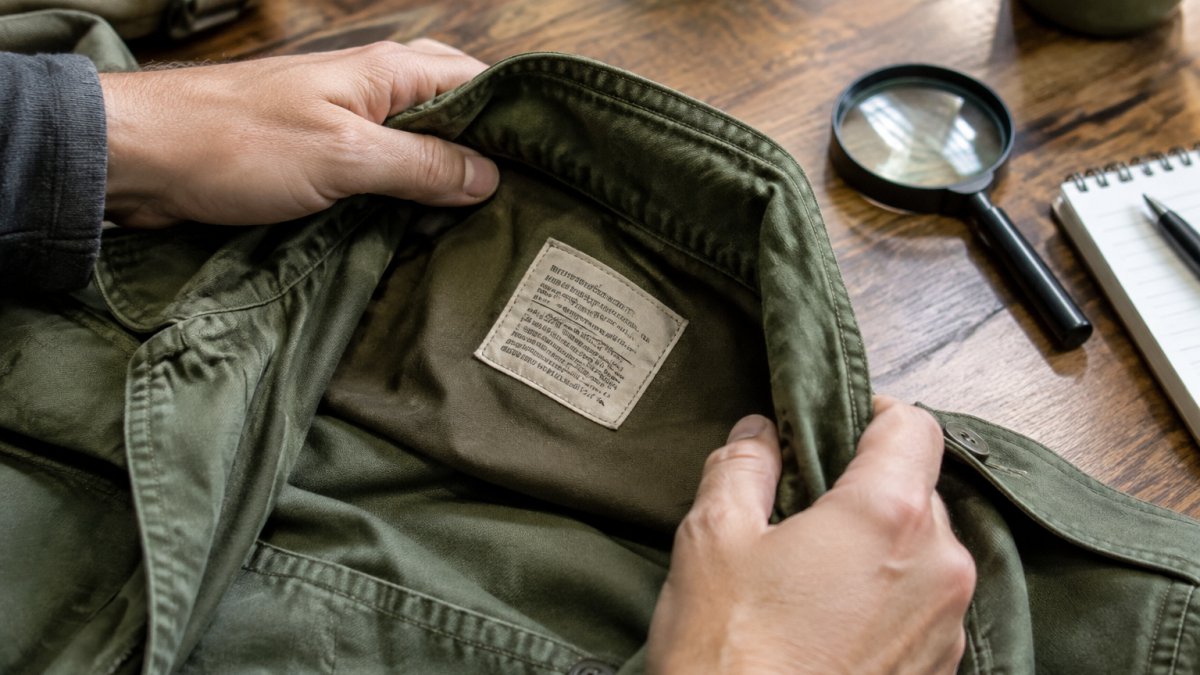
Step 1: Check the Contract Label First
The contract label is the single best clue you have. Genuine gear carries a label listing a contract number, a manufacturer, and often a stock number.
Look for a contract number beginning with letters like DLA, DSA, or SPO, a manufacturer name rather than a blank space, and a stock number in the NSN format.
A reproduction usually has a generic tag, a brand logo, or no label at all.
Step 2: Read the Manufacturer and Date Code
Genuine gear tells you who made it and when. The date code usually sits near the contract number, often as a two-digit year or a full date.
Cross-check the date against the item's design. A jacket claiming 1944 manufacture should show wartime construction, not modern zippers.
Step 3: Examine Fabric, Stitching, and Hardware
Issued gear was built to survive field use, and the materials show it. Feel the fabric weight, check the stitch density, and look closely at buttons, snaps, and zippers.
For a deeper look at what separates tough gear from thin imitations, our guide on how to identify durable military apparel breaks down the construction details worth checking. If you want the reasoning behind those standards first, read what makes military gear durable before you shop.
Here is a quick reference for the three checks:
| Check | Genuine Surplus | Reproduction |
|---|---|---|
| Contract label | Present, legible, with contract number | Missing, generic, or copied |
| Manufacturer and date | Named maker, consistent date code | Blank, vague, or mismatched |
| Fabric and stitching | Heavy fabric, tight even stitching | Light fabric, loose or uneven stitching |
| Hardware | Correct period buttons, snaps, zippers | Modern or mismatched hardware |
Reading Military Uniform Labels and Markings Like a Collector
Military uniform labels and markings are a language, and collectors learn to read them fast. The label tells you who made the item, when, and under what contract.
Start with the label itself. Genuine issue clothing typically carries a woven or printed label with four pieces of information: a contract number, a manufacturer name, a stock number, and a date.
Decoding the Contract Number
A U.S. contract number is not random (Subpart 604.16, Unique Procurement Instrument Identifiers). The prefix usually identifies the buying agency or supply command, and the body encodes the contract sequence and often the fiscal year of award.
Compare the whole label format against known examples from the same period rather than checking the prefix alone.
Reading the Date Code
Date codes appear as a two-digit year, a full date, or a fiscal-year designation depending on the era and the item. A two-digit year is ambiguous by design, so the date only means something when it agrees with the construction, the materials, and the label style. A jacket dated to the 1940s should not carry a modern coil zipper or synthetic thread.
Manufacturer and Stock Numbers
Genuine gear names its maker. The manufacturer name on the label should be a real company that held government contracts in that period, and it should be consistent with the contract number and date. Stock numbers in the NSN format (a 13-digit number grouped as 4-2-3-4) appear on later gear; earlier items may use older stock or specification numbers instead.
Reading Stampings and Markings
Stampings inside collars, hems, and pockets often carry a service branch, a size, and a laundry number. Faded ink is normal on real gear; crisp, fresh stamping on a supposedly old item is not.
A wartime contract number on a jacket with modern synthetic thread is a reproduction wearing a costume. For a broader look at how construction details fit into the picture, our guide on how to identify durable military apparel breaks down the materials worth checking.
World War II Military Surplus Identification: Era-Specific Clues
World War II military surplus identification leans on small period details that modern copies rarely get right. Buttons, thread, and fastener types changed fast during the war years, and those changes are hard to fake well. Authentication clues vary by country, by production period within the war, and by equipment category, so you cannot apply one set of rules to every item.
Start With the Country and the Production Period
A U.S. wartime item, a British wartime item, and a German wartime item were made under different labeling systems, material controls, and hardware standards. Before you judge any detail, identify which military produced the item and roughly when. A detail that is correct for 1942 may be wrong for 1945 on the same type of garment.
Hardware Clues by Category
Hardware is where reproductions slip most often, but the specific tells differ by item type:
- Uniforms and jackets: button styles, snap types, and zipper manufacturers changed during the war. Early-war garments may use different fasteners than late-war production of the same pattern.
- Packs and webbing: buckle styles, strap hardware, and weave patterns are strong clues. Reproduction webbing often uses modern synthetic blends that feel and drape differently from period cotton or canvas.
- Boots and footwear: sole construction, stitching methods, and leather treatment vary by period and maker. Modern reproductions frequently use cemented soles where period boots used stitched construction.
Fabric, Thread, and Weave
Period fabric weave and thread type are among the hardest details to copy well. Wartime gear used specific cotton and wool weaves, and the thread was typically cotton or early synthetic rather than modern polyester. Look at the weave under good light and compare it to known period examples for that country and item type.
Use Wear as Supporting Evidence, Not Proof
A common mistake is judging age by wear alone. A reproduction can be scuffed and faded in a day. Judge the era by construction, then use wear as supporting evidence, never as proof. Genuine wear follows use, knees, elbows, and seat first, while artificial distressing often looks uniform or lands in the wrong places.
Where Era-Specific Rules Break Down
The biggest trap is applying U.S. uniform rules to gear from other militaries or later conflicts. Labeling systems, hardware standards, and material controls differ by country and decade, so a detail that proves authenticity on one item can mislead you on another.
For a deeper look at what separates tough gear from thin imitations across eras, our guide on what makes military gear durable explains the construction standards worth checking.
Reproduction vs. Counterfeit: Why the Difference Matters
A reproduction is honest when the seller says so. A counterfeit is a reproduction sold as genuine, and that is where buyers lose money.
Reproductions have a real place. Reenactors and collectors use them to avoid wearing out original gear.
Ask the seller one direct question: "Is this original issue or a reproduction?" A straight answer tells you a lot.
Authentic Military Surplus Buying Tips for Online Listings
Authentic military surplus buying tips start with the photos, because photos are where most online deals are won or lost.
Use this checklist on every listing:
- Clear photo of the contract label, readable
- Manufacturer name and date code visible
- Close-up of stitching on a seam and a pocket
If a seller cannot supply these, walk away. When you are ready to buy from sources that vet their stock, our guide on where to buy authentic military-themed apparel covers the options.
When Visual Clues Aren't Enough: Limits and Expert Help
Visual checks catch most fakes, but they have limits. Good counterfeiters copy labels well, and photos hide texture, weight, and smell, which are often the strongest tells.
Know when to get help:
- High-value items where the price gap between real and fake is large
- Rare era pieces with few reference examples
- Items with labels that look correct but construction that does not
In those cases, ask a seasoned collector or a militaria appraiser to look at the item in person. The FBI's guidance on counterfeit goods is a useful reminder that fake goods are a real market problem, not a rare fluke. For broader consumer protection context, the FTC's consumer advice on avoiding counterfeit products explains your options if a purchase turns out to be misrepresented.
Build Your Collection With Gear You Can Trust
Knowing the surplus vs reproduction distinction changes how you shop. You stop guessing and start checking labels, dates, and construction in a set order.
That same standard guides what we carry at US Troop Gear, Inc. Our military caps collection includes branch-specific designs and embroidered detail. If you are new to collecting as a civilian, our guide on authentic military gear for civilians is a good place to start.
We offer branch-specific gear across the Army, Navy, Air Force, Marine Corps, and Coast Guard, including ship crests and military band items.
Start with one piece you will actually wear or display.
Frequently Asked Questions
How can you tell if military surplus gear is genuine?
Start with the contract label inside the garment or item. Genuine surplus carries a manufacturer name, a contract number, and often a date code. Check that the stitching is tight and consistent, the hardware matches the era, and the fabric shows honest wear rather than artificial distressing. Cross-check the contract number against known manufacturer records. If the label looks freshly printed, the font is wrong, or the markings are glued rather than stitched, treat it as reproduction until proven otherwise.
Does a manufacturer label prove that military gear is surplus?
No. Reproduction makers copy labels closely, and some counterfeiters print convincing contract numbers. A label is one data point, not proof. Verify the manufacturer actually held that contract, confirm the date code fits the item's design, and inspect construction details like bar-tacked stress points and correct hardware. When buying online, ask the seller for close-up photos of the label, the stitching, and any stampings before you commit.
How can you identify reproduction World War II gear?
World War II items have telltale era details: cotton webbing, specific buckle styles, stamped brass hardware, and label formats with period-correct fonts and ink. Reproductions often use modern nylon blends, cleaner stitching, and uniform coloring that real 1940s gear rarely shows after decades. Look for artificial aging like sanded edges or tea-stained fabric, which genuine service wear does not produce. Compare against reference photos from collector archives before buying.
What should you check before buying military surplus online?
Request high-resolution photos of the contract label, manufacturer stamp, and any date codes. Ask the seller about provenance and prior use. Compare the item's camouflage pattern and color against official specifications for that era. Check the seller's return policy and reviews. If the price is far below market for a rare item, that is a warning sign. Reputable sellers answer detailed questions and provide extra photos without hesitation.
