

8 Benefits of Custom Challenge Coins for Units
Table of Contents
- 1. Strengthening Unit Identity and Esprit de Corps
- 2. Commemorating Deployments and Key Missions
- 3. Recognizing Individual and Team Achievements
- 4. Building Lasting Bonds Through Challenge Coin Etiquette for Military Units
- 5. Honoring Unit Heritage with a Piece of History
- 6. Military Challenge Coin Design Ideas That Tell Your Story
- 7. Understanding Custom Challenge Coin Pricing and Production
- 8. Why Custom Challenge Coins Are a Smart Investment
- Frequently Asked Questions
Last Updated: September 8, 2026
Custom challenge coins are far more than metal souvenirs; they are portable symbols of belonging that carry a unit's identity, history, and standards. In this guide from US Troop Gear, Inc., we break down the eight most significant benefits of custom challenge coins for units and show you how to design a coin your team will be proud to carry.
1. Strengthening Unit Identity and Esprit de Corps
A custom challenge coin is a physical extension of a unit's identity. When a service member carries a coin bearing their unit's insignia, motto, or crest, they carry a piece of the team with them at all times.
Esprit de corps grows when members share symbols that represent their collective pride. The coin becomes a conversation starter, a point of connection between current members and alumni, and a quiet reminder of the standards the unit upholds.
2. Commemorating Deployments and Key Missions
Deployments forge bonds that civilian life rarely replicates, and a challenge coin serves as a permanent record of that shared ordeal. Units often commission a specific coin for a deployment, featuring the operation's name, dates, and location.
For unit history, these coins document the milestones that define a command's legacy, becoming artifacts that future generations can study to understand what their unit accomplished.
For families, a deployment coin is a tangible connection to a loved one's service. It represents the missions they supported from home and the sacrifices that came with them. Many families treasure these coins as heirlooms to pass down.
3. Recognizing Individual and Team Achievements
Recognition is one of the strongest motivators in any organization, and challenge coins offer a versatile way to honor excellence, from superior performance and bravery to reenlistments, retirements, and demanding qualifications.
What makes a coin distinct from a certificate or plaque is its portability and permanence. The recognition becomes part of daily life rather than a document filed away, amplifying its impact and encouraging others to strive for similar acknowledgment.
The Behavioral Science Behind the Coin
The effectiveness of a challenge coin is rooted in established psychological principles that explain why tangible symbols outperform other forms of recognition.
Social proof and visible norms. When a service member displays a coin earned for excellence, it signals to the entire unit what behaviors are valued. A coin on a desk communicates standards more persistently than a verbal commendation or an email announcement that is quickly forgotten.
The endowment effect. Research in behavioral economics shows that people value objects more highly once they own them, especially when earned through effort (wikipedia.org). A coin received after a demanding qualification carries personal history that no purchased item can replicate, making the recognition self-reinforcing over time.
Ceremonial anchoring. A formal presentation during a formation or retirement ceremony creates a memory anchor. The brain links the physical object to the emotional context, which is why veterans often recall exactly where they were and who handed them a particular coin decades later.
Designing a Recognition Program That Works
The most effective recognition coins are tied to specific, meaningful criteria. Vague criteria, "for outstanding service", dilute the meaning. Precise criteria, "for completing the 12-mile ruck march under four hours", create a benchmark that others can aspire to meet.
A common pattern in high-performing units is the tiered recognition system:
- Entry-level coins for basic qualifications or completion of initial training
- Mid-tier coins for specific achievements like expert marksmanship or leadership schools
- Command-level coins reserved for exceptional acts, usually presented personally by the commanding officer
This tiered approach gives service members a visible progression path and protects the value of the highest-tier coins by ensuring they remain scarce.
The Limits of Recognition Coins
Coins are not a substitute for substantive rewards. The most effective leaders use coins as a complement to, not a replacement for, structural recognition. The coin marks the moment; the system must deliver the consequence.
When used correctly, a recognition coin becomes a permanent artifact of a specific achievement, a daily reminder not just of what the service member did, but of what the unit stands for.
4. Building Lasting Bonds Through Challenge Coin Etiquette for Military Units
The traditions surrounding challenge coins are as important as the coins themselves. Challenge coin etiquette for military units typically includes the "coin check," where the last person unable to produce their coin buys the next round, a playful ritual that ensures every member carries the unit's symbol at all times.
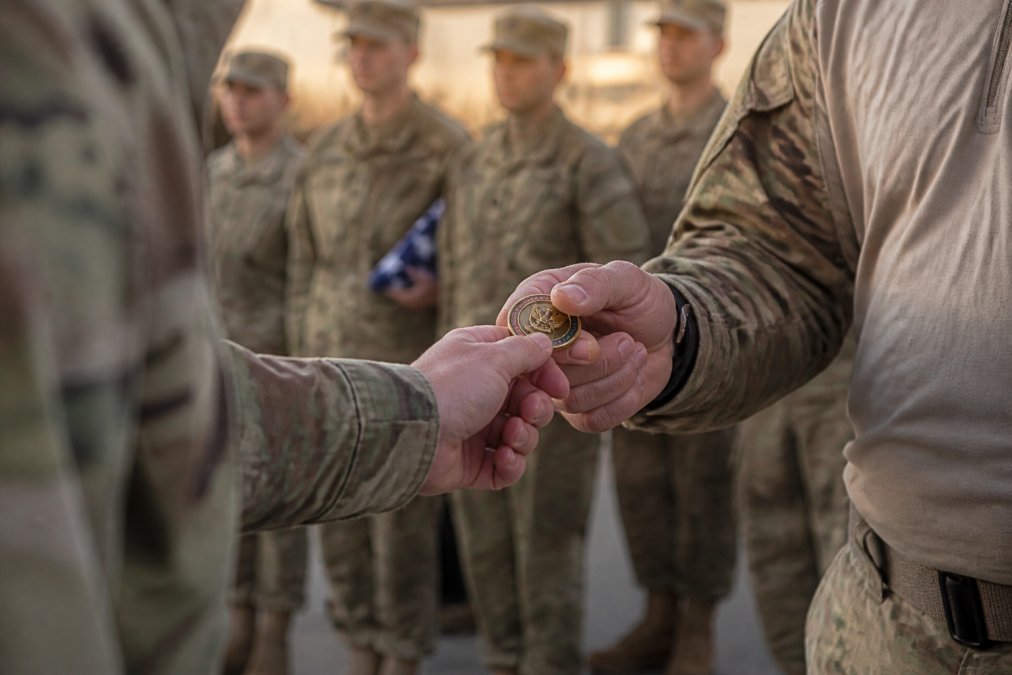
A coin should be presented with a firm handshake, never tossed or thrown casually. When receiving a coin from a commanding officer, the proper response is to accept it with both hands and make eye contact.
5. Honoring Unit Heritage with a Piece of History
Every unit has a story, and custom challenge coins help tell it. Many designs incorporate elements from the unit's past, the insignia of a predecessor unit, the dates of historic battles, or the portrait of a legendary figure, connecting today's service members to those who served before them.
This sense of continuity is particularly powerful in units with long, decorated histories. A new member holding a coin that features the same crest carried by veterans of past conflicts feels the weight of that legacy and the responsibility to uphold it.
Units also use coins to honor fallen comrades. A memorial coin distributed at a remembrance ceremony gives survivors and families a physical object to hold onto, a way to keep the memory of their loved one close.
6. Military Challenge Coin Design Ideas That Tell Your Story
The best military challenge coin design ideas start with a clear story. Begin with the core elements: your unit's name, insignia, and motto. From there, consider the shape, finish, and enamel colors that will make the design stand out.
Shape is the first opportunity to differentiate. While round coins are traditional, custom shapes such as shields, stars, or outlines of your unit's area of operations create a more distinctive profile. Antique brass and bronze offer a classic military look, while gold plating and polished nickel convey a more ceremonial feel. tribute gifts.
Color plays a critical role in readability. Hard enamel allows for precise, durable color application, while soft enamel provides a textured surface that is often more affordable. If your unit insignia is complex, ensure the design retains its detail at the coin's final size, typically 1.5 to 2 inches in diameter.
7. Understanding Custom Challenge Coin Pricing and Production
Custom challenge coin pricing depends on size, thickness, shape complexity, and the number of enamel colors. The two largest cost drivers are the mold fee, a one-time charge to create the die, and the unit cost per coin, which decreases as order quantity increases.
A standard round coin with a few colors is modest in cost, but a complex custom shape with detailed edges and multiple finishes will cost more. Requesting a quote with your exact design specifications is the only way to get an accurate price.
For those seeking high-quality, officially licensed options, US Troop Gear, Inc. offers coins like the Beach Jumper Unit 1 Challenge Coin at $16.45. This coin is officially licensed by the Department of the Navy, and royalties support the Morale, Wellness and Recreation (MWR) program. Similar options are available for Beach Jumper Unit 2 and Beachmaster Units 1 and 2 in both enlisted and officer versions.

8. Why Custom Challenge Coins Are a Smart Investment
When you weigh the cost of a challenge coin against the value it delivers, the return is clear. A well-designed coin serves as a permanent recognition tool, a piece of unit history, and a morale booster, all for a one-time production cost.
The durability of die-cast metal and enamel ensures your coin will survive decades of handling, making it a cost-effective choice for units that want a lasting symbol of their identity. Many service members keep their coins for life, passing them to children or grandchildren as family heirlooms.
Coins also serve as powerful tools for unit cohesion and public relations. Presenting a coin to a visiting official, a partner organization, or a retiring member creates a lasting impression of professionalism and pride.
Protecting the Investment: Display and Storage Solutions
A coin that sits loose in a drawer gets scratched and loses its enamel luster. Units that invest in quality coins should also invest in how those coins are housed.
For single coins or small collections. The standard 2-inch coin display case with a velvet or felt insert is inexpensive, typically under $10 each, and provides adequate protection while allowing the coin to be viewed without handling (amazon.com). For coins with custom shapes that exceed 2 inches, measure the actual diameter before ordering a case.
For larger collections. Shadow boxes with removable backing allow collectors to rearrange coins as their collection grows. A 16x20-inch shadow box with a foam insert can hold between 12 and 20 standard coins (hobbylobby.com). A locking display case with UV-protective glass prevents fading from direct sunlight.
For archival purposes. Coins that document unit history, deployment coins, memorial coins, change of command coins, deserve archival-grade storage. Acid-free coin flips and binder pages protect the metal from tarnishing and the enamel from scratching. A pack of 100 coin flips runs roughly $8 to $12.
Modernizing the Coin: Digital Integration
One of the most underutilized opportunities in challenge coin design is digital integration. A coin can serve as a gateway to digital content that extends its utility and relevance for younger service members.
QR codes. A laser-engraved QR code on the reverse side of a coin can link to a unit history page, a private alumni portal, or a memorial website. The code must be at least 10mm square on a standard 1.75-inch coin and placed in an area without enamel so the contrast remains high.
NFC chips. Near-field communication chips can be embedded in the coin during manufacturing. Tapping the coin against a smartphone opens a linked webpage or app. This technology adds roughly $2 to $4 per coin but offers a cleaner aesthetic and works even when the coin is in a pocket or case.
Practical considerations. Any digital element must be tested before full production. QR codes should be scanned from a printed proof, not just a digital mockup, because engraving can reduce contrast. NFC chips should be tested through the final enamel layer to confirm signal strength. Units should also consider the lifespan of the linked content: a URL that changes renders the digital feature useless.
The Full-Cost Calculation
A smart investment analysis goes beyond the per-coin price. Units should factor in the cost of display cases, archival supplies, and any digital integration features when budgeting. A $16 coin that sits unprotected in a drawer is a poorer investment than a $20 coin with a $6 display case that remains pristine for decades.
The most cost-effective approach is to order display cases in bulk alongside the coin order. Many manufacturers offer matching cases at a discount when purchased together, and the combined order reduces shipping costs.
| Investment Component | Typical Cost Range | Purpose |
|---|---|---|
| Standard coin display case | $6-$12 each | Single coin protection and display |
| Shadow box (16x20 inch) | $25-$50 | Multi-coin collection display |
| Archival coin flips (pack of 100) | $8-$12 | Long-term storage protection |
| QR code engraving | $0.50-$1.50 per coin | Digital link to unit history |
| NFC chip integration | $2-$4 per coin | Tap-to-connect digital access |
The coin becomes an ambassador for your unit wherever it travels, and with proper display and digital integration, it keeps working long after the handshake ends.
Frequently Asked Questions
How much for 100 custom challenge coins?
For a unit ordering 100 coins, expect a lower per-unit cost compared to smaller batches, though the final price depends on design complexity, size, and finish. A basic coin with standard enamel coloring and a single finish might cost less per piece, while options like antique brass, gold plating, or detailed die-cast work increase the price. Mold fees are often a one-time setup cost. For a more accurate estimate, request a quote with your specific design specifications and quantity.
What makes a challenge coin valuable?
A challenge coin's value comes from its symbolism, the unit it represents, and the story behind it. Coins tied to specific deployments, historic units, or significant achievements carry deep personal meaning for service members. The physical quality matters too: durable metals, detailed die-cast designs, and quality enamel finishes make a coin a lasting heirloom. Officially licensed coins, like those supporting Navy Morale, Wellness and Recreation (MWR) programs, also hold added significance for collectors and veterans.
What is the significance of a military challenge coin?
A military challenge coin represents membership, achievement, and shared identity within a unit. Carrying one is a point of pride and a symbol of the bond formed through service. The tradition includes the challenge: a service member slaps their coin on the bar or table, and others present must produce theirs. If someone fails, they buy a round of drinks. This ritual reinforces camaraderie and keeps unit heritage alive long after service ends.
How do custom challenge coins improve unit morale?
Custom challenge coins improve morale by giving service members a tangible symbol of their contributions and belonging. Receiving a coin for a job well done or for completing a deployment creates a sense of recognition and pride that goes beyond a formal commendation. The coin becomes a daily reminder of the unit's mission and the individual's role in it, which strengthens commitment and fosters a stronger sense of esprit de corps among the team.