

How to Judge Why Professional Grade Tactical Gear Matters
Last Updated: October 30, 2026
Quick Summary
Professional grade tactical gear matters because it is built to hold up under repeated, high-stress use rather than just looking tactical. Its durability, materials, and stitching determine whether it performs or fails when conditions are hard.
- Judge gear by cost per year of service, not by its sticker price.
- Check whether the maker sells replacement parts and whether local shops can repair the construction.
- Look for stated fabric specs, dense stitching, and reinforcement at stress points.
- Measure yourself rather than relying on your usual size, since sizing varies between manufacturers.
- Retire gear when seams fail, fabric thins or has holes, or hardware no longer locks reliably.
Table of Contents
- What Professional Grade Tactical Gear Actually Means
- Why Durability Decides Whether Gear Is Worth the Money
- Tactical Gear Benefits for Comfort, Mobility and Protection
- Tactical Gear Materials: What Fabric and Stitching Should Tell You
- How to Choose Tactical Gear for Your Use Case
- Fit, Sizing and Load-Specific Setup
- Limits, Trade-Offs and Care: Knowing When Gear Is Done
- Checking Your Current Kit Before Your Next Purchase
- Frequently Asked Questions
Professional-grade tactical gear is built to hold up when conditions are hard, not just when they are easy. For current and former U.S. military personnel, law enforcement, and the family members and collectors who buy this kind of kit, the difference between gear that performs and gear that fails shows up fast. This guide looks at what separates professional grade tactical gear from cheaper alternatives on the market, and explains how to judge it before you spend your money.
Professional grade tactical gear is best understood as equipment designed to meet the demands of repeated, high-stress use, rather than a label applied to any product with military styling. That distinction matters because much of what is sold as tactical gear is built for appearance. The sections below explain what to look for.
What Professional Grade Tactical Gear Actually Means
The term gets used loosely. In practice, professional grade usually means the gear was built around function first: the fabric, stitching, hardware, and fit are chosen for sustained wear in demanding environments. Tactical clothing and apparel are often designed for field conditions, where freedom of movement, protection, and reliability matter more than style.
A useful test is to ask what the gear was designed to survive. Items meant for field use should be assessed against the conditions they will actually face, including repeated abrasion, moisture, heat, and long hours of wear.
Why Durability Decides Whether Gear Is Worth the Money
Durability is the clearest line between professional grade gear and the rest, but the real question is not whether a jacket lasts longer, it is whether the longer service life justifies the higher purchase price. That is a lifecycle-cost question, and most buyers never run the math.
Start by estimating expected service life in the conditions you actually face. Service life depends on use intensity, climate, and care, and no product lasts the same across every user.
Then compare total cost of ownership rather than sticker price:
- Purchase price, the number on the tag.
- Maintenance, cleaning supplies, re-waterproofing treatments, and hardware replacement.
- Repair options, whether the maker or a local shop can replace a zipper, patch a panel, or re-stitch a seam, and whether replacement parts are available.
- Replacement frequency, how often you expect to buy the item again over the same period.
A piece that costs more up front but can be repaired and kept in service longer may cost less per year of use than a cheap piece that must be replaced often.
Repairability is the underrated variable. Gear with standard hardware, accessible seams, and available replacement parts can stay in service far longer than gear built with proprietary components that cannot be sourced. Before you buy, ask whether the maker sells or supports replacement parts, and whether local repair shops can work on the construction.
When a brand does not explain how its gear is constructed or whether it can be repaired, treat that as a reason for caution. Durability claims without service-life or repair details are marketing, not evidence.
Tactical Gear Benefits for Comfort, Mobility and Protection
Good tactical gear balances three things that often pull against each other: comfort, mobility, and protection. Gear that is too rigid restricts movement, and gear that is too light may not protect against abrasion or the elements.
When shopping for tactical gear, look for articulated patterns, stretch panels in high-movement areas, and breathable fabrics that keep you from overheating during long wear. Protection depends on the use case. A lightweight outer layer suits a training day in mild weather, while heavier materials suit sustained work in harsh conditions. The right choice comes from matching these features to where and how you will wear the gear.
Tactical Gear Materials: What Fabric and Stitching Should Tell You
Fabric and stitching are the most reliable indicators of build quality you can check before buying, but only if you assess them against objective criteria rather than vague claims like "premium fabric" or "professional grade." The sections below explain what to look for and how to test it. Understanding these material constraints provides a clearer perspective on premium gear longevity, a principle that applies just as readily to the rigorous demands of athletic training.
Fabric: read the spec, not the label
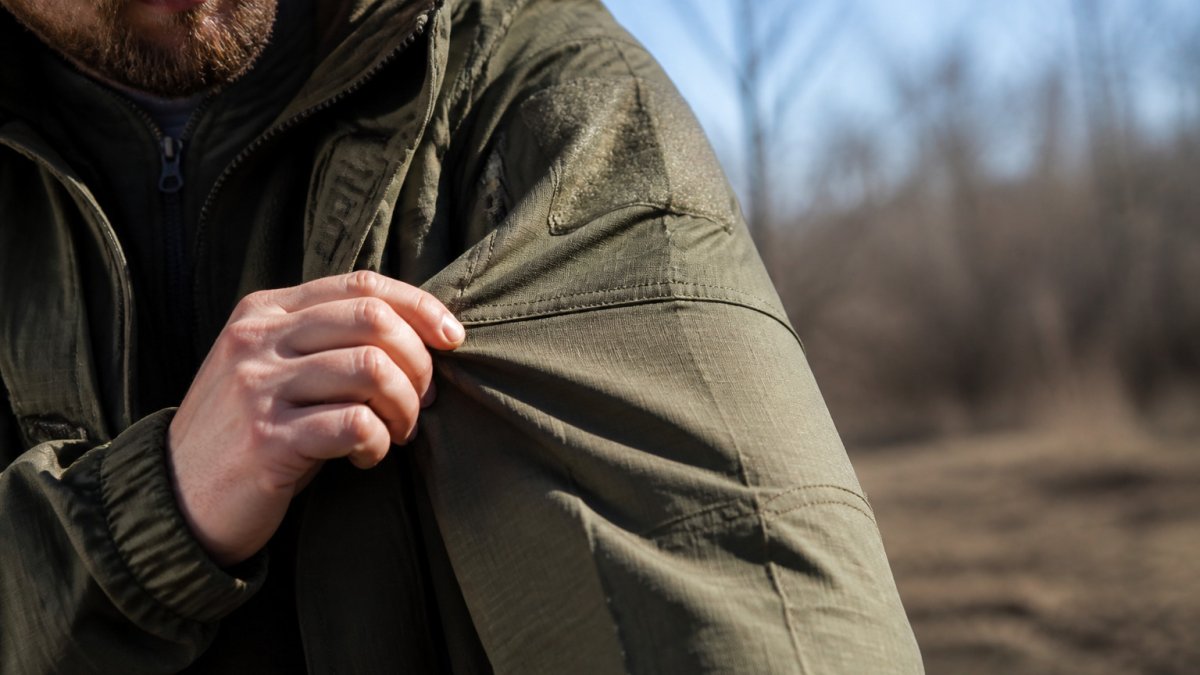
Look for measurable specifics such as fabric weight and weave, which tell you more than adjectives. Ripstop weaves are designed to resist tearing from a small initial cut, and tightly woven fabrics generally handle abrasion better than thin, loosely woven ones.
Ask how the fabric was tested. Reputable makers can describe how their materials were tested. If a product page offers only marketing language, treat the material claims as unverified.
Stitching and construction: inspect the stress points
Dense, even stitch lines with reinforced seams in stress areas suggest better construction. Check the points that take the most load: shoulder seams, crotch and knee areas, zipper tapes, and attachment points for webbing or load-bearing equipment. Loose threads, skipped stitches, and uneven seams are early warning signs.
Where hardware is used, look for components that lock and release reliably. Hardware that binds or feels flimsy under load is a failure waiting to happen.
A practical inspection checklist
- Confirm the fabric spec (denier, weight, weave) is stated, not implied.
- Check stitch density and look for reinforcement at stress points.
- Test zippers and hardware for smooth, reliable operation.
- Look for consistent seam allowances and clean finishing inside the garment.
- Ask whether the maker publishes test data or standards the gear is built to.
This evidence-first approach is what separates professional grade gear from products that merely look tactical. Judge materials by measurable specs and inspection, not by appearance.
How to Choose Tactical Gear for Your Use Case
The right gear depends on how you will use it. A veteran wearing branch-specific apparel for daily wear has different needs than someone using gear for outdoor work or hunting in cold, wet weather. Start by writing down the conditions, duration, and activities you expect.
Then rank your priorities. If abrasion resistance matters most, weight the fabric and stitching criteria above. If comfort during long wear is the priority, focus on fit, breathability, and movement. Compare options against those priorities rather than against the lowest price.
Fit, Sizing and Load-Specific Setup
Fit is often overlooked, yet an ill-fitting piece of gear can cause chafing, restricted movement, and premature wear. Measure yourself rather than relying on your usual size, since sizing varies between manufacturers. Check the size chart and read how the cut runs, whether it fits true to size, runs large, or runs small.
If you carry equipment, load-bearing gear needs to be set up for your body and the load you carry. Adjust straps and webbing so weight sits where it is meant to, and confirm that the attachment points on your garments can handle the equipment you plan to attach. Gear that fits well and is adjusted correctly will perform better and last longer.
Limits, Trade-Offs and Care: Knowing When Gear Is Done
No gear lasts forever, and professional grade does not mean indestructible. Every piece has limits, and using gear beyond them, or for purposes it was not designed for, shortens its life. Lightweight items may trade durability for comfort, and heavy-duty items may trade weight for protection.
Care extends service life. Follow the manufacturer's washing and drying instructions, since high heat and harsh detergents can weaken fabric and coatings. Store gear dry and out of direct sunlight. Retire gear when seams fail, when fabric thins or shows holes, or when hardware no longer locks or releases reliably. Continuing to rely on compromised gear is the false economy this whole article warns against.
The article lists the signs that show gear is no longer fit for service and the care steps that extend its life.
| Sign or step | What it means | Action |
|---|---|---|
| Seams fail | Gear is worn out | Retire the item |
| Fabric thins or has holes | Protection is lost | Retire the item |
| Hardware no longer locks or releases | Reliability is lost | Retire the item |
| Washing and drying | High heat and harsh detergents weaken fabric | Follow manufacturer instructions |
| Storage | Dampness and sunlight degrade gear | Store dry, out of direct sunlight |
Checking Your Current Kit Before Your Next Purchase
Before you buy anything new, inspect what you already own. Look at the seams, zippers, fabric, and hardware on your current pieces. Note which items hold up well and which show wear, and use those observations to set a baseline for your next purchase.
This check also helps you decide whether a vintage or heritage piece is worth keeping in service or better suited to display. For guidance on keeping that kind of gear in shape, see our article on how to maintain vintage Marine Corps gear. When you are weighing your options, our Armed Forces Gear vs Military Best comparison lays out how the two stack up on value and quality. If fabric choice is your main concern, our guide to the best materials for long-lasting veteran t-shirts goes deeper on what lasts. And for a quality checklist to run each item against, see 7 military gear standards Navy veterans should check.
Professional grade tactical gear matters because it is the difference between equipment that supports you and equipment that lets you down when it counts. Judge it by durability, fabric, stitching, fit, and honest limits rather than by appearance alone.
Frequently Asked Questions
What is professional-grade tactical gear?
Professional-grade tactical gear is built for sustained use in demanding conditions, such as duty shifts, field training or outdoor work where failure has real consequences. It typically uses reinforced stitching, abrasion-resistant fabrics and hardware rated for repeated loading. Consumer apparel that looks similar may use lighter materials and simpler construction. Because no single federal standard covers most apparel, buyers should ask manufacturers for material specifications, construction details and any independent testing they have performed.
How can you tell whether tactical gear is durable?
Look at fabric weight and weave, seam construction, reinforcement at stress points such as knees, shoulders and pocket attachments, and the type of thread and zippers used. Ask whether the product has been tested for abrasion or tear strength, and whether the seller offers a repair or replacement policy. Inspect a sample after a few weeks of use. Seams that pull, fabric that pills quickly or hardware that loosens are early signs of poor durability.
How should tactical gear fit?
Tactical gear should allow full range of motion, including squatting, reaching and kneeling, while still sitting close enough that loose fabric does not snag. Check sizing charts against your actual measurements rather than your usual clothing size. Fit should also account for what you will carry, since a jacket or vest that fits well unloaded can bind once equipment, armor or a belt is added. Try items with your normal layers when possible.
What should you look for when choosing tactical gear?
Start with the actual task: duty wear, range training, hunting or general outdoor use each stress gear differently. Then compare fabric, reinforcement, fit and the features you really need, such as pocket layout or attachment points for webbing. Choose based on what you will wear most often rather than the most features. Buying fewer, better-built pieces usually lowers the total cost of ownership compared with replacing inexpensive gear every few months. Pricing varies with materials and order details, so check current pricing and quotes directly with US Troop Gear, Inc.
